

Bullets & Brass
45-70 Government Chambering Problems
column By: Brian Pearce | December, 26
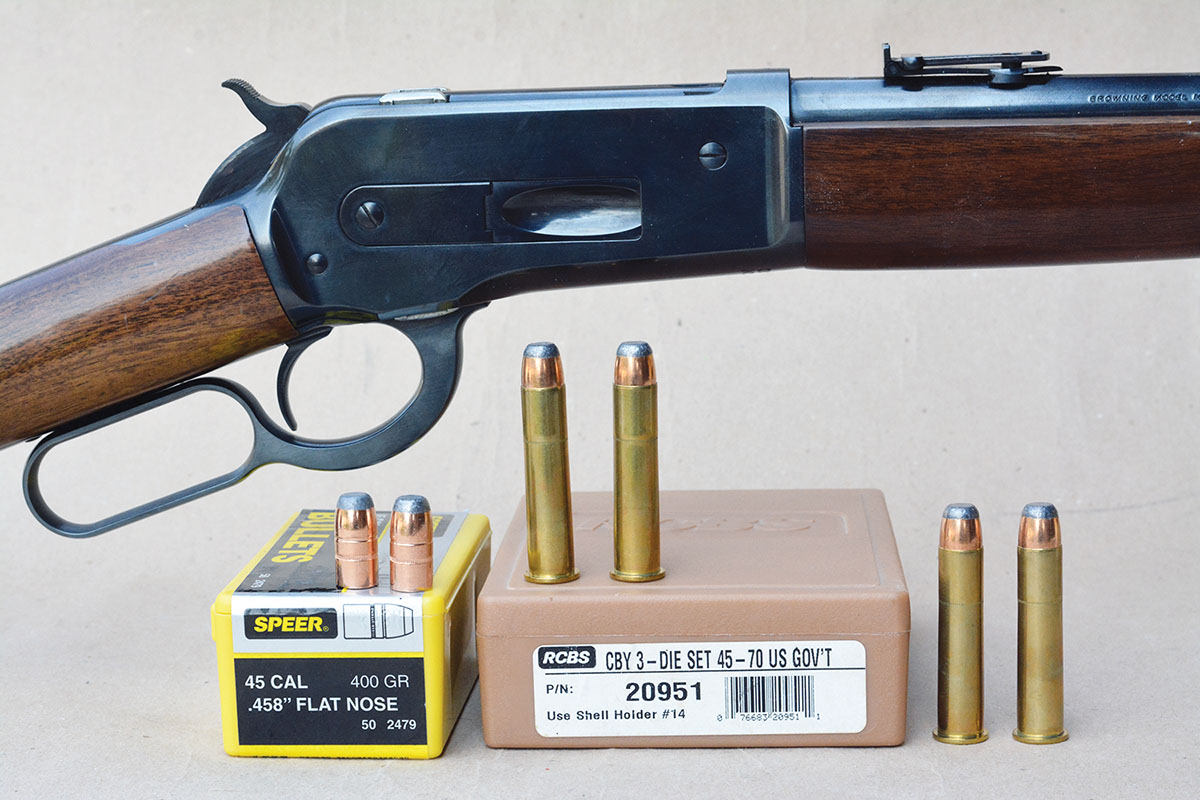
Here is my problem: When chambering a loaded cartridge, just as the bolt is closing and locking up the breech, there is significant resistance. In examining cartridges that are extracted after being chambered and not fired (and are almost impossible to extract), there is a shiny ring or scuff mark on the bullet just forward of the case mouth, about .150 to .200 inch or so.
The good news is that I have fired 40 or 50 of these handloads with your data, and they are shooting great in the Browning. However, the hard chambering feature is something of a problem. The interesting part of this puzzle is that these same cartridges function and chamber perfectly in my brother’s Marlin Model 1895.
I enjoy Handloader and learn something from every article, even if it is about a caliber that I don’t shoot. Any insight on my 45-70 handloads that you can offer will be greatly appreciated.
Tommy J., via Facebook
A: The Browning Model 1886 rifles feature a very short throat, and when the Speer 400-grain Jacketed FNSP
is chambered, the ogive contacts the rifling leade before the cartridge is fully chambered, which explains the shiny ring on the bullet that you describe. Based on your photos, your rifle has an unusually short throat. The bullet would have to be seated to an excessive depth to prevent it from contacting the leade, so that is not a good option. Incidentally, almost all Marlin Model 1895s produced since 1972 will chamber and function perfectly with the Speer bullet. However, under different ownership over the past couple of decades, there were a few Marlin rifles shipped that feature the same short throat as the Browning. Again, those rifles are rarely encountered.
There are several solutions for your problem, but let’s just discuss the two most practical. First, a qualified gunsmith can ream the throat to a longer length. However, that can be costly, and really good gunsmiths seem scarce these days. Most have a long waiting period. Probably the most practical is to change bullets. The old Remington 405-grain SP bullet is a two-diameter arrangement that has a small enough ogive to permit it to chamber in Browning rifles without alteration. These bullets are offered in bulk quantity from time to time and are very good big game bullets in the 45-70.
Low Muzzle Report Loads for the 327 Federal and 32 H&R Magnums
Q: I carry one of my 327 Federal Magnum revolvers almost every day when I run my pointers for exercise. I had up to five coyotes follow my dogs in when I ran them very early in the morning along the river bottom. They surrounded us about 5 yards away. That was in town, and those coyotes have never been shot at. After educating two of them, the rest were never a problem. I now run my dogs on the mesa and only have trouble with juveniles learning to hunt. I don’t like to wear hearing protection every day and would like some handload data to help reduce the 327’s muzzle blast and report.
Also, I would like a load or two with the same ballistics, but fired from 32 H&R Magnum cases. All loads will be shot in Ruger Single-Sixes, Single-Sevens or an SP101 with a 3-inch barrel.
Thank you for sharing your insight and your incredible knowledge of handloading data.
Martin K., via YouTube
A: Yes, I agree that 1,000 feet per second (fps) sixgun loads will work fine at 75 yards and are capable of putting down malicious coyotes.
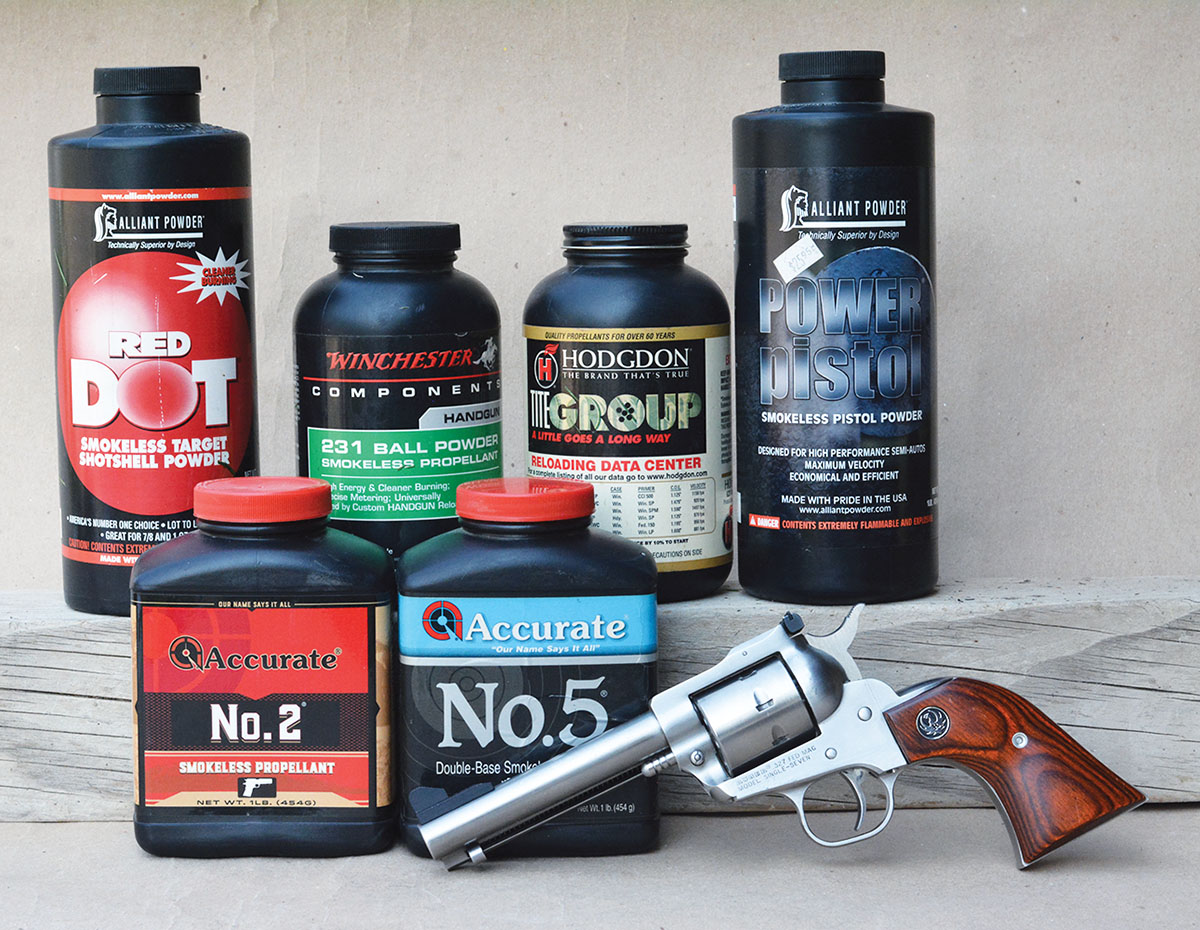
Using 327 Federal Magnum cases in conjunction with 105-grain Keith-style cast bullets, try 4.0 grains of Winchester W-231, 3.5 grains of Hodgdon Titegroup or 3.6 grains of Alliant Red Dot. Depending on barrel length and other factors, including throat size, bore dimensions, barrel cylinder gap and other factors, each of those loads should produce right around 1,000 fps and will give a comparatively modest muzzle report.
Moving on to loads in 32 H&R Magnum cases, try 3.5 grains of Accurate No. 2, 3.5 grains of Winchester W-231, 4.5 grains of Accurate No. 5 or 3.8 grains of Alliant Power Pistol powder. Again, these will all produce around 1,000 fps from your Single-Six and Single-Seven revolvers. Muzzle report should be modest. All of the above loads should be used in conjunction with standard non-magnum pistol primers.
I am sure your pointers will be enjoying their daily exercise routine knowing that you can keep those pesky coyotes at bay.
What to Look for Before Buying a Smith & Wesson 629 Mountain Gun
Q: I have seen quite a few negative reviews on the new Smith & Wesson model 629 Mountain Gun in 44 Magnum. I am wondering what I should be looking for when I purchase mine. The most concerning thing that I have heard is that the forcing cone is undersized. Is there an easy way to check this before I buy?
Tedman A., Nikiski, Alaska
A: First, I have fired and owned many Smith & Wesson sixguns that have been produced since the changes to EDM rifled barrels, key locks, MIM parts, etc., that started around 25 years ago. Most have been pretty good, but the ones that had issues, I easily fixed in a few minutes.
Regarding the 629-9 Mountain Guns, I have examined several, but I have not fired one. I have good reports from several people that have purchased them, but I also have reports of problems. Based on your email, I finally decided to pull the trigger and order one to be reviewed within these pages at a future date.
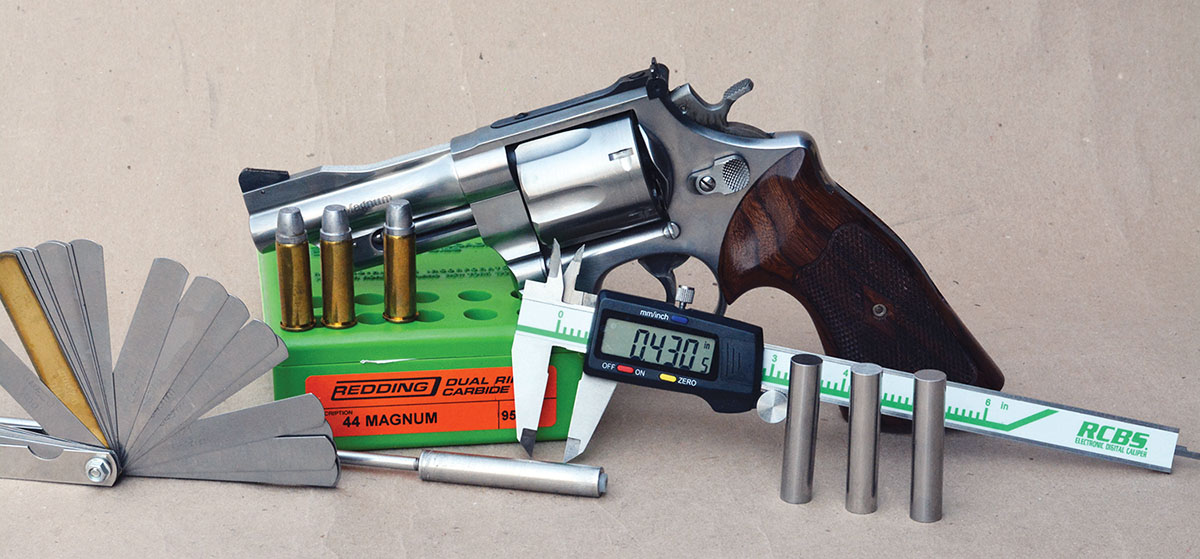
If I were in your shoes and examining a gun for possible purchase, I would check the cylinder end-shake and hope that there would be less than .002 inch of movement. While SAAMI (Sporting Arms and Ammunition Manufacturers’ Institute) allows up to a .012-inch barrel-to-cylinder gap, I would look for .003 to .004 inch and certainly not over .006 inch (checked with a feeler gauge). I would also check firing pin protrusion, which should be at least .035 inch for reliable ignition. Check the hammer to be certain that it does not push off the sear engagement, and check the trigger pull weight. If you have a range rod (available from Brownells.com), check each chamber for correct alignment. Also, I would check throat size with either calipers or plug gauges (a more accurate method), with the ideal size generally being .430 inch for the 44 Magnum. I know there has been some trouble with the Smith & Wesson Micro click adjustable rear sights as late. So, you might adjust the rear sight for elevation and windage to ensure that it is functioning correctly. Check the front sight to make certain it is tight, but also that it is not leaning to one side or the other, which might suggest that the gun will not sight in correctly without turning the barrel. Regarding the forcing cone, there are many misconceptions about them and what they should measure; however, in my opinion, Smith & Wesson 44 Magnums should measure .442 to not over .446 inch at the very breech for best accuracy and to prevent powder and lead spitting. (Note: Guns such as the Freedom Arms Model 83 can have much smaller forcing cones due to their precise line-bored chambers and super tight fitting cylinders.) While this is a difficult area to measure without removing the barrel, it can be done with blade calipers. I would also look at the forcing cone and hope for a nice, smooth 11-degree cut.
Good luck; I hope the above suggestions help.