

From the Bench
Lapua’s New Lead-Free Big Game 6.5mm Bullet
column By: Art Merrill | December, 26
Scandinavian hunters have been bagging caribou and moose with the 6.5x55 Swedish (6.5 Swede) cartridge since just after its introduction as a military cartridge in 1894. To this day, the 6.5 Swede remains popular in Scandinavian countries for hunting big game. Despite that 130 years of sustained success, it took a long time for American hunters to embrace the 6.5mm as a big-game bullet. America’s first excellent 6.5 for big game, the 256 Newton, might have caught on soon after the turn of the 20th century had the Newton Arms Company of Buffalo, NY, not folded after suffering a sequence of unanticipated and improbable setbacks (including World War I and then losing its financial backer, a brewer, to Prohibition).
Since then, wildcatters have necked rifle cases up and down to accept 6.5mm bullets and gotten very good performance from them, but with the marketing failure of cartridges like the 6.5 Remington Magnum and the 264 Winchester Magnum, the word in the industry was that American hunters just don’t like metric calibers, and so major ammunition manufacturers in the U.S. remained leery of the 6.5mm. Even labeling 6.5mm bullets in Imperial-inch measurements such as .256 or .264 didn’t help in a culture that saw the .30 caliber as the do-all for big game. It took the advent of Hornady’s 6.5 Creedmoor competition cartridge in 2007 to get American hunters to finally wake up and smell the caribou.
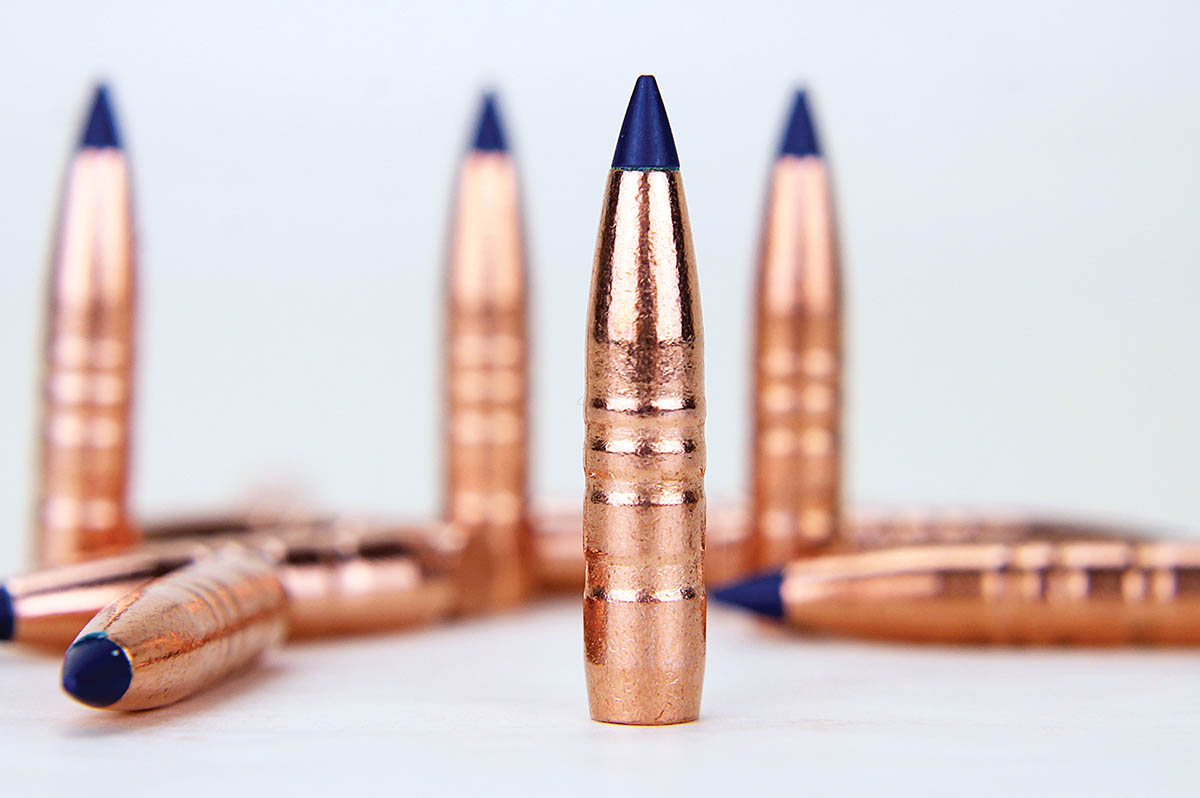
Weighing and measuring the dimensions of 10 of these bullets plucked from the box at random (see table) shows the 6.5mm 120-grain TRX bullet compares well with match-grade bullets in their bullet-to-bullet consistency. Weight and base-to-tip overall length variance are in the same class as competition bullets, and the TRX’s base-to-ogive variance of .008 inch is impressive for an expanding hunting bullet.
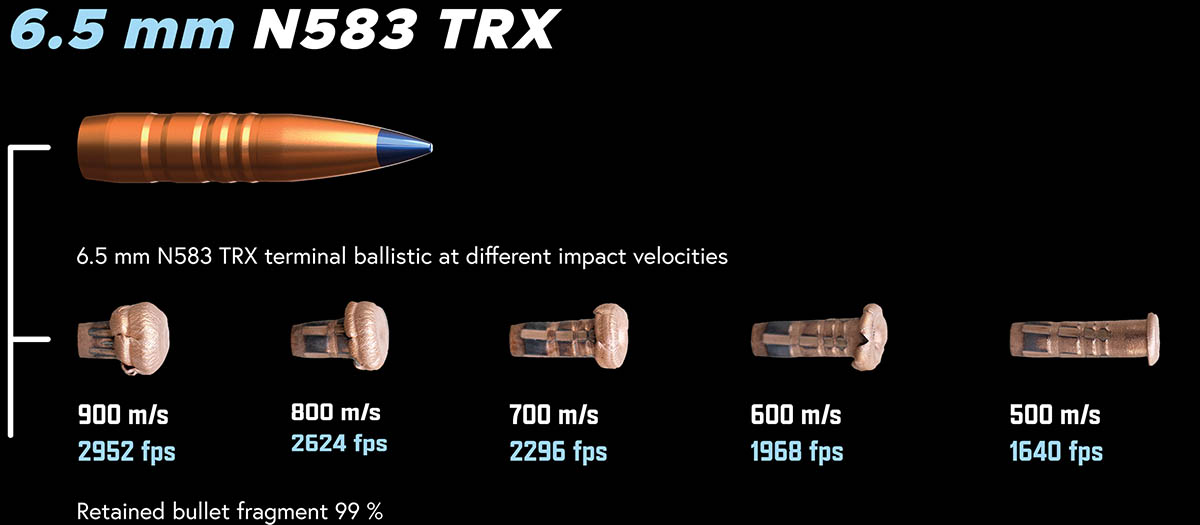
Consistency and ballistic goodness equate to accuracy, but hunting, however, is additionally demanding in that shots at game may be near or farther away, distance is usually only estimated, and we expect big game bullets to expand under any and all conditions. Above and beyond ballistic performance, designing homogeneous lead-free bullets to reliably expand at both high velocity (close range) and low velocity (long range) has been the engineering challenge. Lapua’s “True-Range Expanding” label is a reference to that reliable expansion of the TRX bullet across the velocity range of approximately 1,600 feet per second (fps) to 3,000 fps.
While polymer tips on rifle bullets is the new convention, Lapua’s 6.5mm TRX bullet still looks a bit unconventional in sporting three grooves – more circumferential indentations, really – around its bearing surface (shank). Their purpose is to reduce the amount of the shank’s surface area in contact with the barrel while still mitigating powder gas “blow-by” passing around the bullet. “The challenge with solid copper projectiles is that they do not ‘form’ to the rifling as effectively as a lead-core bullet,” Capstone (Lapua’s American importer) Marketing Director Geoff Esterline told me. “Too much bearing surface contact with these bullets generally produces poor precision.” We see these grooves in the homogeneous bullets from other manufacturers, as well, and engineers tweak their number and locations on each bullet design to make them work.
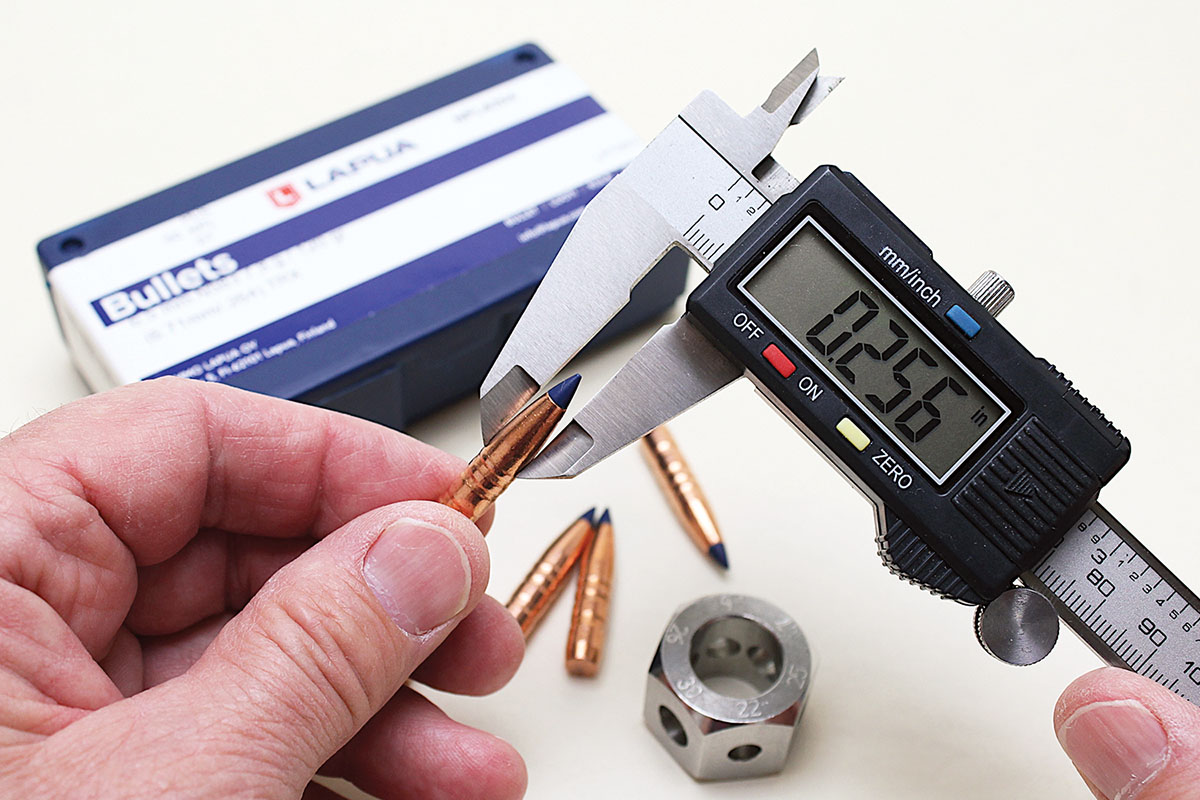
According to Mikko Latvala, Lapua’s Product Development Engineer, the TRX’s ogive is not secant, despite appearances. “It is not purely secant as the ogive has a short bore rider section behind the ogive,” he explained in an email exchange. “Without the bore rider, it would be secant.” Sure enough, just in front of the bullet’s first full .2635-inch bearing surface, a caliper measured a short .256-inch bore riding surface. Though I once had to muddle through trigonometry to earn a degree, it is not one of my superpowers, yet we can understand how the TRX’s bore-riding section and multiple bearing surfaces might throw a delta wild card into the math so that the ogive is technically not “purely secant” to a trigonometric engineer.
Regardless, Lapua assigns this TRX a respectable G1 ballistic coefficient (BC) of .428 and a G7 BC of .212. Online ballistic calculators work somewhat differently from each other and produce somewhat different results given the same inputs, so I utilized three online calculators that you might use yourself and looked for a ballpark consensus among them. Conservatively, with an initial muzzle velocity of 2,900 fps and a reliable expansion at 1,600 fps, the TRX bullet still expands at 500 yards, and one calculator stretches that out to about 700 yards. If you’ve got the wind doping skills for a humane shot into a game animal’s vitals at 500 yards and maybe a smidgeon more yards, the TRX should be up to the task when it gets there.
Lapua recommends a minimum twist rate of 1:81⁄2 inches for the 120-grain 6.5mm TRX bullet. Interestingly enough, Berger Bullet’s online Twist Rate Stability Calculator indicates a 1:8.5 twist rate provides only marginal stability for the TRX bullet launched at 2,900 fps. “The bullet is plenty stable even though the calculator says ‘marginal stability,’” Mikko assures us. “The 6.5 TRX is a long bullet for the weight, but it is proven to stabilize with even 1:9 rifle twists of the 6.5x55 [Swedish].” Another TRX wild card in the calculation’s math, I reckon.
An online check of five retailers rendered prices for Lapua’s 120-grain 6.5mm TRX from $77 to $94 per box of 50 bullets, or $1.54 to $1.88 per bullet – about comparable to that of premium lead-free hunting bullets from other manufacturers. While certainly more pricey than lead core bullets, they can get us hunting in places where lead core bullets cannot. Besides, after working up a load, there’s still enough bullets in a box to bag a dozen or so deer or elk – or caribou.
.jpg)
.jpg)