

Propellant Profiles
The Creed by Shooters World
column By: Rob Behr | December, 26
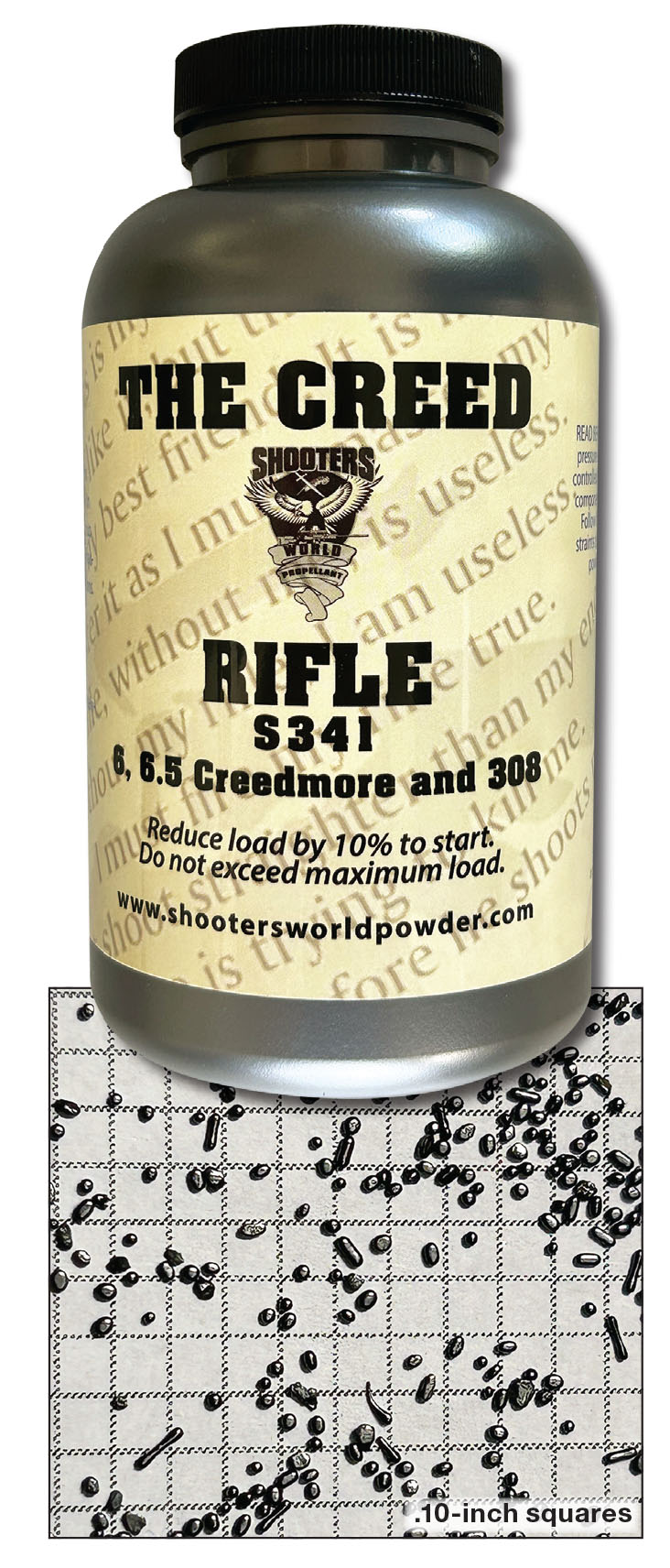
The simple truth is that The Creed, in a cartridge that is remotely within its burn rate, is a much better propellant than it looks to be on paper or to the naked eye. I admit that I came into testing with limited expectations for this propellant’s performance, and it proved me wrong time after time. This is why you test before you judge. Doing otherwise may cheat you out of something great.
The Creed is manufactured in Somerset West, South Africa, by Rheinmetall Denel Munitions (Pty) Ltd. Outside the United States, this powder is part of the Somchem line of canisterized propellants under the name S341. With a bulk density of .983 grains per cubic centimeter (g/cc), the powder is very dense and an excellent fit for smaller capacity cartridges that demand high pressure loads. It also meters extremely well, which seems to be a hallmark of the propellants Shooters World elects to import.
Physical Characteristics
The Creed’s individual powder grains are a dizzying array of shapes and sizes. I had seen this before with Somchem’s S321, which is imported by Shooters World as The Patriot propellant. The Patriot performed well during testing, which should have laid some of my concerns over the odd geometry to rest. Once again, I had to be reminded through testing that Somechem makes very capable propellants.
I made a real effort to categorize the majority of shapes and sizes present in The Creed. The smallest were balls, which is not surprising because S341 is a spherical, double-base propellant. The smallest one I measured was .015-inch. There were a lot of spheres that measured about .026-inch, which was consistent with the published diameter of this powder. Others were tubes that measured around .060 inches by the aforementioned .026-inch diameter. Then there were the extraordinarily long powder molecules, some that looked like dumbbells and others that had a shape that would drive a group of thirteen-year-old boys to laughter. The longest I found of these, in the small sample I examined for photography, was a whopping .102 inch. These are not all the shapes, but they are some of the more prominent ones. All of these shapes and sizes give The Creed a decidedly reflective characteristic, flashes of light in a matrix of blacks and grays. It is a very distinctive-looking powder.
Temperature Stability Testing
I chose the 308 Winchester for temperature testing because The Creed is slow enough to offer nearly 100-percent case fills. This limits powder migration that might skew the test results. Five of these cartridges were stabilized at -22° Fahrenheit (F) for 24 hours before testing. The average velocity of these rounds was 2,918 feet per second (fps). The five cartridges that had been stored at 70°F produced 2,940 fps. The last five held at 120°F for 12 hours averaged 2,949 fps. This 31-fps velocity shift is outstanding for a double-base propellant, representing a 1.06 percent velocity increase over a temperature range of 142°F.
Positional Sensitivity Testing
Powder migration within a cartridge can produce fluctuations in pressure and velocity. SAAMI (Sporting Arms and Ammunition Manufacturers’ Institute) procedures call for cartridges to be tested with the powder oriented toward the primer, the position that creates the highest potential for pressure.
My format for this testing is to select the cartridge with a high internal volume and pair it with the lowest published charge mass for a given powder. The powder is then tested in a forward position, a rearward position against the primer and an intermediate position where the propellant is equally distributed throughout the cartridge.
In the case of Shooters World’s data, the 30-06 Springfield looked like a good testbed with a minimum charge weight of only 45 grains using The Creed. I briefly considered the 300 Winchester Magnum for this test, but The Creed’s burn rate simply seemed too fast to make this test fair. After seeing the 30-06 results, I wish I had used the big magnum. It might have come out fine.
With loads that only filled the 30-06 case to about 70 percent of its total capacity, the potential for velocity shifts and high extreme spreads seemed the rule rather than a potential outcome. Instead, I got an average of 2,420 fps in the forward position, 2,416 fps in the intermediate position and 2,398 fps with the pow-der oriented near the primer. I’m amazed by the result, but Somchem won again.
Accuracy Testing
With a case fill of nearly 100 percent usable capacity, the 223 Remington looked like a suitable candidate for accuracy testing. It also gave me a chance to try Hornady’s Aeromatch® bullets. Shooting conditions were good, with a light breeze from behind and sunny conditions on a 78 degrees Fahrenheit late afternoon. Using my Bushmaster Varminter, I shot 30 very carefully loaded cartridges in groups of five. The largest by far was right
at a minute of angle, and this was only because of a flier fifth shot that destroyed what had been a nice group. The average group size, including the one destroyed by the flier, was .740-inch.
Data
There are two notable sources of data for The Creed. The first is from Shooters World and can be found at ShootersWorldPowder.com. The second is from LoadData.com. Data for S321 can be found at SomChemReload.com/propellants/s341.
The Takeaway
When I first looked at data for The Creed, I suspected it was too fast-burning to be a good match for many of the listed cartridges. Based on the case fills, I suspected I would find higher than normal extreme spreads and lower than expected velocities. In some cases, like the 300 Winchester Magnum, those expectations were borne out, but in most of the tested cartridges, performance was much better than I expected. In the 223 Remington, 308 Winchester and 6.5 Creedmoor, cartridges well within The Creed’s burn rate, performance was on par with the best powders I’ve tested.
.jpg)