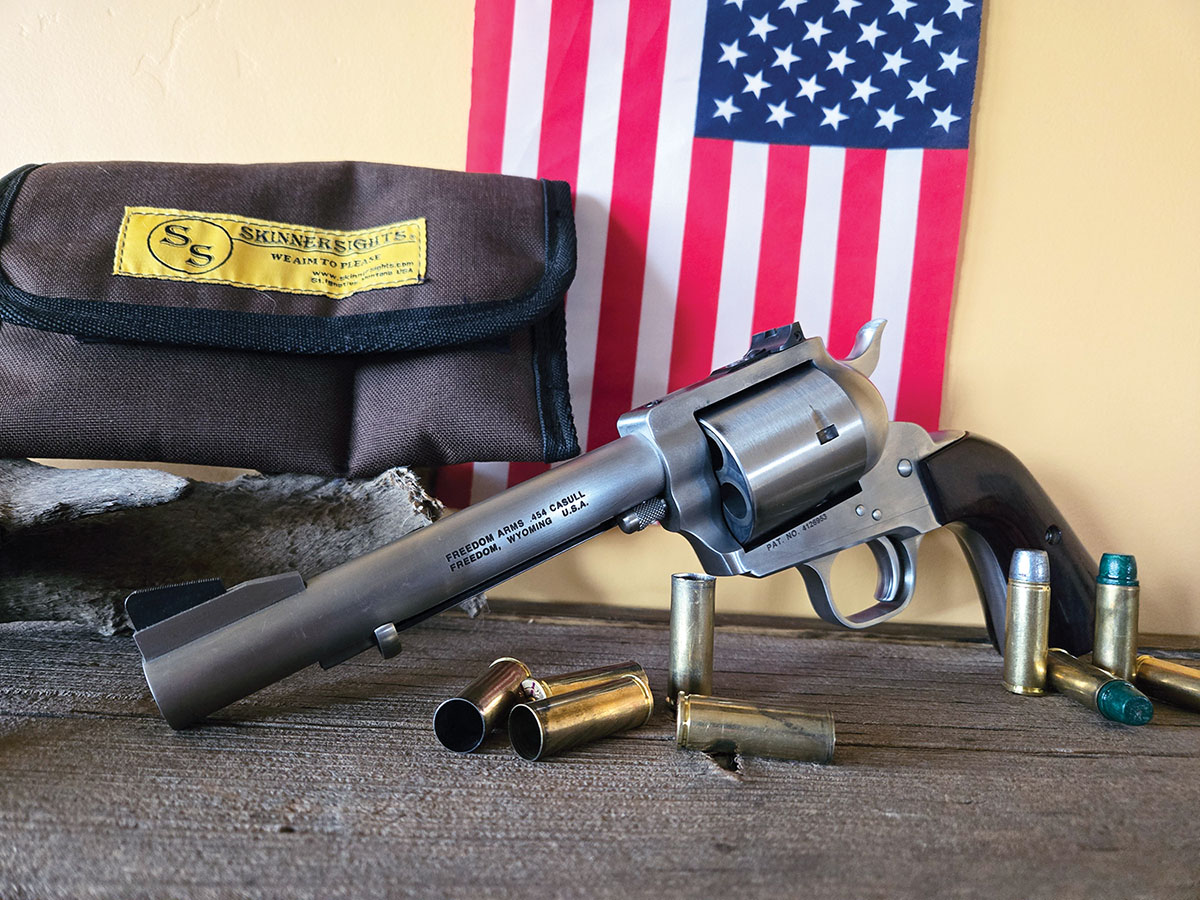
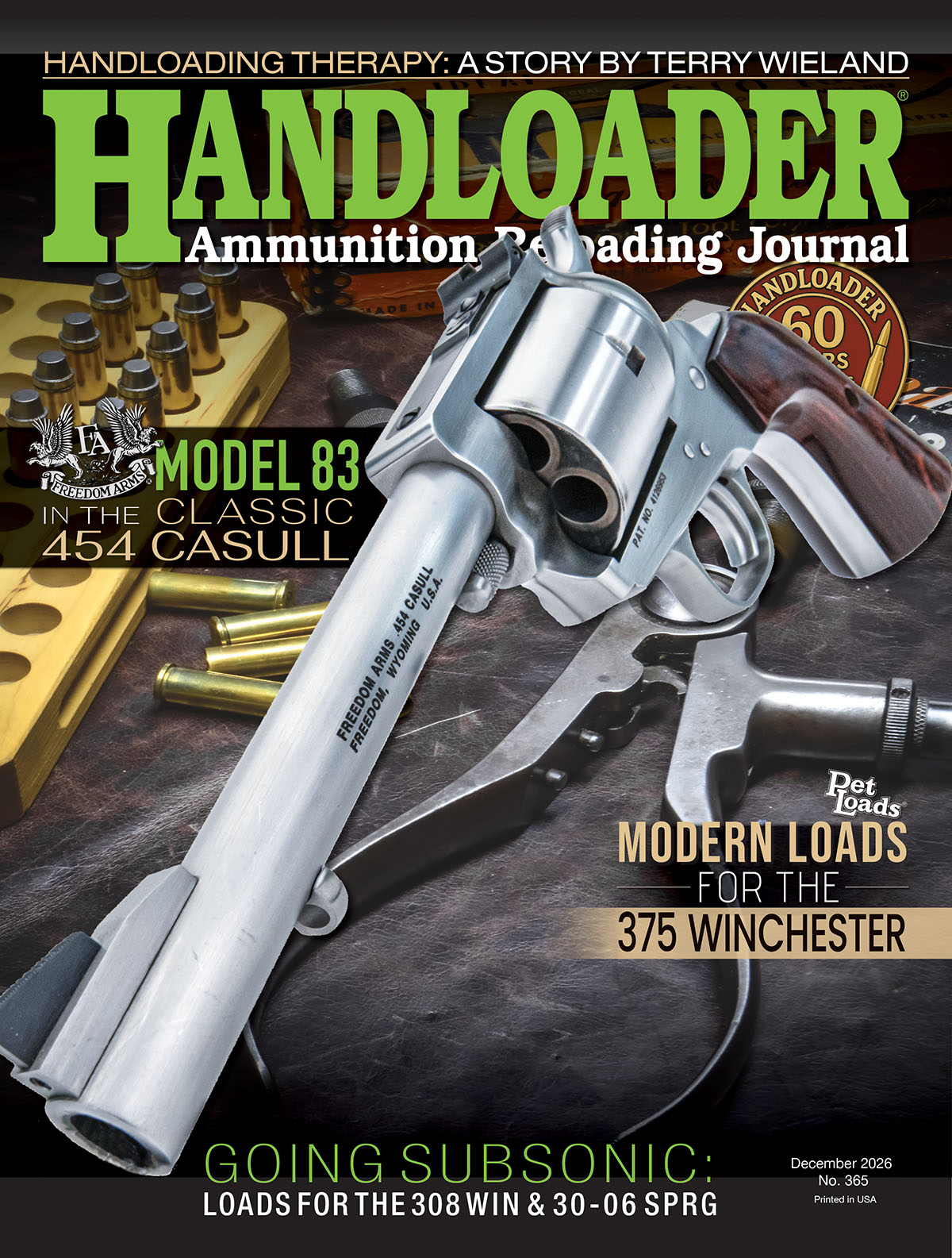
The 454 Casull and Freedom Arms Model 83 have rightfully earned a legendary reputation for accuracy, reliability and outstanding terminal performance.
For many years, I have been a huge fan of big-bore sixguns, in particular the 45 Colt; like many, this passion has led to progression. This led me straight to the 454 Casull, a cartridge that, in my mind, is one of the more practical big-bore magnum performance cartridges. This is largely thanks to the excellent and relatively compact guns that Freedom Arms makes chambered in the cartridge. When hunting, shooting, or carrying a handgun, I prefer mine to be in a holster and not a sling. This is where the Freedom Arms Model 83 chambered in 454 Casull truly shines.
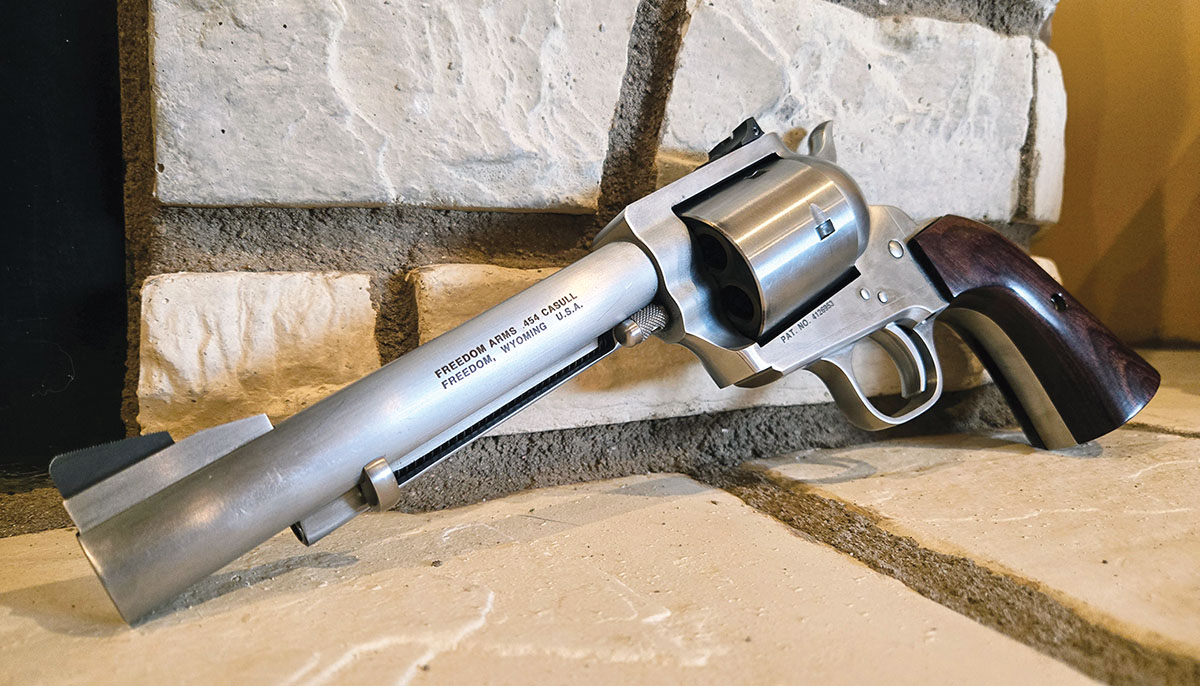
The Freedom Arms Model 83 is an elegant revolver built to very tight tolerances and capable of impressive performance while weighing just over 3 pounds and still comfortable to pack around in the backcountry.
Like those who came long before me, from Elmer Keith to Whit Collins, these men pushed the envelope when it came to high-performance cartridges. Keith is often credited with the 44 Magnum, and Whit Collins and Col. Jeff Cooper with the 10mm Auto. In like manner, Dick Casull created the 454 Casull, which came about from pushing the 45 Colt beyond what it was capable of to the point that an entirely new cartridge was needed. Thus the legend was born and to this day it lives on with a loyal following.
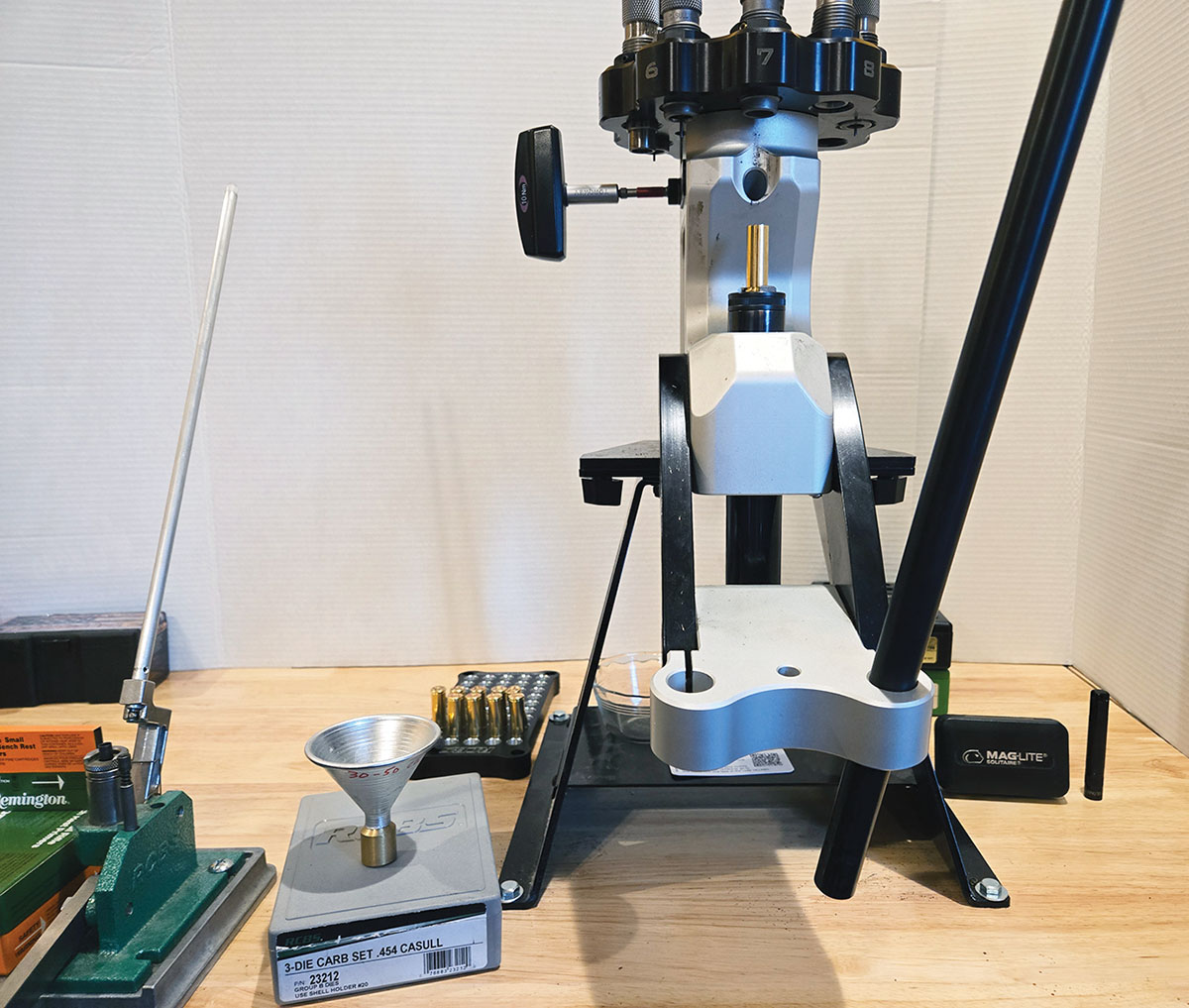
All handloading was done using an Area 419 Zero Reloading Press with RCBS dies and an RCBS Automatic Priming Tool, which made it easy to seat primers into fresh Starline cases with tight primer pockets.
However, like most cartridges, it took time for it to get established. Most folks were introduced to the cartridge in 1959 with an article in Guns & Ammo magazine; it was far from an instant success. I would argue it wasn’t until
the 1970s when it truly started to gain traction. Fast forward to 1978, Wayne Baker and Dick Casull founded a company called Freedom Arms, located in Freedom, Wyoming. The company produced the Patriot revolver chambered in 22 LR. However, in 1983, the Model 83 was introduced as the first commercially produced revolver in 454 Casull. Then in 1997, SAAMI (Sporting Arms and Ammunition Manufacturers’ Institute) published official industry standards for the 454 Casull, setting the maximum average pressure at 65,000 pounds per square inch (psi). Folks have been testing their wits and wrists ever since. The Model 83 remains popular; although it is not the most powerful handgun cartridge, it remains extremely practical, thanks to the Freedom Arms Model 83. It has a stellar reputation for accuracy and packs easily into a holster on the hip,
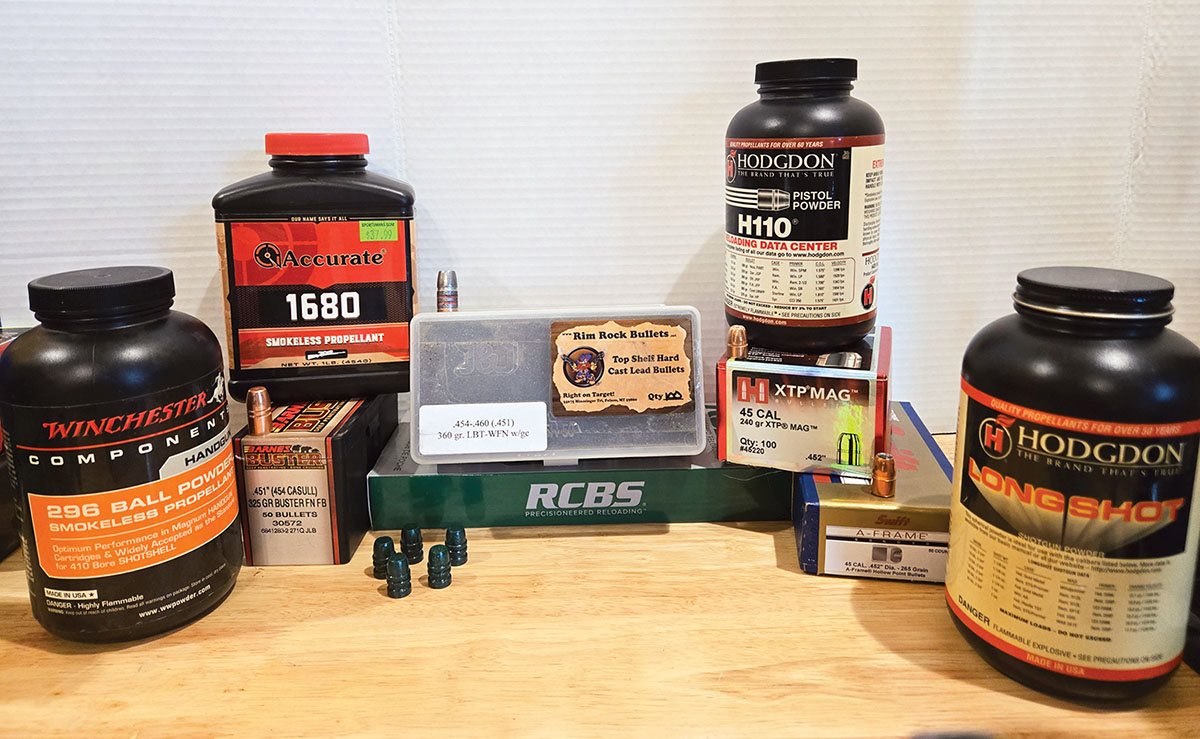
A wide variety of bullets and powders were gathered for this test and evaluation.
shoulder or chest. This is a huge advantage, as my idea of a handgun should fit in a holster and be comfortable enough for carry in the field all day. The Model 83 in 454 Casull does this quite well all while offering enough terminal performance to protect you from dangerous game. It has successfully been used in Africa on the largest game and has a good reputation for stopping the big bears of Alaska. All while weighing 3 pounds,
2 ounces with a 6-inch barrel when it’s needed. That is the lightest insurance card you can carry into the backcountry. The Freedom Arms Model 83 is an extremely well-built revolver featuring extremely tight tolerances and perfection when it
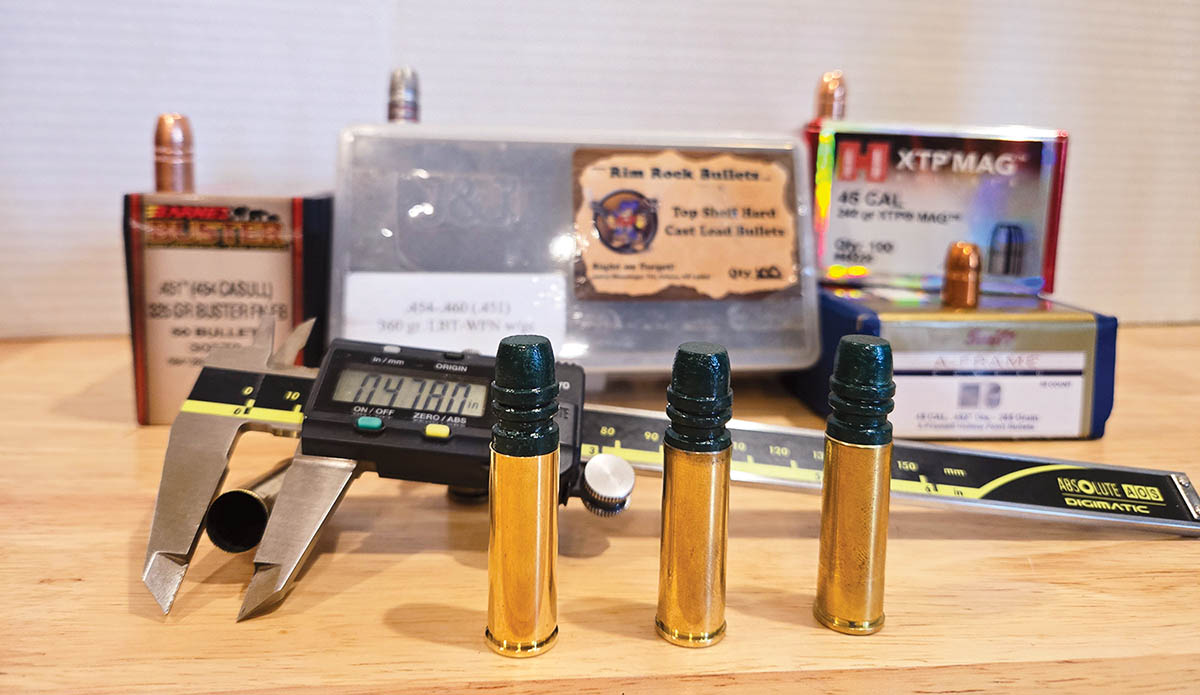
When it comes to expanding the case mouth, it is suggested to expand those case mouths specifically for the bullet you intend to shoot. Of the bullets tested, nearly every one of them required varying amounts of flare to achieve ideal case wall tension. If the case is overexpanded, the only thing preventing bullets from moving under recoil is the crimp; with full-power loads, a heavy roll crimp is mandatory.
comes to fit and finish. The premier grade shown in this article has a bright brushed finish on the 17-4 PH stainless steel and features exceptional attention to detail when it comes to fit and finish. The cylinder throats across all five chambers gauge perfectly at .452 inch and the
cylinder gap measures .0015 inch. It is thanks to these exceptionally tight tolerances that these guns have earned a reputation for precision. Which is exactly the reason for the test today. Having done load development in the past at 15 and 25 yards, I wanted to see what could reasonably be expected if that distance was pushed to 50 yards or beyond, especially with higher round counts. The next order of business was loading for the Model 83, startingout with high-quality new, unfired Starline cases. Each
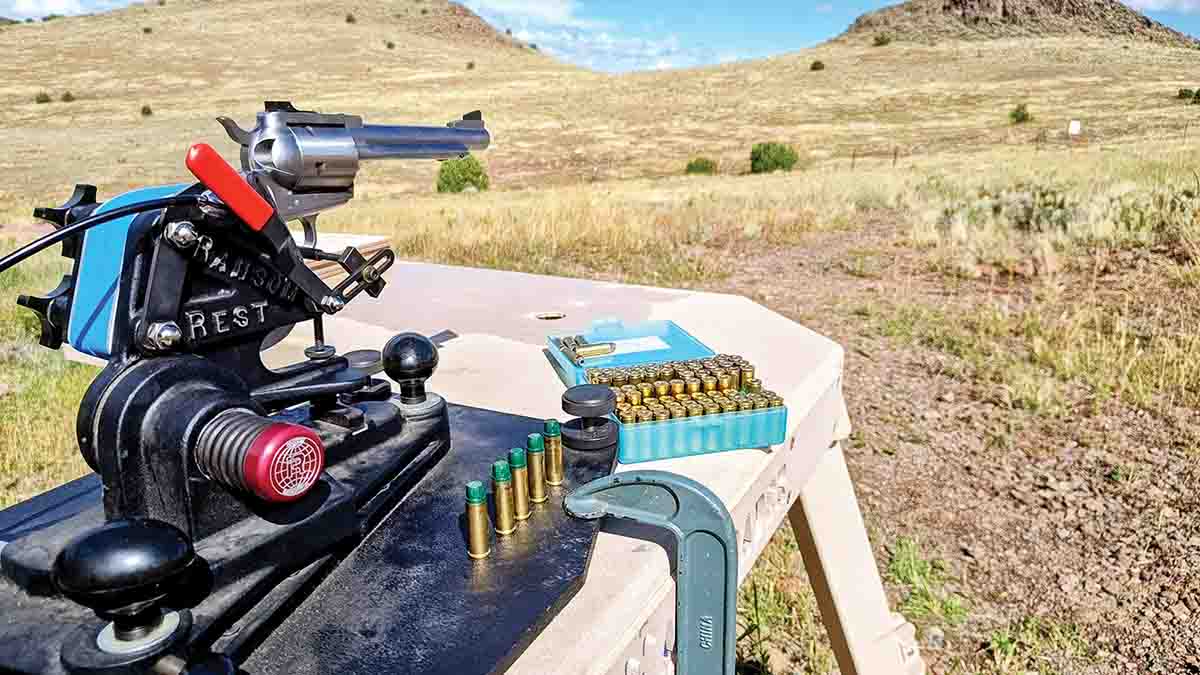
To test all loads, a Ransom International Master Series Rest was used. It proved reliable and repeatable all day long, which is more than I could say for my wrists.
one was hand-
inspected, and the case mouth expanded to fit whatever bullet would be loaded in that case. One thing I have found in reloading the 454 Casullis that there is no shortage when it comes to excellent bullet options. However, due to the wide variety of loads from cast and jacketed to solid copper, the amount of flare on the case should be adjusted for the particular bullet being used. This is especially helpful when loading near maximum pressure with heavy bullets where you want some tension from the case walls as that bullet is seated, as well as a stout crimp to prevent the bullet from jumping crimp and locking up the cylinder. A slight chamfer and deburr was applied to every case to aid in seating bullets, especially cast projectiles. My go-to primer is the Remington 71⁄2 when working with the 454 Casull; this opinion is one shared by many, and thankfully I had some on the bench for this project. Primers were seated with an RCBS Automatic Priming Tool, which mounts on the bench, and it has proven reliable and consistent, as well as fast. To weigh and dispense powder an RCBS Matchmaster
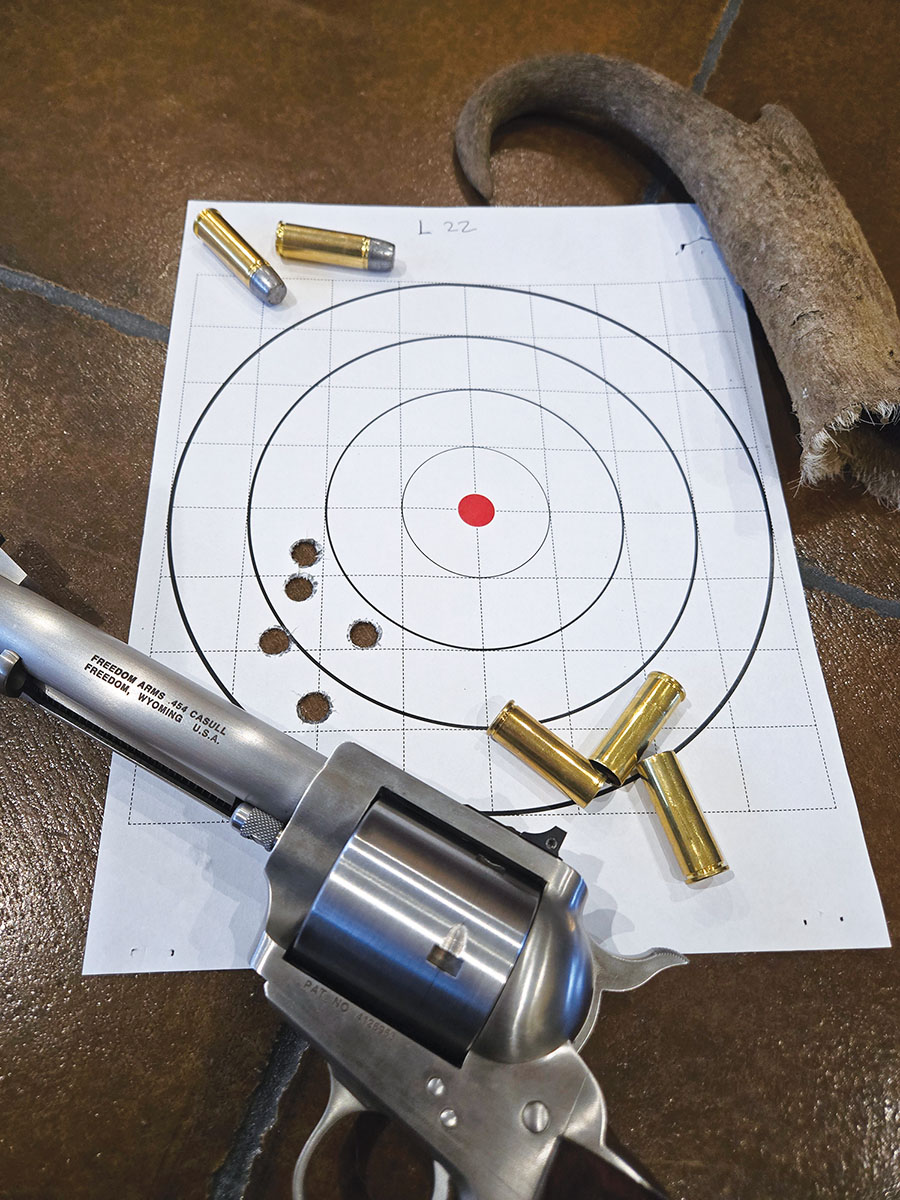
At a distance of 50 yards, this group measured out to 2.00 inches using the hard-hitting 360-grain Rim Rock LBT-WFN hardcast bullet. This would be an excellent choice for any game around the world.
powder dispenser was used and charges were kept within .04 grains of the target charge weight. Bullets were seated with an RCBS seating die, and then, with the seating stem backed off completely, the bullets were crimped in place with a heavy roll crimp. This is mandatory when loading the 454 Casull as bullets can easily jump past a light or even medium crimp and lock up your cylinder. Applying this crimp as a separate step is a good idea if maximum accuracy is desired, as applying
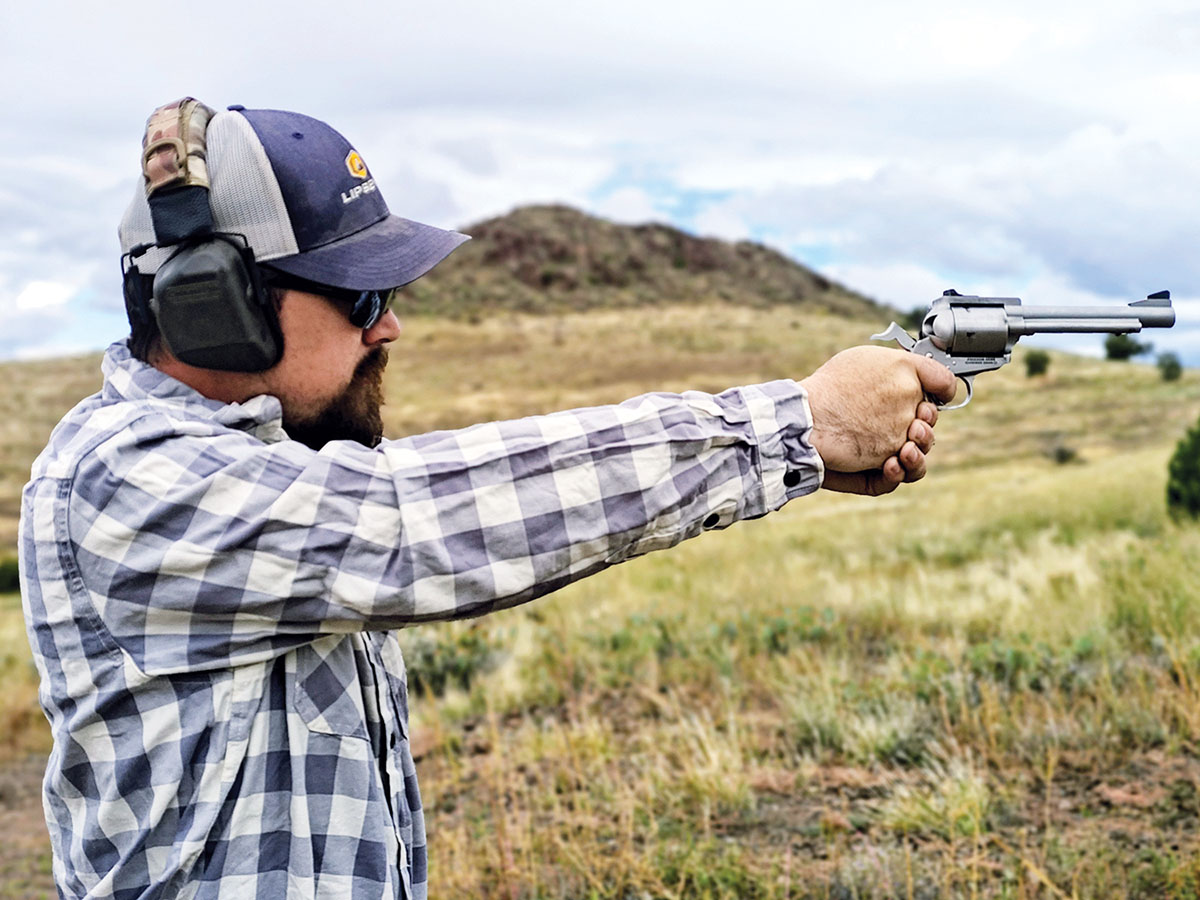
The 454 Casull is a heavy recoiling cartridge, while many will advocate practicing with light loads, then loading with full-power loads “when you need them.” My advice is quite the opposite: If you become proficient with full-power loads, you will handle the gun better and know what to expect in the heat of the moment.
such a heavy crimp while seating the bullet can deform the bullet and even buckle the case if care is not taken. As I was handloading for this project, I realized this felt much more like loading for a precision rifle than a handgun.
With all the ammunition loaded, I just had to wait for a good day to shoot; unfortunately, the weather had other plans. With the deadline rapidly approaching, I had no choice but to shoot this project if we wanted to make the deadline for this issue. I began testing with cold weather hunting gear on and a reinforced target stand to deal with the 25 miles per hour winds. I have no doubt the accuracy could have been improved upon if it had not been for the wind, in particular the 25-round test, where the wind conditions were shifting rapidly and waiting for consistent conditions simply wasn’t an option across 25 rounds.
As Table I shows, the results were still quite good; one notable failure was an attempt to use Accurate 1680 powder, which I had never used before in the 454 Casull. Sadly, the results were dismal, with extreme spreads and standard deviations I could not, in good conscience, call worthy of repeating. Over half of the task of finding a good load that works is finding one that doesn’t, so for those reasons the results are included in this table, and despite the high extreme spreads, accuracy was not terrible at the test distance of 50 yards.
One powder that truly stood out was Hodgdon Longshot. Across the board, the standard deviations, extreme spread and accuracy were all exemplary. With medium-weight bullets in the 454 Casull, I saw no more reason to experiment with other powders and will be conducting more testing with Longshot in the future. Hodgdon H-110 is a staple in the 454 Casull and it is for this reason 25 rounds were loaded with the same powder charge just to see what this Model 83 and renowned powder were truly capable of in terms of precision. The wind and weather conditions no doubt played a role in the size of the group. Despite this the group would still score very high on an NRA B-6 Bullseye target, with a couple of outliers widening the group by over 1.5 inches, enlarging the group to 5.52 inches.
All in all, the 454 Casull is a powerhouse of a cartridge, and it is more than capable of taking all manner of game, including dangerous game. However, the recoil is severe and diligent practice is required to become proficient with such a cartridge. The Model 83 is fairly compact and easily carried. The handloader is also capable of tailoring loads to suit his needs or application. Mine will likely be loaded with Hodgdon Longshot and a hard cast bullet dropped from a RCBS 45-255 SWC mould. However, if the situation dictates, there is plenty of versatility available on both ends of the spectrum to use the 454 for any situation, all while being easily packed on the hip.
If you would like to know more, watch the video titled “Freedom Arms 454 Casull” on our YouTube channel Handloader TV.


.jpg)