

.257 Puzzle
The Many Faces of Weatherby’s Masterpiece
feature By: Terry Wieland | October, 26
At various times in its 80-year career, the 257 Weatherby has been everything from the last word in modern, toasted from coast to coast, to the last word in excess, exhibiting every vicious trait of bullets that are too light, moving too fast and do a lousy job when they get there.
The 257 has been Exhibit ‘A’ for those who believe velocity alone can kill; its designer, Roy Weatherby, was one, but, conversely, also for those who insist that light bullets at high velocity do more wounding than killing.
It’s no wonder, then, that one of the surest ways to provoke arguments, if not actual fistfights, in any hunting camp is to claim that Weatherby’s 257 is one of the finest big-game cartridges ever developed. It is, or was, a sure way to get skeptical looks and knowing winks if you showed up with one of Weatherby’s “California style” 257s. It was assumed that either (a) you had more money than brains, (b) knew nothing about ballistics, or (c) were overawed by Hollywood types and sure to muck up any shot you were given. Or, most commonly, all of the above.
For much of its life, carrying a 257 Weatherby marked you as something no big-game hunter wanted to be: A know-nothing greenhorn dazzled by glitz.
At this point, I should confess I’ve been an admirer of Roy Weatherby and his products, albeit with some qualifications, since 1975, when I acquired a German-made 300 Weatherby Mark V. It taught me a lot, including the fact that if you buy a Weatherby with anything less than a 26-inch barrel, you are wasting your money. Offsetting that revelation is the fact that with that rifle I killed two caribou, an Alaska brown bear and a British Columbia moose. When I acquired my first chronograph in 1990 and found out what velocity I was really getting, I was certainly disillusioned. We live and learn.
In 1990, I bought my first 257, a Mark V in the elegant Safari Grade of dark wood, banner-style checkering and no white-line spacers. Yes, it had a heavy 26-inch barrel, and it proceeded to do everything one could ask. Out of the box, I took it to the range and, using Weatherby factory loads with 100-grain Hornady bullets, shot a five-shot group that measured .600 inches. Velocity? Everything Weatherby promised, and even a little bit more.
If I ever had doubts about the virtues of the 257 Weatherby, that rifle banished them all. But, again, with some qualifications.
First, the 87-grain bullet that delivers 3,850 feet per second (fps) is best left at home. I have owned or used a half-dozen 257s since then, and not one would shoot the 87-grain bullet worth a damn – and that includes the much-loved and long-lamented Safari Grade that vanished in a divorce.
What is? Well, a good 100-grain big-game bullet will do everything one could want on deer and antelope, while a 115- or 120-grain spitzer, like a Swift A-Frame or Nosler Partition, is the answer for anything bigger.
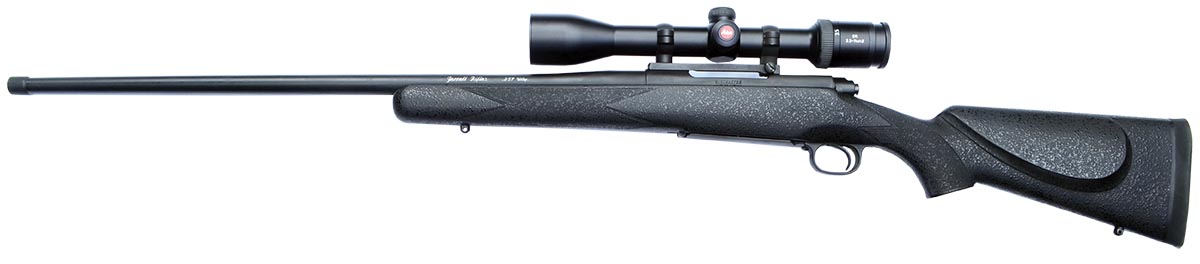
In 1996, Kenny Jarrett, the reigning accuracy king at the time, approached me with the idea of making a rifle to show what he could do. I was all for it; who wouldn’t be? Being of a contrarian bent, I wanted something other than his standard 300 Jarrett in an accurized Remington Model 700 action. Instead, I asked for a 257 Weatherby, and wanted it built on an action with controlled feed and a three-position safety.
Winchester had recently resurrected the pre-’64 design in an action I called the post-’93 pre-’64. If Jarrett was as good as they said, I argued, he should be able to work his magic on that, his magic being a guarantee of half-minute of angle (.500 inch) three-shot groups with his own handloads.
Oh, and one other thing: Instead of using Nosler Ballistic Tips (Kenny’s favorite) I wanted to be able to load 115-grain Trophy Bonded Bear Claws. Kenny gulped again and said he’d do his best.
This last requires some explanation.
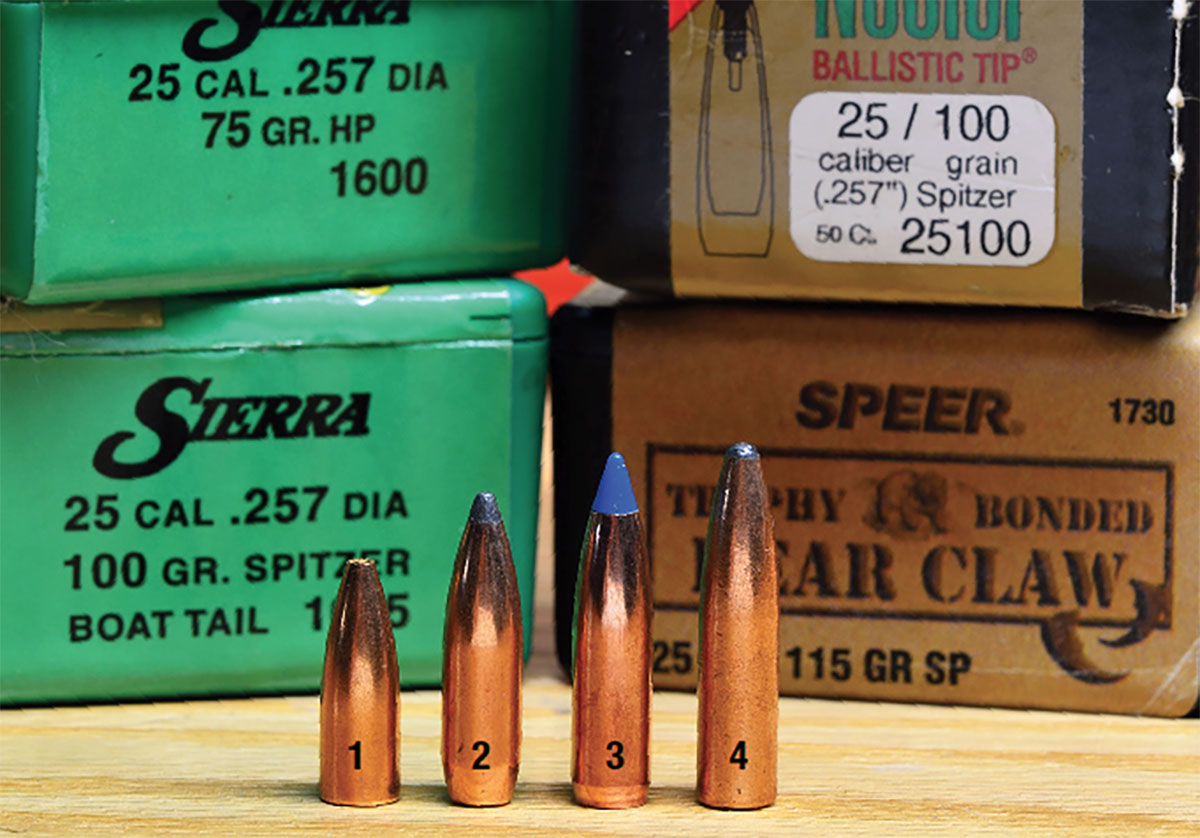
At the time, Jack was not making Bear Claws smaller than .270, mainly because no one had ever produced small-caliber premium bullets, including his inspiration, Bill Steigers, of Bitterroot Bullets. I persuaded Jack to make me a .257 bullet, and while he was at it, he produced some .243s for his 243 Winchester and 6.5s for Finn’s 6.5x55. For the record, for Cape buffalo, I was using the then-new 416 Weatherby, Jack had a 450 Ackley and Finn a 416 Taylor.
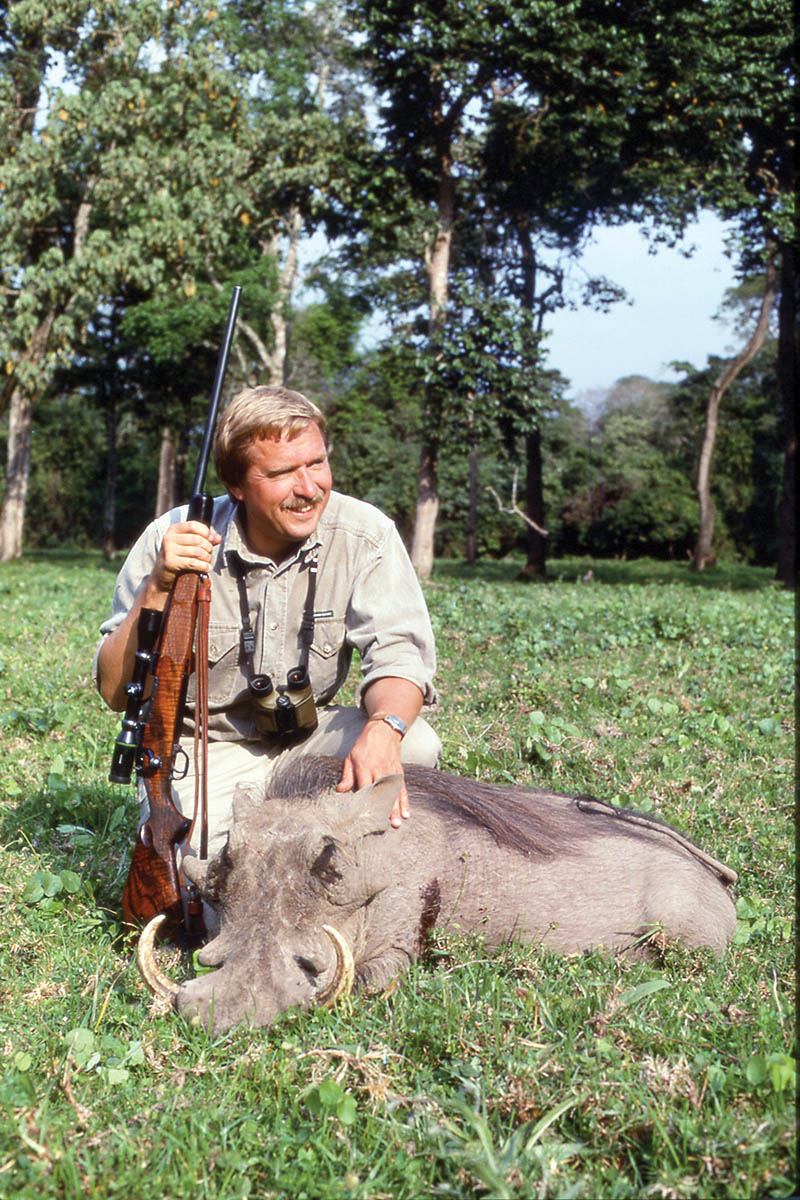
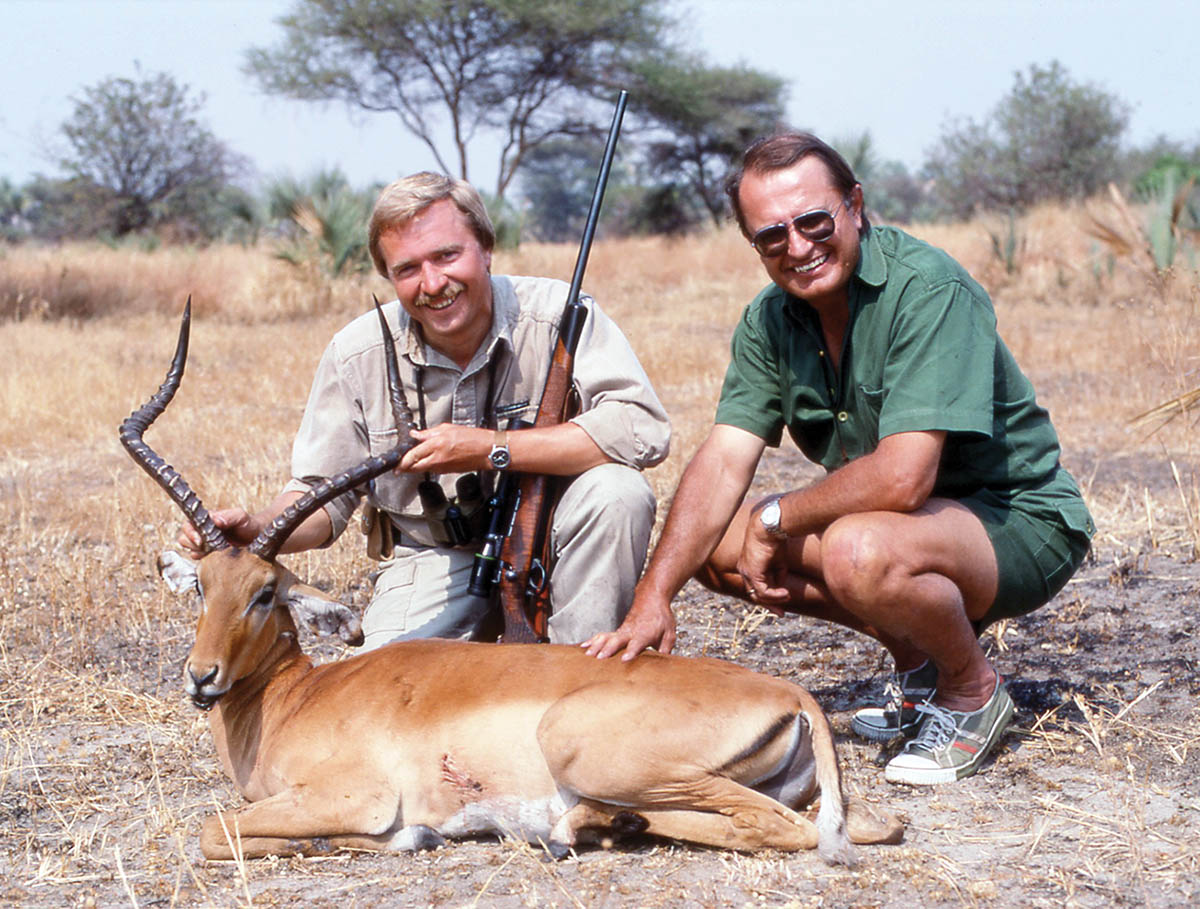
On those two safaris, the 257 Weatherby and its handloaded 115-grain Bear Claws acquitted themselves spectacularly, including a succession of one-shot kills on animals as large as zebra and wildebeest. Its one failure occurred in Tanzania when it struck between the ribs of an impala, did not expand, exited the same way, the impala bounded off into the long grass, and there followed an excruciating several hours of search, shooting (and missing), more searching and what Finn later described in print as “some truly dreadful shooting” on my part. For some game, a super-tough bullet actually works against you. But yes, I did finally get the impala.
Robin Hurt, our Professional Hunter in Tanzania, was sufficiently impressed with the rifle’s performance to change his views on the 257 Weatherby, as did Tony Henley, later, when we hunted with him in Botswana.
It was this bullet I wanted to shoot in the Jarrett but, by the time I took delivery of the rifle in 1999, Tom Friedkin had sold Trophy Bonded to Federal, and they had undertaken to make changes that resulted, ultimately, in the disappearance of small-caliber Bear Claws.
But that came later. In the summer of 1996, I visited Kenny in South Carolina to try out the new rifle, with a variety of factory ammunition.
The year before, in Austria, I hunted chamois in the high Alps with a Weatherby rifle and factory 117-grain bullets provided by the outfitter. I looked askance at this; I was the one carrying it up the mountain on my back, but remembering the impala, I made sure I hit the shoulder of the tiny antelope and had no problems. I mention this to show I have some experience with that ammunition.
South Carolina was hideously hot, each day topping one hundred degrees. Immediately, accuracy with the Jarrett rifle became the least of my worries. The chronograph showed velocities exceeding 4,000 fps with 87-grain ammunition and 100-grain in the 3,800 range, while factory 117-grain roundnose blew every primer.
Kenny had developed loads for the 257 Weatheby using 100-grain Sierra GameKings, and his groups were everything one could ask. In a detailed letter, he explained what he had done and the results he achieved.
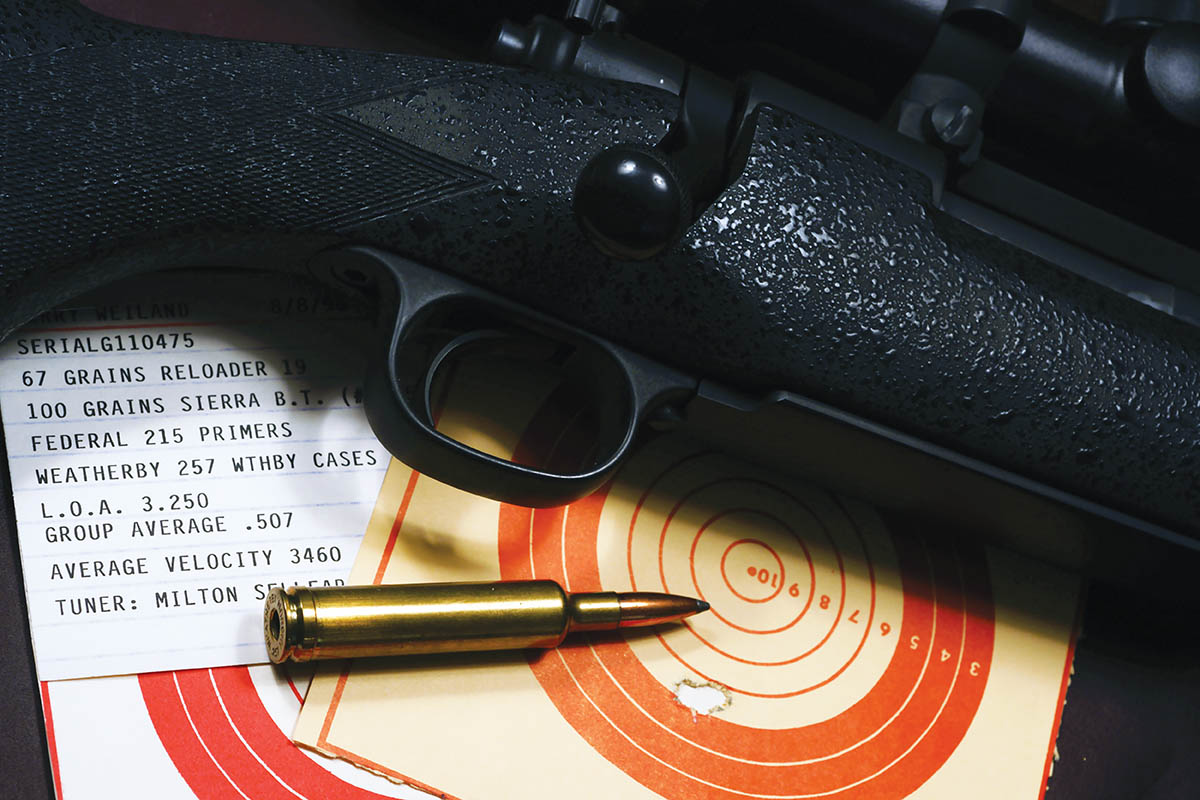
The main change was to give the chamber some freebore, similar to factory Weatherby rifles. With factory ammunition, he was still getting unusually high velocities, and the 117-grain stuff still blew primers. The load he developed to fulfill the half-minute guarantee, using Reloder 19, fell between the maximum in the Speer manual (65.0 grains) and that in the Nosler manual (69.0), and delivered velocity of 3,460 fps.
Much later, Kenny confessed to me he was sorry he’d ever come up with the half-minute guarantee for his “beanfield” rifles, since it depended on the proviso that it applied only to handloads he and his ballistician developed for the specific rifle. Also, too many buyers didn’t know how to shoot well enough to get such groups. Regardless, it set off a chain reaction in the industry and by the late 1990s several rifle makers were offering accuracy guarantees.
Actually, Weatherby, Inc., was the first to do so, way back when, guaranteeing three-shot groups of 1.5 inches with factory ammunition back in the day when that was the aspirational standard. As we’ve seen, my Safari Grade 257 bettered that easily.
In 1983, Ken Waters reviewed the 257 Weatherby for “Pet Loads,” and noted that his rifle, built in Japan, had both less freebore and a faster rifling twist than Mark Vs built by Sauer in Germany until 1973. German Mark Vs had a twist of 1:12 inches, the Japanese 1:10 inches; later freebore was “reduced by about half” to .363 inches. When you factor in two different barrel lengths available, 24 and 26 inches, one can expect significant differences in performance.
For the record, my Jarrett rifle has a 26-inch barrel with a twist rate of 1:9 inches.
Waters also noted some problems with load data contained in a couple of manuals, particularly Sierra’s. He tried a load using H-380 and blew primers left and right, and one load even froze the bolt on his Mark V, something I’ve never seen in my life, yet it was well below the maximum prescribed load. Was this due to the difference in freebore between old rifles and new? Possibly. He didn’t know, and suggested varying burning rates among different lots of powder. That load was still in Sierra’s manual as late as 2003, and since their test Mark V had a twist of 1:12, it was probably a German one with greater freebore. I think that’s where the difficulty lay.
As you can see, this is the same situation we ran into with the Jarrett rifle: Freebore, or the lack thereof.
The accompanying chart lists the load Kenny Jarrett developed, and others I used in my old Safari Grade. None exceeds safe loads listed in reputable loading manuals, and I include them because they displayed excellent performance and accuracy. Some bullets and powders are no longer available, so they are included for historical interest.
However, I would caution anyone tempted to try them to confirm their rifle model (old or new Weatherby Mark V) or custom, and what the freebore might or might not be. Starting five percent lower is prudent, to say the least.
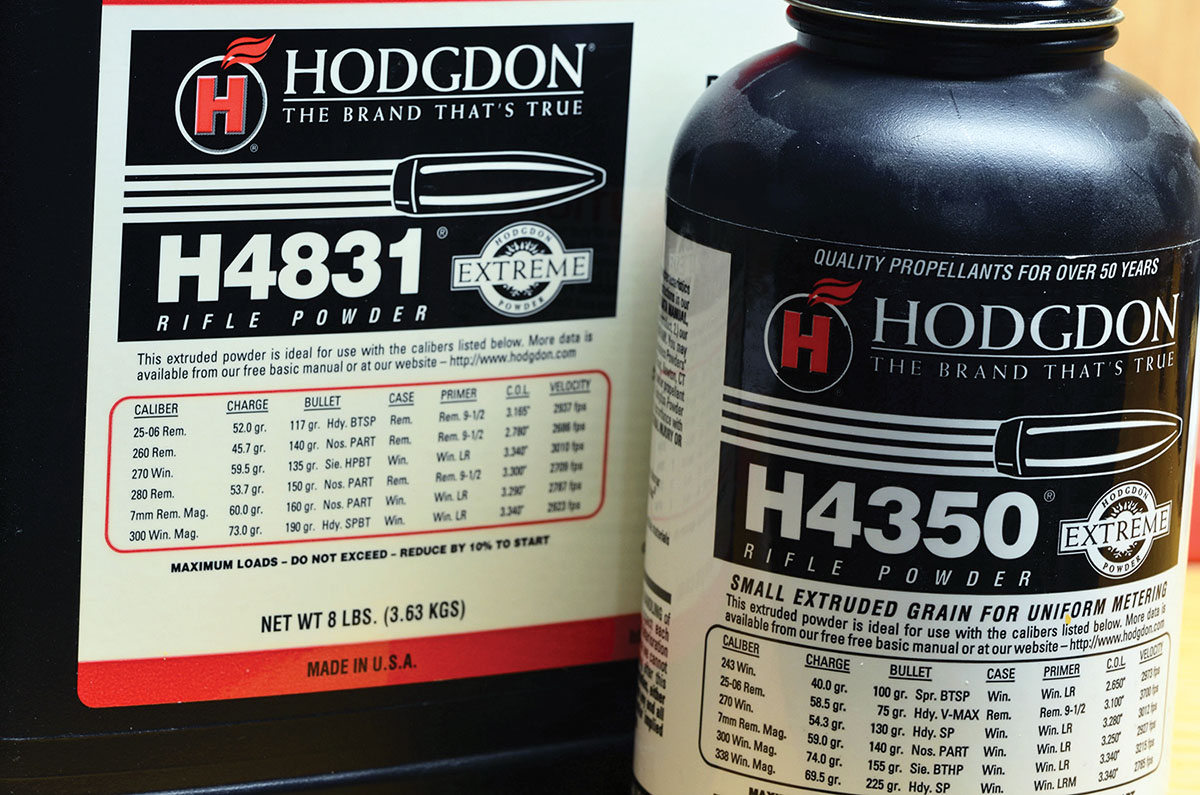
For the record, if I was restricted to one powder for my Jarrett rifle, it would be H-4350, followed by H-4831. At the moment, RL-19 and RL-22 (almost identical to the old Norma MRP) are not available (and may never be again), but as long as I can get H-4350, I don’t feel too deprived.
.jpg)