

In Range
Bibliopathology, It’s NOT a Sickness
column By: Terry Wieland | October, 26
The young lady had the garage door open when I arrived, standing in front of a dozen plastic hampers piled high with books.
I’d come across a listing for a couple of hunting books from years past and learned Miss Rachel was dispersing her late father’s library. Since there were several hundred books, and she was only a half-hour’s drive away, it was simpler to go and root through them myself rather than ask for a list.
They were divided roughly by subject matter: handloading, big game, military and Western gunfighters, with one hamper reserved for books of high value, according to internet listings. Her father, who died in his early eighties, shared some of my interests. The overlap between his library and my own was almost spooky, but he also had books that would fill a niche or two on my ever-burgeoning shelves.
I brought cash, and Miss Rachel was not giving them away, but she insisted, “I want them to go to a good home.” Since she said it several times, there was obviously some leeway.
Such situations are becoming more common as guys of a certain age go to their reward, leaving their heirs to dispose of books and guns and stuff, once treasured but now surplus to requirements and often a complete puzzle to the bored descendants.
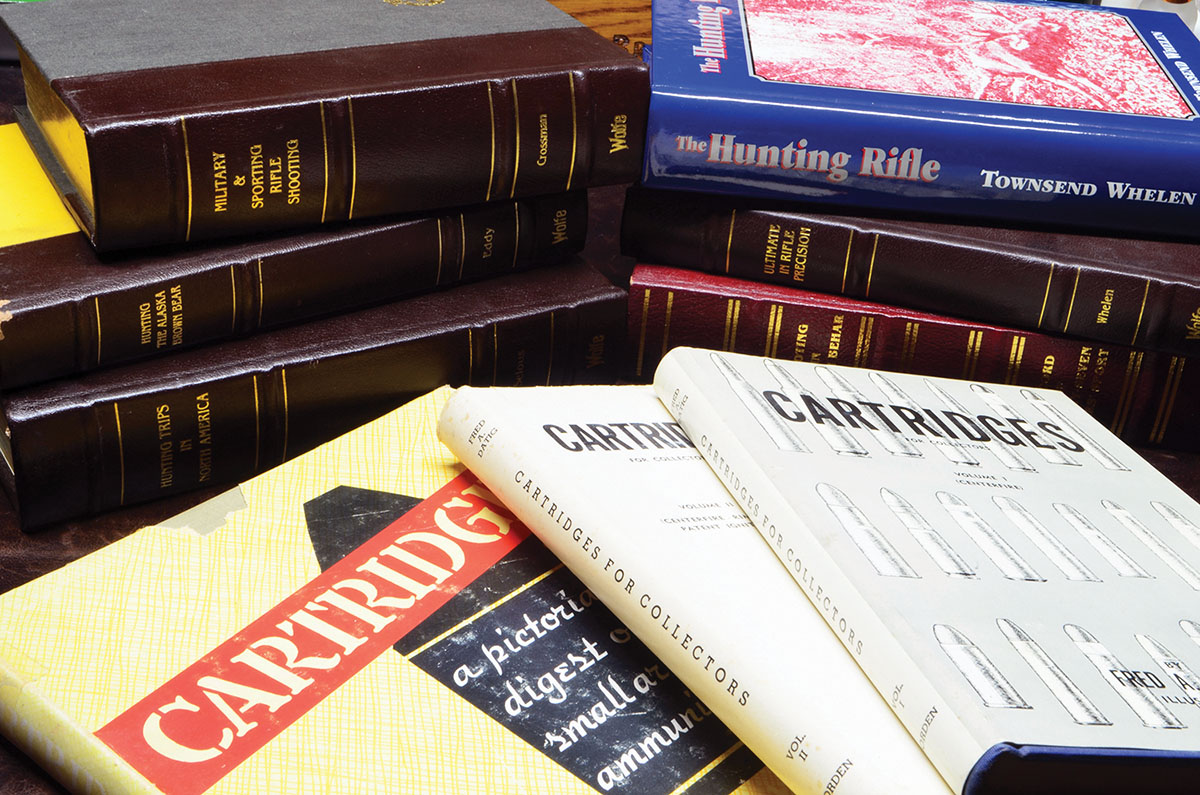
Who, for example, would suspect that Fred Datig’s two volumes on collector cartridges, cloth-bound with dust jackets from way back in 1956, are of interest to anybody today, much less worth money?
“Hmmm,” I said. “And these?”
“Ten dollars?”
“Each? Or both?”
(Hopefully) “Each?”
“Sure, why not?”
She was a nice young lady, and, after all, these were her dad’s books. Respect pays off.
***
Exploring a stranger’s life by going through his books is a cross between deciphering hieroglyphics and an archaeological dig, complete with dust, bats and cobwebs – literally, in some cases.
What is one to make of a man whose books include a first edition of Cartridges of the World (but no later ones), several volumes on gunfighters of the old west, a lonely anthology of Charley Waterman’s early newspaper columns (dogs and fishing, mostly), Ned Roberts and Ken Waters on American single-shot rifles (original hardcover with jacket), Townsend Whelen on hunting and target rifles, an analysis of the personnel of von Thoma’s Condor Legion in the Spanish Civil War, a 1973 publication on winning blackpowder matches (reproduced apparently by mimeograph) and a modern book of detailed instructions on dismantling and reassembling 20th-century military rifles?
Those are not the only ones I bought, but they give you some idea.
A couple had ancient sales slips tucked into the pages, suggesting they were purchased used – unmistakable evidence of bibliophilia.
Halfway through the second box, setting some aside and rejecting others, I came to the conclusion that, in many ways, the gentleman was not unlike myself. His interests were wide-ranging, with a particular bent toward old cartridges and cartridge collecting. I asked if he was a handloader, and Miss Rachel replied she was not sure what that was, but her dad had a workshop in his basement with a bunch of equipment, so probably yes. Among the books was a hoary MTM handloader’s log, but with all pages pristine: Not a single entry. Like new, except for the dust and grime. What should one make of that?
Among the books were several leather-bound limited-edition reprints from Wolfe Publishing in the 1980s. Since these were promoted primarily in Rifle and Handloader, I assume he was a subscriber and therefore, probably, loaded his own.
Unable to resist any book printed on fine stock with gilt edges, leather binding and a silk ribbon, I naturally added The Ultimate in Rifle Precision (Whelen), Military And Sporting Rifle Shooting (Crossman), Hunting the Alaska Brown Bear (Eddy), Recent Hunting Trips in North America (Selous) and, last but not least, Thirty-Seven Years of Big Game Shooting in Cooch Behar, The Duars, and Assam (Maharajah of Cooch Behar).
All are classics of hunting and shooting, which is why Wolfe reprinted them in the first place. They now go for a pretty good buck, if you can find them. Although it did not seem so at the time, from 1975 to about 2010 was a true golden age for outdoor literature. Magazines were at their absolute height, with no YouTube to compete, and guys could get into book publishing with little more than an idea, a neat company name and the phone number of a printing house in China.
The writers who were extant back then were the best in the business, mainly because competition was intense and you didn’t make it if you didn’t know your stuff and didn’t know how to write. I temper that statement because several outright frauds made it big, which may be the exception that proves the rule. None of them are mentioned here by name, nor will they be, not because of fear of libel suits (they’re all dead) but because I don’t care to promote them even indirectly.
While all of the above will add a certain je ne sais quoi to my bookshelves, the real treasures are three books on collector cartridges: the two by Fred Datig, and an earlier one by Herschel C. Logan.
Logan’s book, called simply Cartridges, was published in 1948, and is a history of cartridge development. One might think that subject has been covered thoroughly over the past century, and to some extent it has. Most writers on the subject, however, limited by word count or irascible editors, tend to ignore the dead ends and false leads that plagued early cartridge designers, sticking to the main roads the well-traveled interstates of the information world – rather than venturing off onto narrowing dirt tracks that often lead nowhere.
This matters should you come into possession of an early cartridge rifle, say, and want to shoot it. To do this, chances are you’ll have to make your own ammunition, and even a random reference in an old book can be priceless.
Here, we are not just talking about factory cartridges, or even proprietary ones. The world of what we now call wildcat cartridges seems to get bigger all the time. This is not just because of new developments, but from older publications where we find weird designs we never suspected existed from the 1920s or 1930s. As they fell from favor with the shooting public, they also disappeared from the pages of new books on the subject and from updated loading manuals.
There is a class of gun nut, among whom I number myself, who want to be able to shoot every gun they own. They, we, may fire it only once, and thereafter keep the wherewithal stashed in a cardboard box, but the important thing is to have a firearm that can be used for something more than a decoy anchor. Don’t ask me why. Last time I had to explain it – to a Canadian police officer who insisted collectors should be happy with deactivated guns, which would solve all the problems – I did not succeed. No, I said, they shouldn’t and won’t be. But why? Difficult to articulate.
At one point, I inherited from my uncle a dozen guns that had been deactivated years previously, and I slept fitfully until each was restored to health. This included a mule-ear side-slapper muzzleloader made near Buffalo, New York, around 1860. Only one barrel was salvageable, but the other one works fine and would probably handle a charging opossum at any range out to eight feet, should it become necessary. I even have a powder scoop for it, custom made from a 38 Special case.
***
When I left Miss Rachel’s garage, I was poorer by $280, but richer by two dozen books, packed into five, plastic grocery bags. And no, I did not give a thought to the problems my heirs will face disposing of my library.
I couldn’t care less, which is the mark of the true bibliopath, although I would like them to go to a good home.