

Primer Performance in the 6mm Dasher
How primer selection influences ignition, velocity consistency and accuracy.
feature By: Patrick Meitin | October, 26
Anyone who has shot a flintlock firearm understands the significance of the centerfire primer. That tiny component is a huge part of the larger metallic cartridge equation. Every hand-loader understands this, made more pointed by recent shortages.
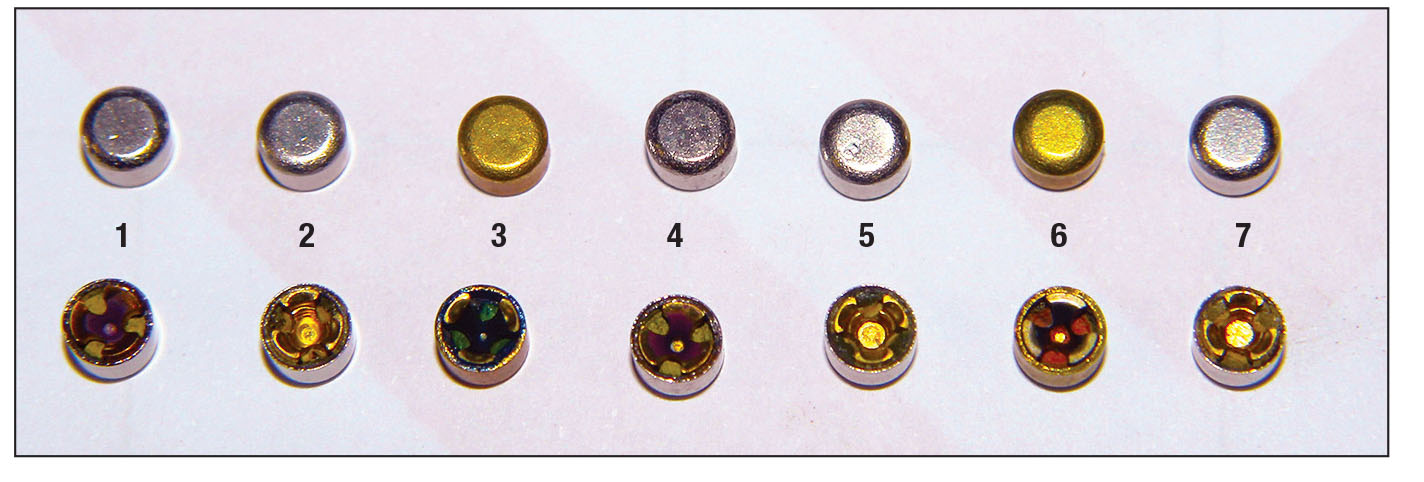
In simple terms, Boxer primers consist of a metal cup (most commonly brass or nickel-plated brass) holding an explosive mixture capped by an anvil. The primer is seated flush inside the primer pocket. The firearm’s firing pin crushes the explosive mixture between cup and anvil, which ignites to send hot gas through the case flash hole and into the contained powder. Centerfire primers require about 40 pounds per square inch (psi) of concentrated pressure (from a firing pin) to initiate ignition, the reason centerfire cartridges can be dropped without fear of detonation.
Standard small pistol primers are used in rounds like the 9mm Luger and 38 Special utilizing smaller charges of faster-burning powders. High-pressure pistol rounds like the 221 Remington Fireball require more robust small rifle primers. Small pistol magnum primers are suited to 10mm Auto and 357 Magnum loads using larger charges of slower-burning pistol powders. Standard large pistol primers pair best with rounds like the 45 ACP, while large pistol magnum primers are recommended for rounds like the 44 Remington Magnum and 50 Action Express burning larger doses of slower-burning powders.
Magnum primers of either size are often used in standard cartridges to help burn through inhibitor coatings found on many ball powders. It is also common to find that a particular cartridge provides lower extreme velocity spreads when a small rifle magnum primer is employed, like in the 22 ARC or 6mm Dasher. I recently came across an interesting statistic revealing that 63 percent of the top-100 nationally-ranked Precision Rifle Series (PRS) shooters chose CCI No. 450 small rifle magnum primers (CCI’s BR-4 and Federal’s GM205M tied for second) in cartridges like the 6mm BR Norma, 6mm Dasher and 6mm GT. Understand a small boost in average chamber pressure is possible, but testing here showed that jump to be minimal to negligible in some cases. We advise you consult primer recommendations found in published load data if uncertain.
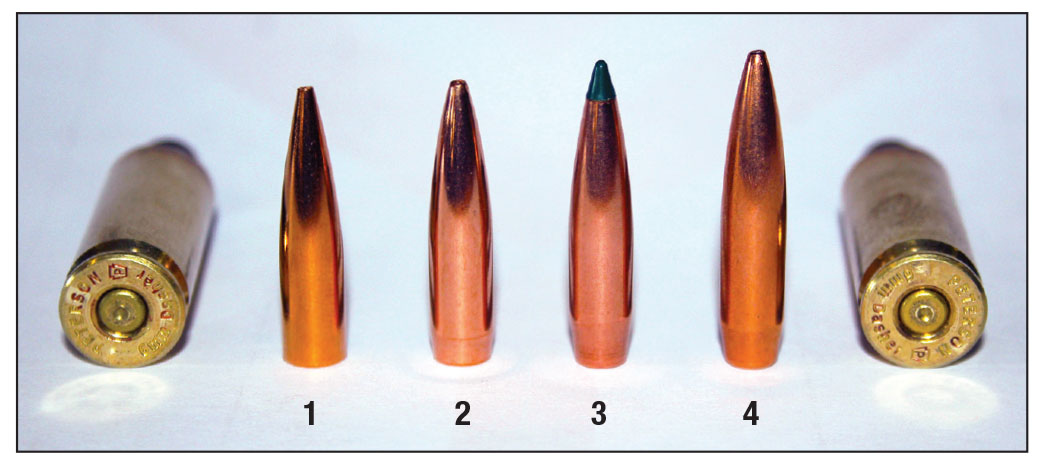
In PRS circles, a recent survey revealed 98 percent of ranked shooters use small rifle primer brass, even in cartridges that may have been introduced with large rifle primer pockets. As an example, after extensive testing, Lapua engineers found small rifle primers offered an accuracy edge in the 6mm Creedmoor, the exception being in very cold temperatures. My 22 Creedmoor groups shrank after adopting small rifle pocket brass, but that might also be attributed to the fact that those top-quality Small Rifle Primer (SRP) brass were manufactured by Peterson Cartridge, as opposed to mass-produced Large Rifle Primer (LRP) pocket factory brass.
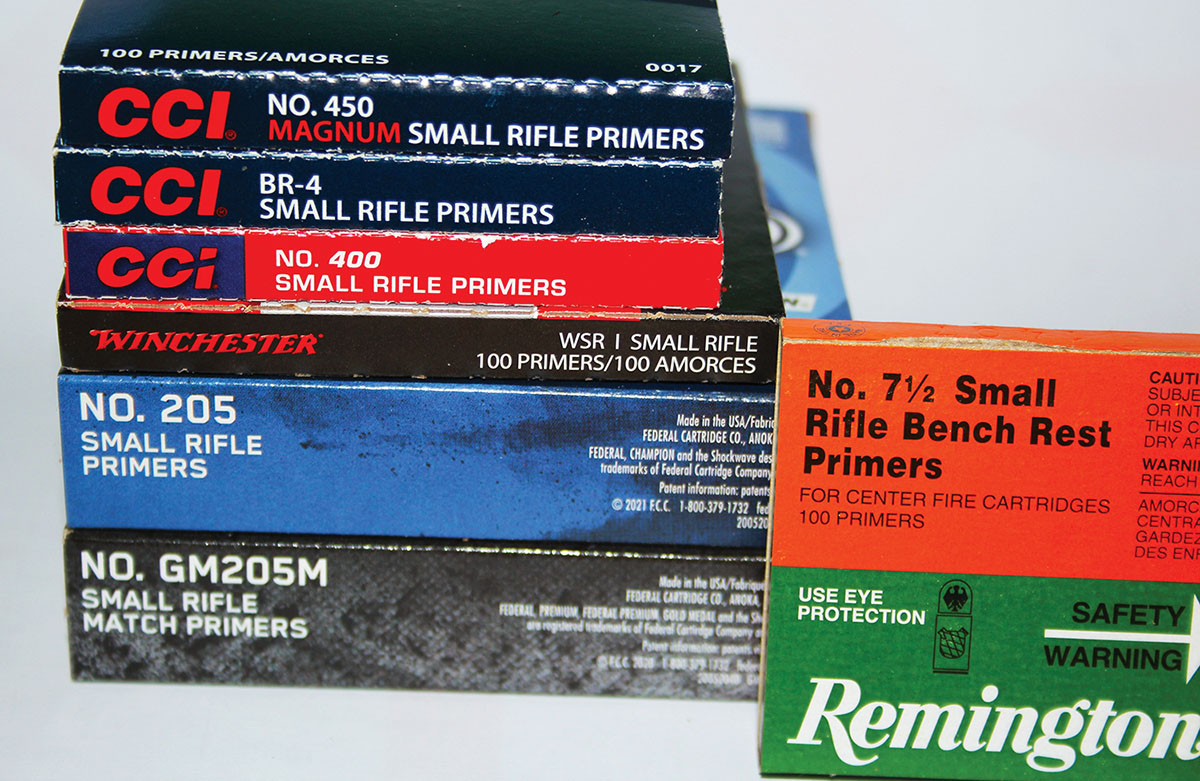
Even in standard offerings, not every primer supplies the same flame intensity, or brisance. This explains why a particular primer usually best synchronizes with a particular case, powder and chamber dynamic. Curious to learn how common primers ranked in brisance, I consulted the internet. The only brisance chart I could locate found on several different forums without attribution listed common primers thusly, hottest to coolest large rifle primers: Federal No. 215, Winchester WLRM, CCI No. 250, Remington No. 91⁄2, Winchester WLR, Federal No. 210, CCI BR-2 and CCI No. 200. Small rifle: CCI No. 450, Remington No. 71⁄2, Winchester WSRM, Winchester WSR, CCI BR-4, CCI No. 400, Federal No. 205, Federal No. 200 and Remington No. 61⁄2.
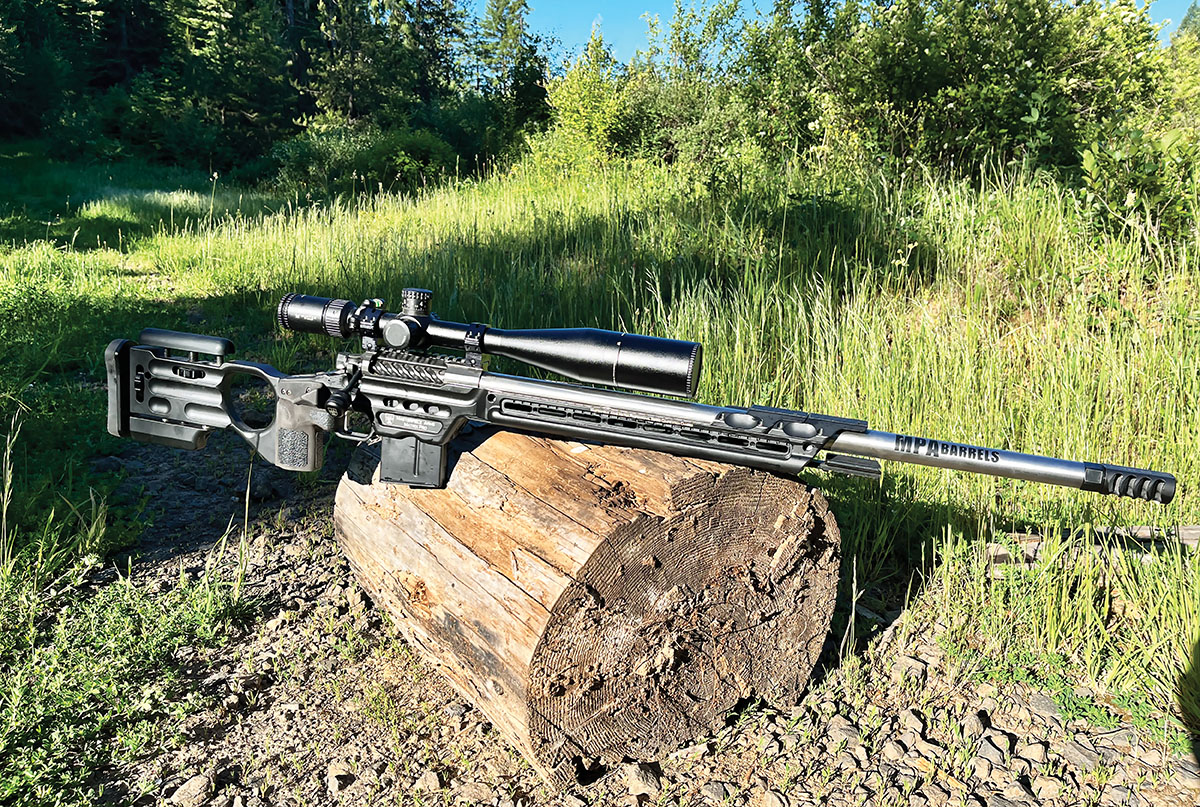
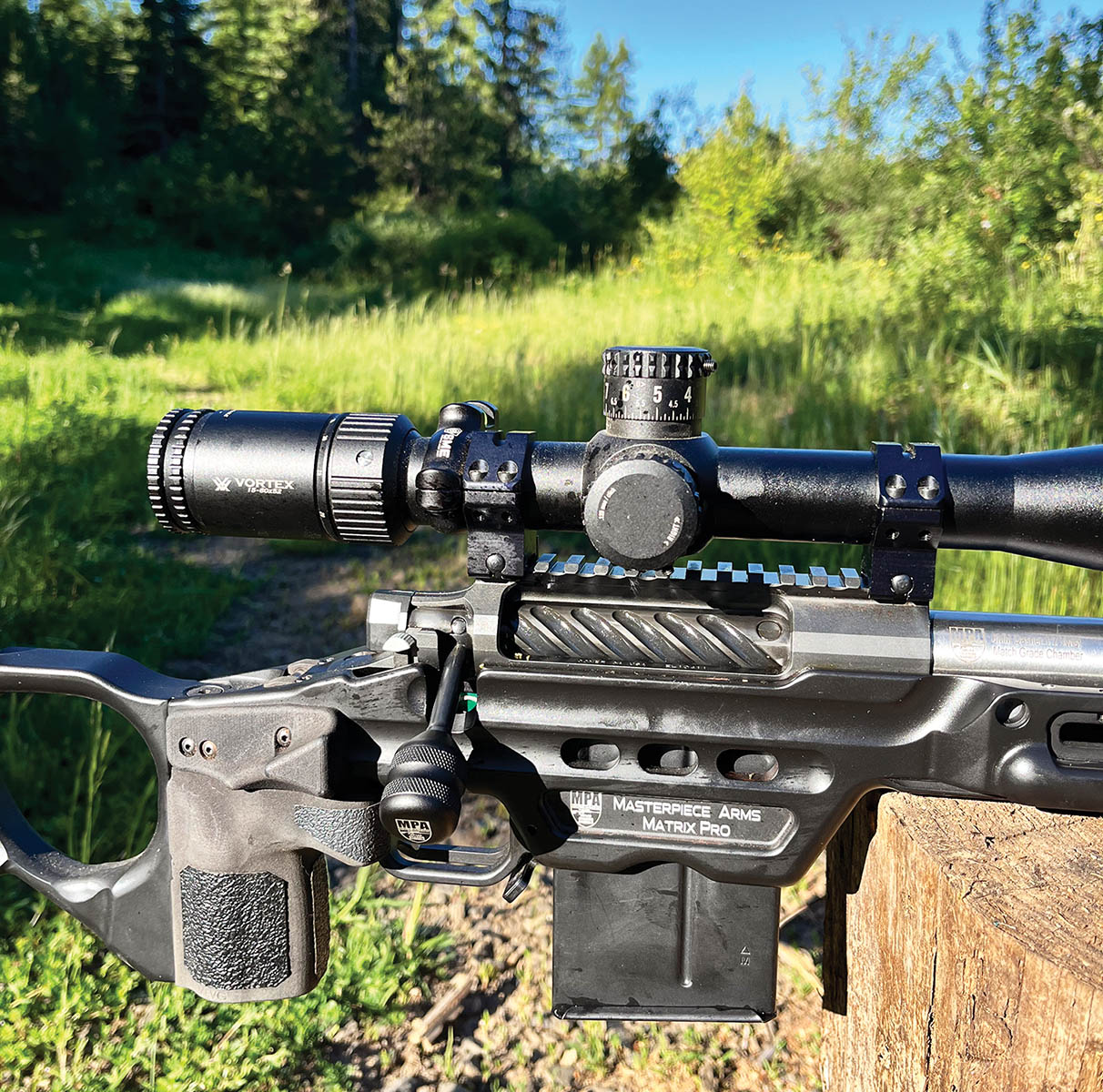
That rifle is Masterpiece Arms’ (MPA) Matrix Pro PMR, designed to meet the 2023 PRS Production Class requirements. It is based on a Matrix Pro II chassis including a V-bedding system. The comb and butt are adjustable for fit (length of pull 12.75 to 14 inches), and the stock includes a
Picatinny rail, Arca Swiss Rail and RAT systems, a built-in inclinometer, Matrix EVG grip and thumb ledge. The action features a three-lug bolt, integral recoil lug and 20 MOA Picatinny rail. The MPA/Spencer barrel is 26 inches long with a 1:7 twist. The heavy match contour tube is cut from 416RQ stainless steel, stress-relieved and hand-lapped before undergoing video bore-scoping and inspection with a Sheffield air gauge to guarantee specifications within .0001-inch. The chamber is indicated within less than .0001-inch of the rifle bore. The chamber was reamed specifically for Peterson’s Cartridge brass, and an MPA DNS muzzle brake is added on 5⁄8x24 threads. The three-piece bolt includes spiral fluting, black nitride coating and a mechanical extractor. The trigger is a Bix’n Andy TacSport Pro with a 1-pound break. It feeds from a 10-round Accurate-Mag magazine. MPA guarantees 1⁄2-inch accuracy.
For an optic, I chose all the power at my disposal: Vortex Optics’ 15-16x 52mm Golden Eagle HD mounted in quality four-screw rings. It was designed for F-Class and Benchrest shooting and includes good resolution and an ultra-fine second focal plane ECR-1 MOA reticle. It allows aiming at a center dot, not just center mass on an overall bullseye. It holds exposed turrets with precision 1⁄8-inch movements, allowing 55 MOA of elevation and 45 MOA of windage corrections inside a trim 30mm tube. It weighs 29.7 ounces and measures 16.1 inches long. With the addition of this powerful scope, the rifle’s finished weight is 18.74 pounds.
The rifle is chambered in one of the most inherently accurate cartridges in the long-range benchrest world, the 6mm Dasher. The Dasher holds a number of 600- and 1,000-yard world records, so the inherent label is apt. To further accentuate accuracy and eliminate one more accuracy variable, test loads were assembled using world-class Peterson Cartridge brass. Peterson cases hold small rifle primer pockets with .060-inch flash holes requiring a slim de-capping pin. Dimensions are based on specs found in Sierra, Berger, and Lyman handloading manuals – SAMMI (Sporting Arms and Ammunition Manufacturers’ Institute) offers no approved drawings. They include .0013-inch-thick neck walls requiring no turning, 1.53-inch overall length, plus proper headstamps and harder heads than most brands.
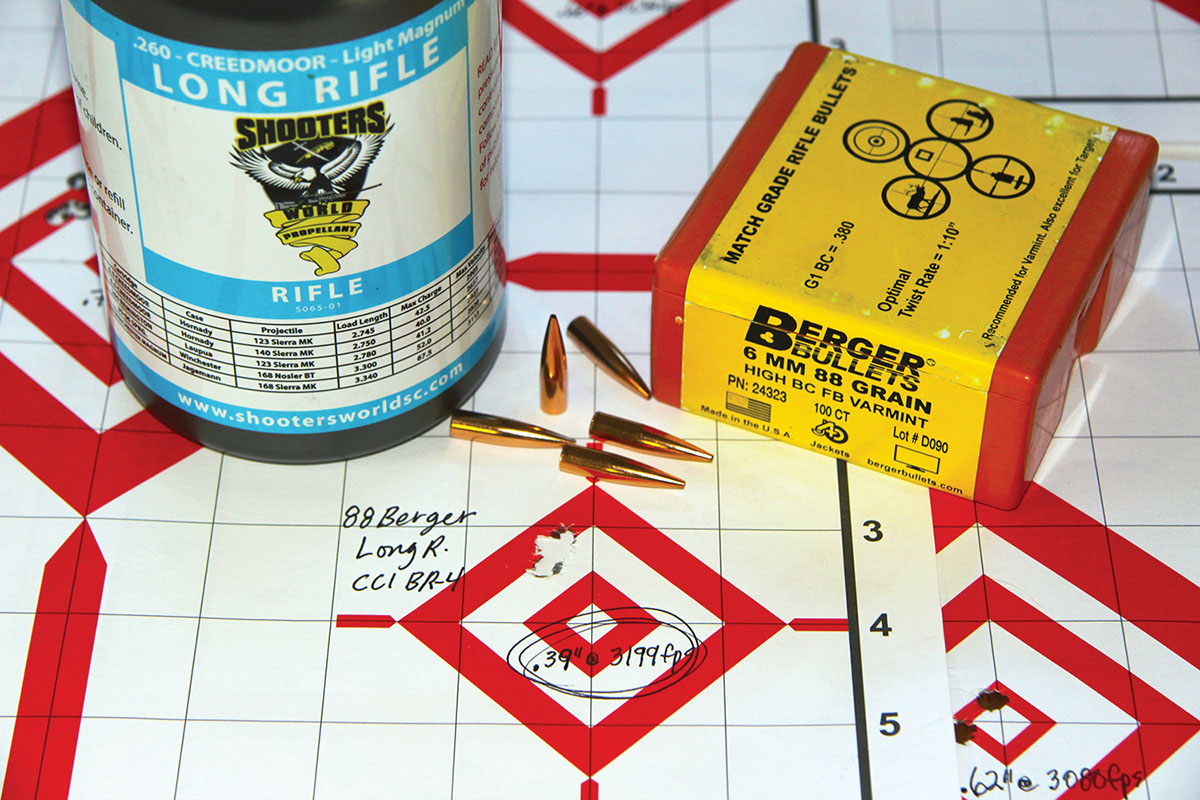
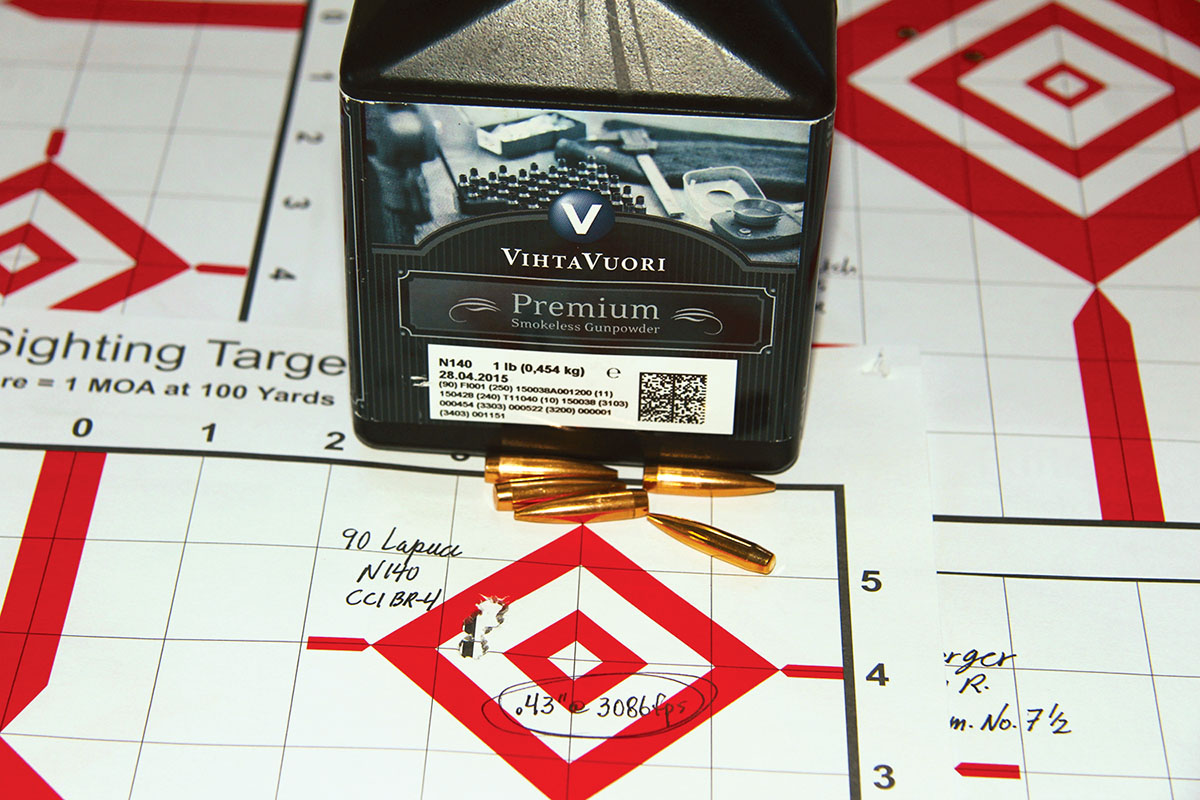
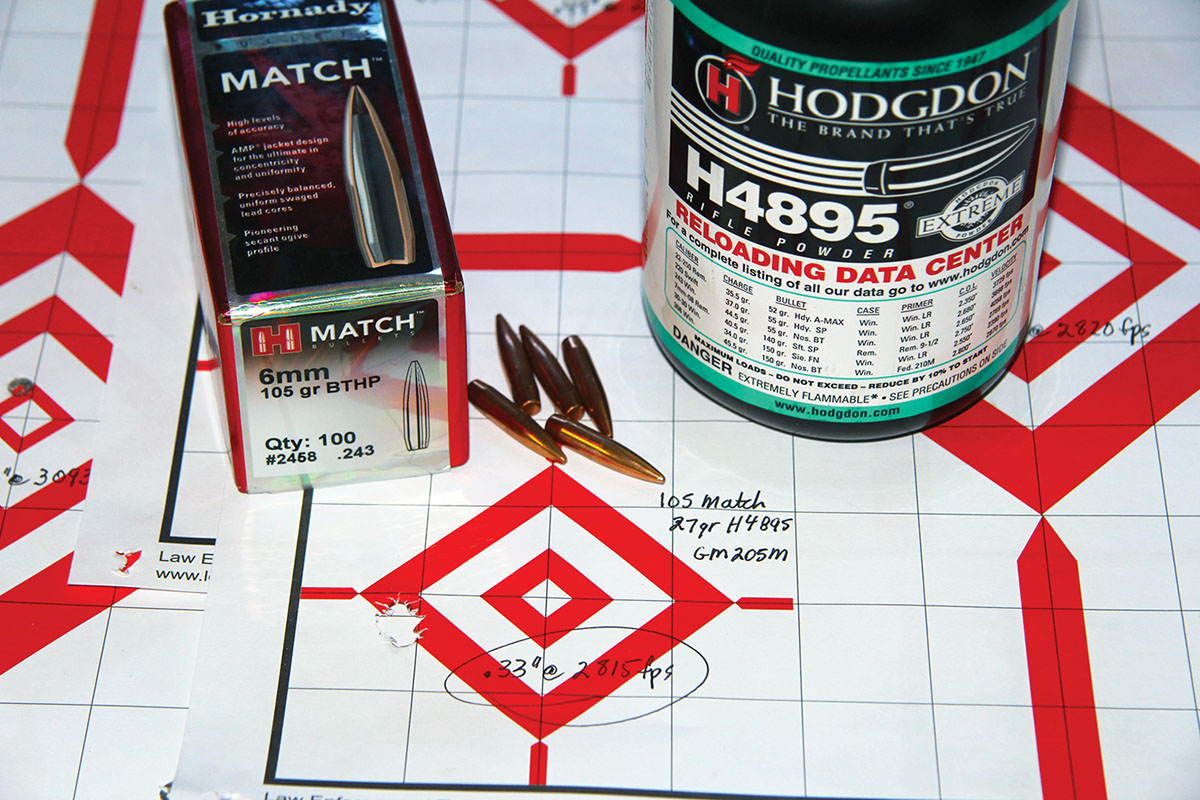
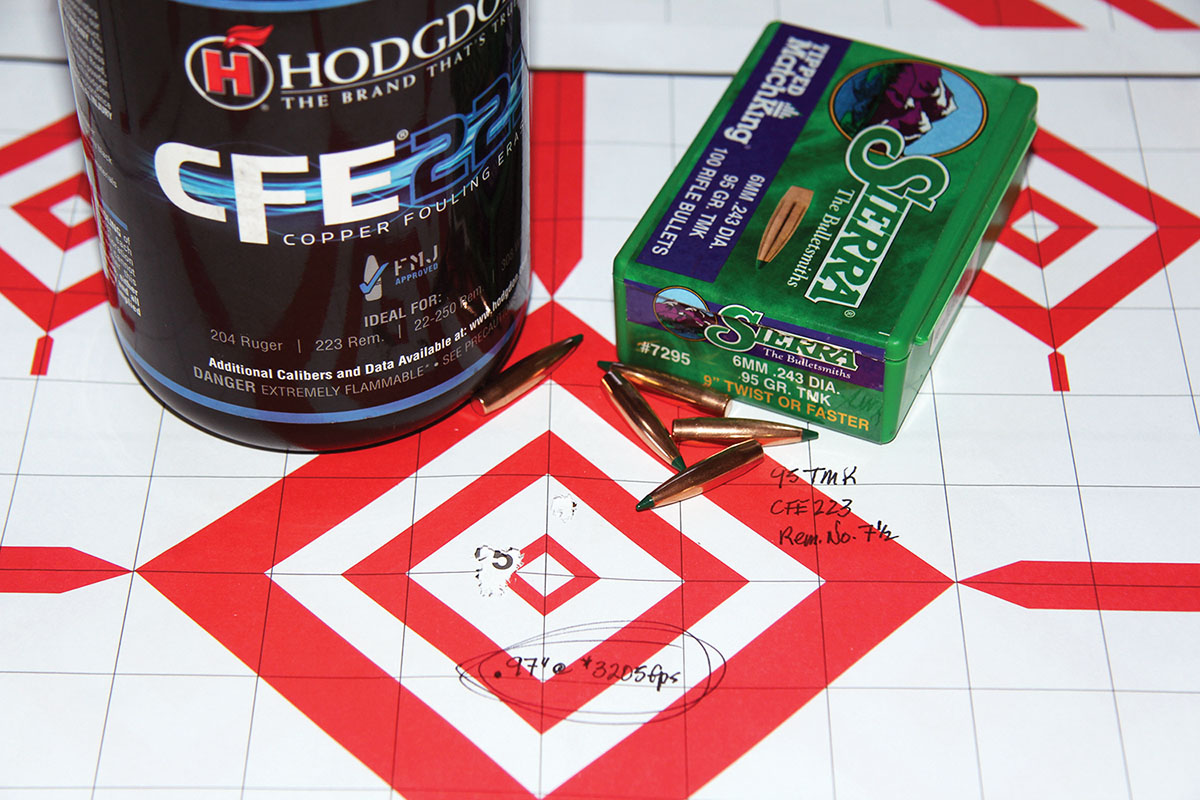
For dies, I also chose the best: a Redding Series D Deluxe Die Set. This set includes both full-length and neck-sizing dies. A 6mm Free Floating Carbide Button Kit and Redding Micrometer head were added. For base loads, I chose four recipes that have provided small groups in past tests. This included combinations of Berger’s 88-grain High BC FB Varmint and 34.5 grains Shooters World Long Rifle; Lapua’s 90-grain Scenar-L and 30 grains Vihtavuori N140; Sierra’s 95-grain Tipped MatchKing and 33.5 grains Hodgdon CFE 223 and Hornady’s 105-grain BTHP Match and 27 grains Hodgdon 4895. Five-shot instead of three-shot groups were fired to further distinguish accuracy results.
One expects groups to grow when shooting five- instead of three-shot groups, but other factors conspired to wreak havoc on results. During the single day available to me for shooting (a looming deadline, active bear baits and visiting friends had me pressed for time), winds gusted wildly from 10 to 15 miles per hour (mph). Also, temperatures climbed into the mid-80s, instead of the much cooler weather original loads were developed in – which may or may not have factored… Finally, I’d been forced to bump brass shoulders while loading, as the last time I shot this rifle, cases (which had only been neck sized to this point) were chambering quite tightly. Whatever the case, this rifle is certainly capable of greater accuracy than demonstrated in this test series.
Given the brisance ratings for each primer example, I expected a somewhat linear progression of slight velocity gains as we moved through the various examples. This did not occur with the 88-grain Berger or 105-grain Hornady – some of the hottest primers actually showing lower muzzle velocities. The 90-grain Lapua remained relatively stable until the two hottest primers – the 95-grain Sierra showing substantial velocity gains with the Remington No. 71⁄2 and CCI No. 450 examples. It’s safe to say that benchrest/match primers are worth the added cost, the CCI BR-4 and Remington No. 71⁄2 giving the tightest groups with the Berger, Federal’s GM205M, CCI’s BR-4 and Remington’s No. 71⁄2 producing the smallest Lapua groups and Federal’s GM205M and CCI BR-4 tops with the 105-grain bullet. The Sierra and Hodgdon CFE 223 combination shot poorly enough under testing conditions that results were somewhat inconclusive, though Remington’s No. 71⁄2 resulted in the only sub-1-MOA group with that bullet. Surprisingly, given PRS shooter preferences, CCI No. 450 primers did not win any accuracy accolades with the first three bullets, but did come through with the 105-grain slug.
It is safe to say that primers do matter, but which primer works best with what powder, case and charge is still something that requires old-fashioned trial-and-error experimentation.
.jpg)