I love the state of Alaska and had I known what I know now at a much younger age, what you are about to read would likely have been written there rather than here. Even though I have never lived in that great land, I have been fortunate to hunt there on numerous occasions. Long before my first Alaskan hunt, though, I read everything I could get my hands on about the state, and it all started when I was attending the 8th grade in school. Back in those days, everybody who was anybody in my little hometown hunted, and those who did not either had no objection to it or, if they did, they kept quiet for fear of being run out of the county.
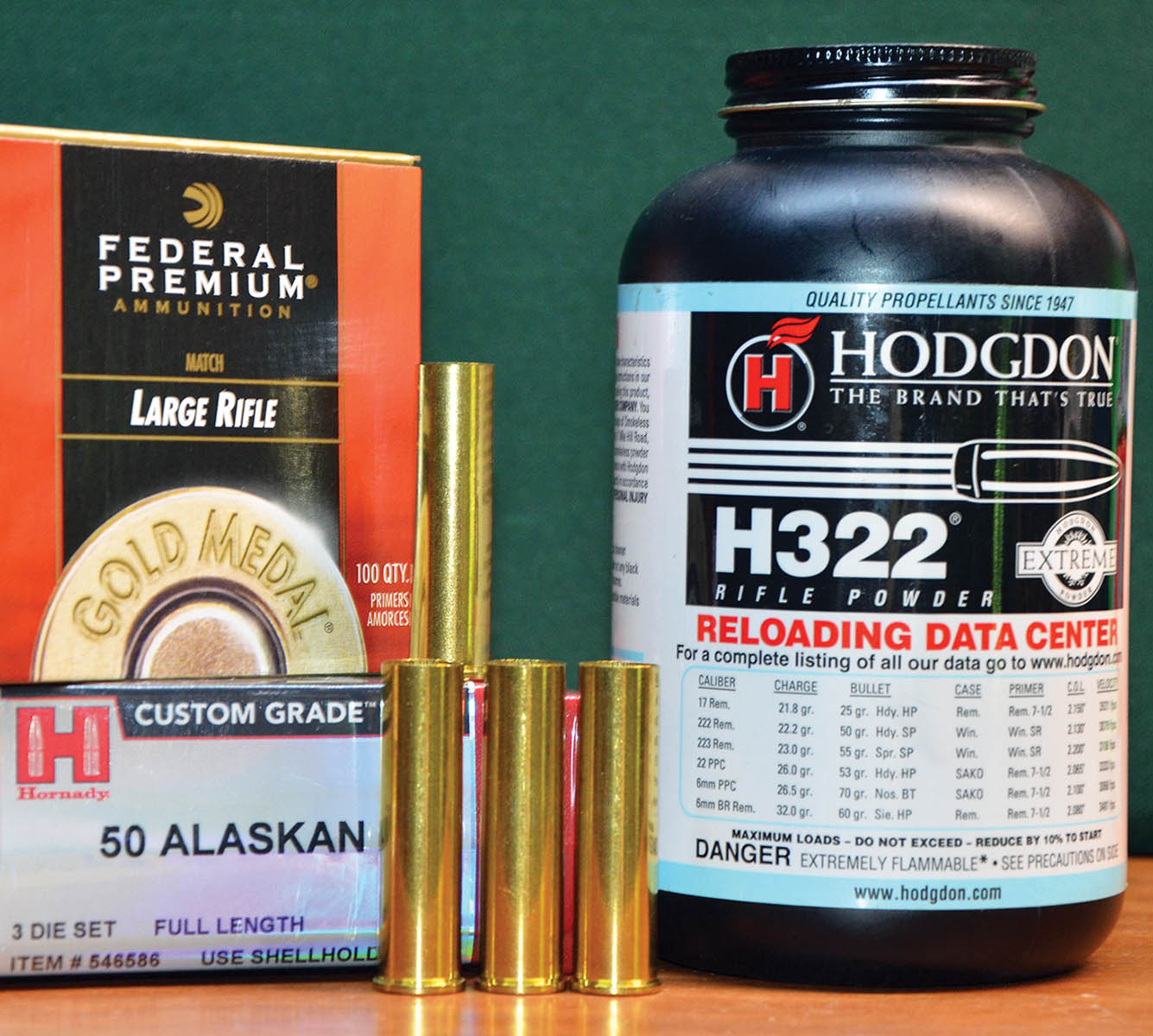
The 50 Alaskan cases made by Starline are top-drawer in quality. The Federal 210 primer does a good job of igniting H-322 and other relatively quick-burn rifle powders suitable for use in the cartridge. Reloading dies made by Hornady are usually available at Graf & Sons.
The library at the school I attended received copies
of various magazines such as Life, Popular Science, and National Geographic. Many folks nowadays will find this hard to believe, but a school library used by kids also received and displayed Outdoor Life and Field & Stream, and both contained wonderful stories about people who headed to the woods in pursuit of deer, bear, elk and other animals for sport. Back then, they even published photos of dead animals! Like all the other kids who hunted, I knew exactly when each magazine was to arrive each month, so it was always a race to see who got there first. We literally devoured everything in each and every one of them. One of the stories I read told about Harold Johnson, a gunsmith who had a shop in Cooper Landing, Alaska called “Johnson’s Kenai Rifles.” Rifles were built on one end of the building while the other end offered marine supplies, ice cream, hamburgers and soft drinks. Lever-action rifles such as the Winchester 86 in 45-70 and the Winchester 71 in 348 Winchester were quite popular among hunting guides there, so Johnson, who also guided, necked up the 348 Winchester case to .45 caliber, blew it out to a bit greater capacity than that of the 458 Winchester Magnum and called it the 450 Alaskan. The ad he ran in American Rifleman offered a complete rifle in 450 Alaskan on a new Model 71 action for $185 or on the customer’s action for $85. Sometime later, Johnson traded for a Model 86 in 50-110 Winchester with a rusted-out barrel. A barrel for that cartridge has the same .510-inch
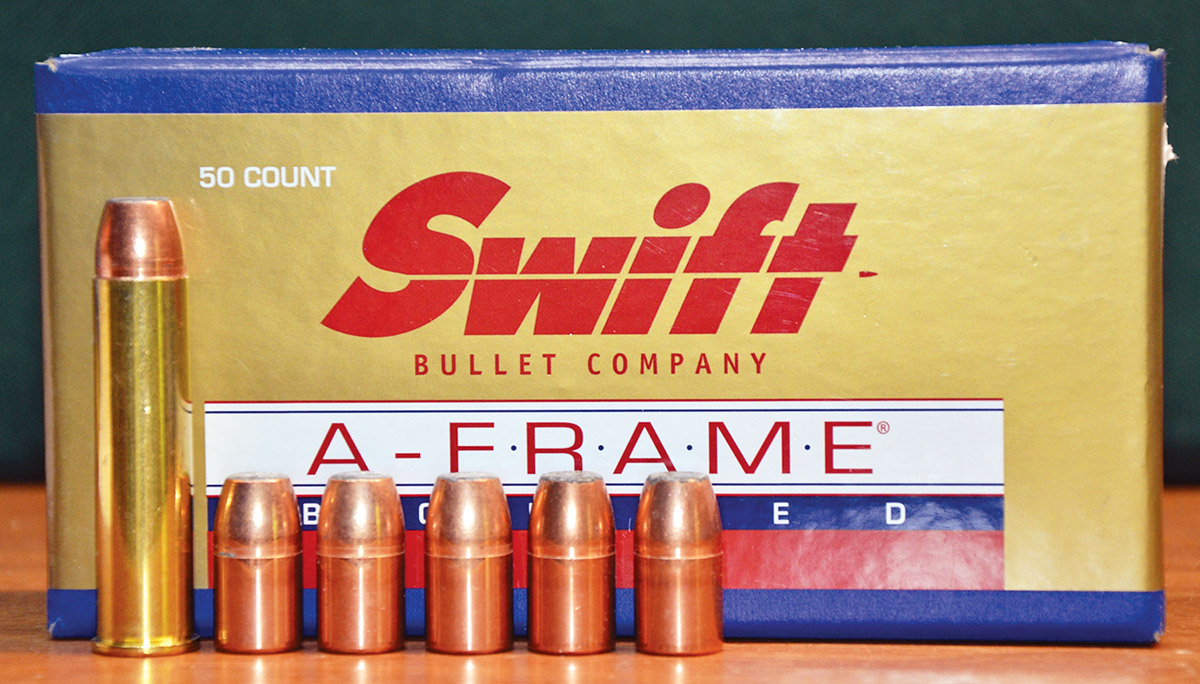
The Swift 450-grain A-Frame bullet will do a good job of handling all game ranging from whitetail deer to the biggest brown bear making tracks on an Alaskan alder thicket.
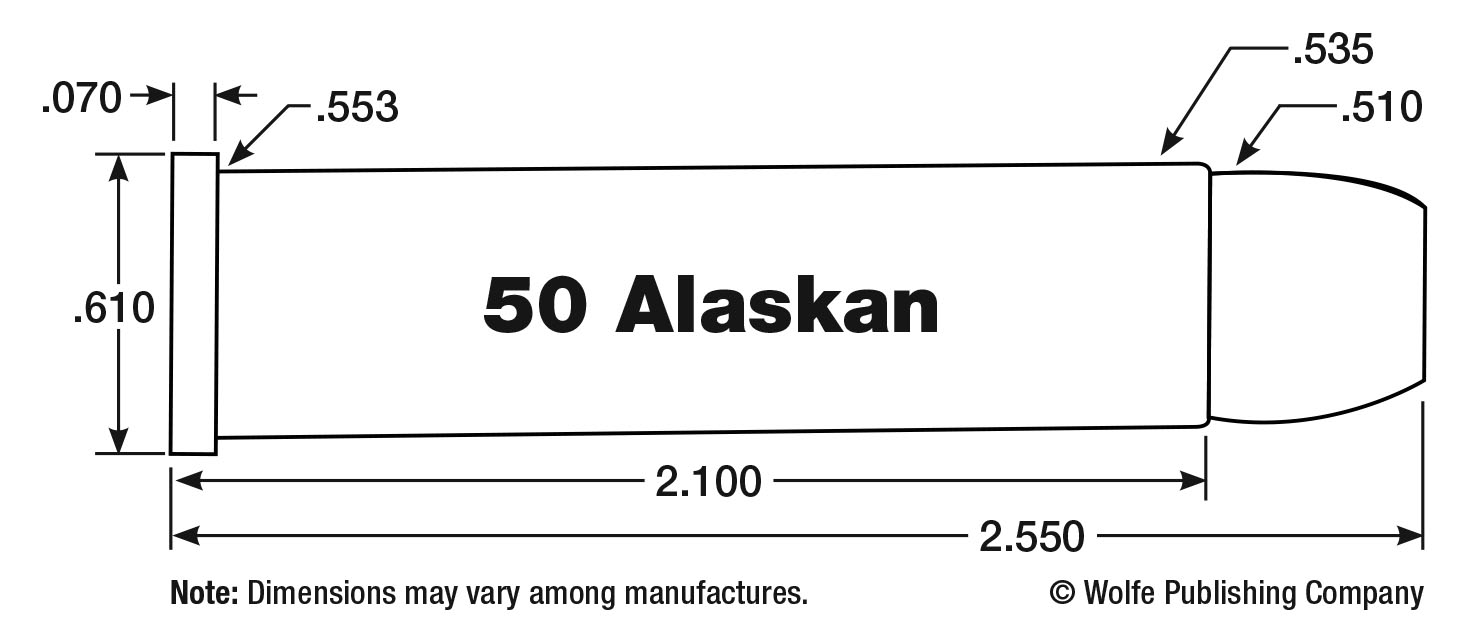
groove diameter as one in 50 BMG, and soon after buying one of those barrels on the military surplus market, Bill Fuller, who worked for Johnson at the time, whittled it down and fitted it to the Winchester 86 action. However, rather than chamber it for the 50-110 cartridge, Johnson instructed Fuller to ream the chamber for the 348 Winchester case necked up to .50 caliber – and so the 50 Alaskan was born.
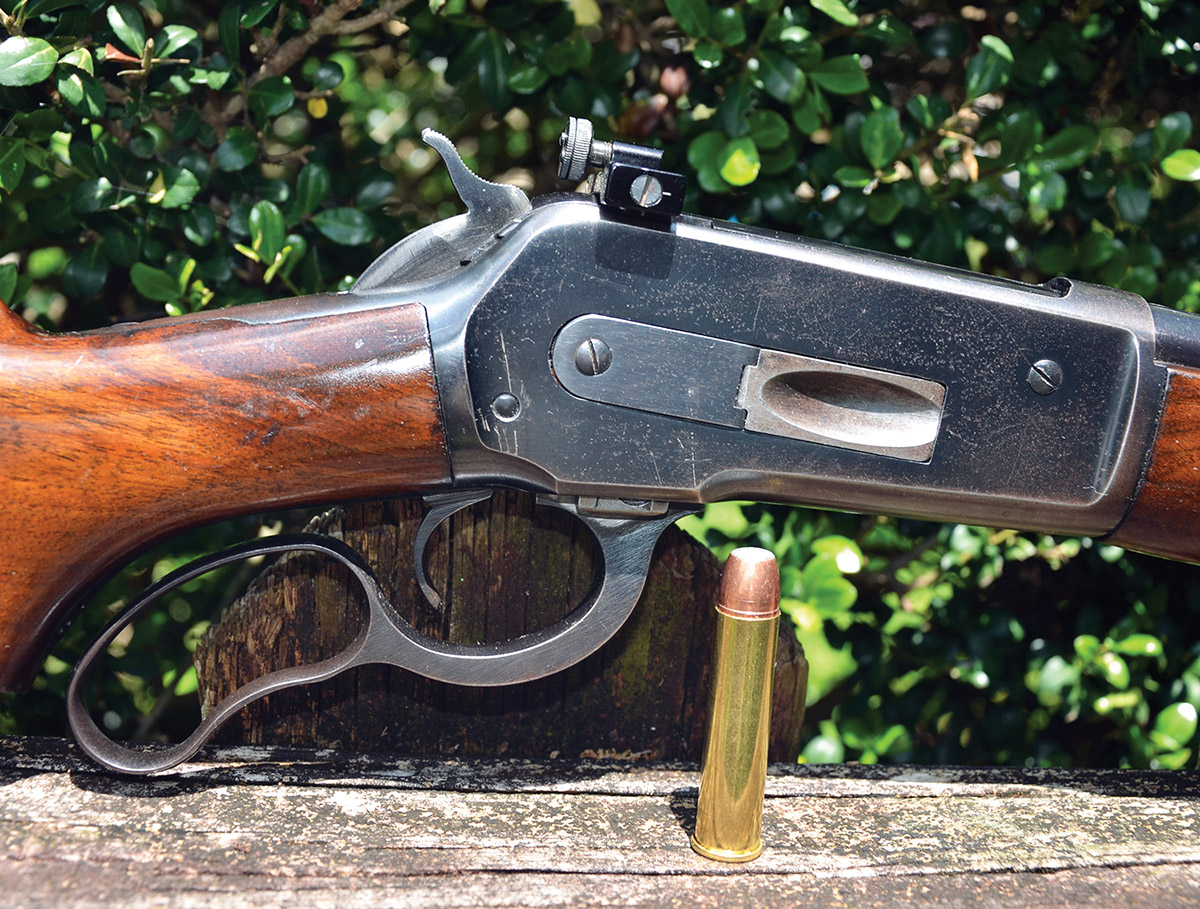
Rebarreled by Harry Gowen, the 22-inch barrel of Layne’s Winchester Model 71 has a 1:20 twist. The rifle weighs 9.25 pounds.
The first bullets loaded in the cartridge were made by shortening 750-grain BMG bullets and seating them boat-tail forward in the case. Stem-to-stern penetration of the biggest brown bear was claimed, and it was surely no brag. A 400-grain softnose bullet made by Fred Barnes at the time was later also used. Behind that bullet, Johnson loaded 51.5 grains of IMR-4198 for an estimated velocity of 2,100 feet per second (fps). During my 2018 email exchange with Harold Johnson’s son, Jeff, he mentioned that the original rifle in 50 Alaskan built by his father was still in the family. He did not know how many were built after it.
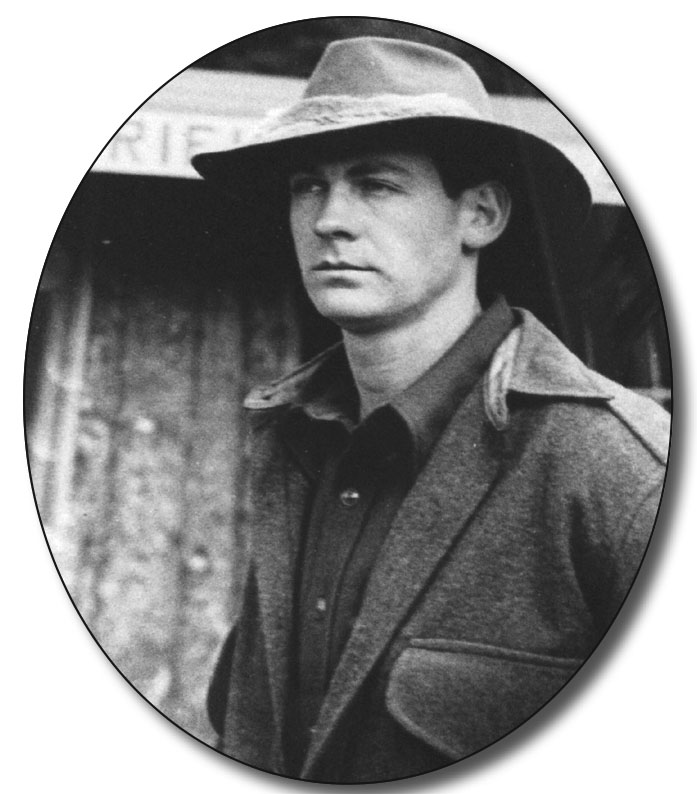
Harold Johnson, shown here in front of his shop, moved to Cooper Landing, Alaska in 1941. While gunsmithing was his primary occupation, he also guided other hunters for brown bear in the alder thickets of coastal Alaska. After building several rifles in 450 Alaskan, he decided that if a big bullet was good for stopping a wounded bear, an even bigger bullet would likely be better.
A number of rifles in 450 and 50 Alaskan were built by SSK Industries
while the company was owned by long-time friend J.D. Jones. Most of those rifles were on Marlin 1895 actions, although Japanese-built Browning 71 and Ruger No. 1 actions were used as well. SSK also 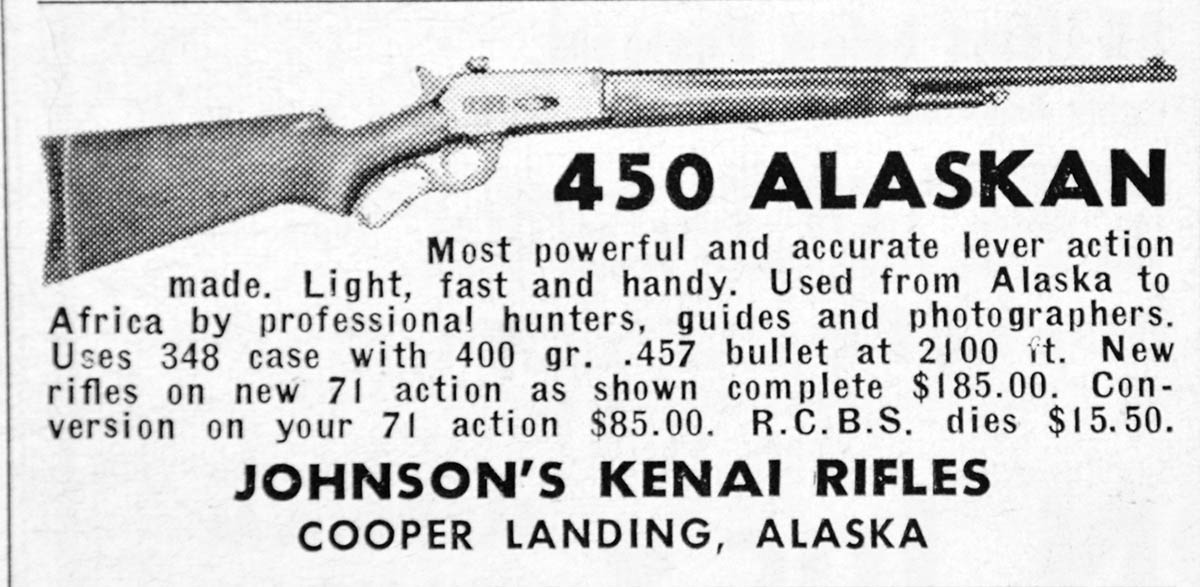
Rebarreled by Harry Gowen, the 22-inch barrel of Layne’s Winchester Model 71 has a 1:20 twist. The rifle weighs 9.25 pounds.
Harry McGowen, who had a barrel-making shop in St. Anne, Illinois, built rifles in 450 Alaskan and 50 Alaskan for over 40 years. He averaged building a dozen or so annually, with most chambered for the 450 Alaskan. In addition to the Winchester and Browning Model 71 rifles, McGowen converted the Marlin New Model 1895 and military surplus Siamese Mausers. My Winchester 71 in 50 Alaskan has one of his 22-inch barrels with a 1:20 rifling twist rate. Muzzle diameter is .800 inch, and the rifle weighs 9.25 pounds with a Williams Foolproof
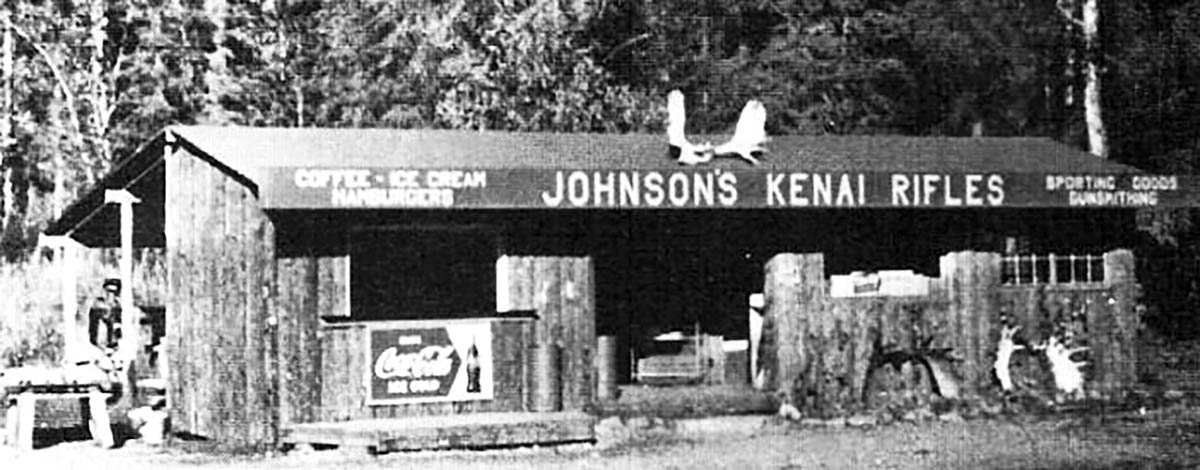
While rifles were being built in one end of this building, everything from marine supplies to ice cream and hamburgers were sold in the other end.
receiver sight. McGowen told me that he converted far more Marlin 1895 rifles because the Winchester Model 71 was more expensive and not as easy to find.
I have no idea how many rifles in 50 Alaskan have been built since the cartridge was introduced by Harold Johnson during the 1950s, but enough are out there for Starline to continue making the unprimed cases. In addition to eliminating the chore of necking up and fireforming scarce 348 Winchester brass, the Starline cases are top-drawer in quality and a small supply will last for more firings than owners of rifles chambered for the cartridge will likely shoot in a lifetime. Due to the extremely high expansion ratio of the 50 Alaskan, relatively quick-burn rifle powders such as H-4198, H-322 and Benchmark should be used. As bullets go, the Swift 450-grain A-Frame should nicely handle all game ranging in size from whitetail deer to the biggest brown bear making tracks in an Alaskan alder thicket. By no means a long-distance cartridge, zeroed dead on at 50 yards, its bullet strikes close to a foot low at three times that distance. Reloading dies made by Hornady are usually available at Graf & Sons.