

Propellant Profiles
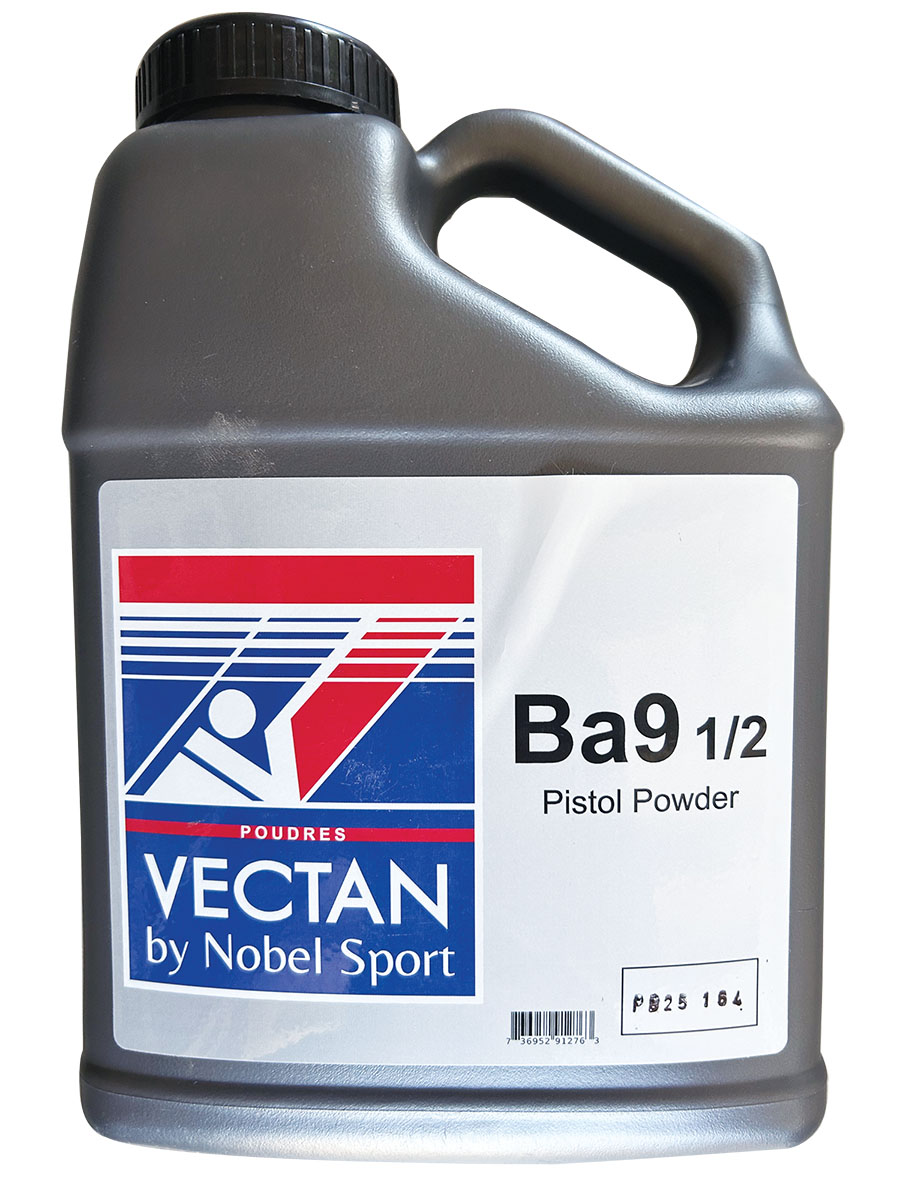
Nobel Sport VECTAN Ba9 1/2
column By: Rob Behr | October, 26
Nobel Sport Vectan Ba9 1⁄2 is a fast-burning pistol powder. The company’s line of single-base powders begins with Vectan Ba10, with a burn rate approximating Alliant Bullseye, and ends with Ba6 1⁄2, which has a burn rate similar to Hodgdon H-110. By way of comparison, the company’s burn-rate chart suggests that Ba9 1⁄2 is close to Accurate Solo 1000 and Vihtavuori N320.
Loading with Fast-Burning Pistol Powders: A Cautionary Tale
I had a cup of coffee on the bench while I was loading the first 357 Magnum for this test. I had carelessly placed it in Penny’s ballistic path to her blanket. She jumped up onto the bench and encountered my mostly full coffee cup, creating what can fairly be called a distraction. After cleaning up and getting a fresh cup of coffee, I made a powder throw into the 357 case. Upon examination, I took the time to note in my log that Ba9 1⁄2 had filled the case extremely well. I wrote it off the BA9 1⁄2’s very low bulk density of .595g/cc. I loaded the next one and again checked the case fill. This case was less than half full. This is because the second case had 7 grains of BA9 1⁄2 and the first had 14. I had double-charged the case during the cat-induced mayhem. I am sentimentally attached to my Ruger Security Six and thankful that I did not test the outer limits of its strength. It probably would have blown. Always, especially when working with very fast-burning powders, visually check each individual charge. It’s a quick step that protects your firearms and your anatomy.
Physical Characteristics
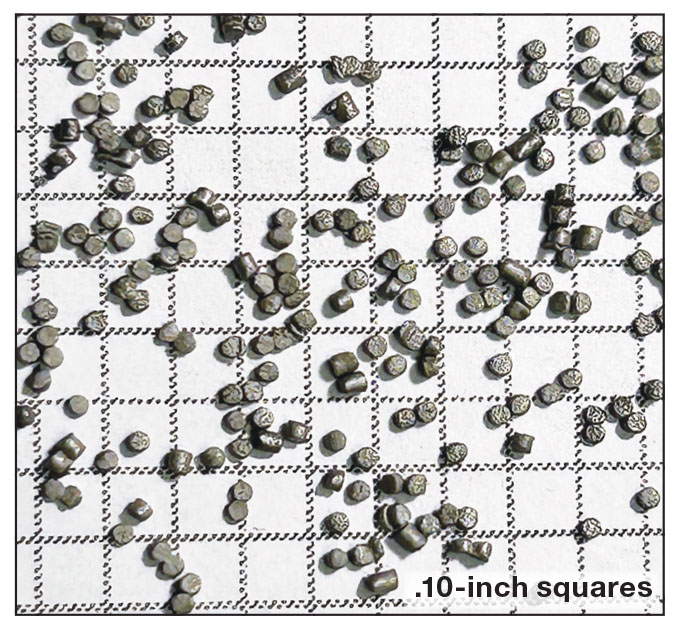
The characteristic that really stands out in BA9 1⁄2 is the uniformity and size of the propellant’s individual grains. This is a hallmark of Nobel Sport manufacturing. According to the company’s literature, all of the Ba powders use the same geometry. This geometry, like most single-base propellants, is cylindrical with most of the grains measuring approximately .025 inch in diameter and .035 inch in length. The grains are universally light grey with no reflective surfaces.
Temperature Stability Testing
Single-base propellants usually handle temperature extremes very well. BA9 1⁄2 was no exception. Test conditions were perfect at the range with a slight breeze and an ambient temperature of 70 degrees Fahrenheit. The frozen cartridges steamed when I took them out of the insulated mug that had been wrapped in one of my sweaters for the trip to the range. The average velocity for these frozen rounds was 1,063 feet per second (fps). The hot rounds that had stewed away in my sous vide overnight at 120 degrees in another insulated mug produced 1,070 fps. A velocity shift of .66 percent over a test range of 142 degrees is extraordinary performance.
Powder Positional Testing
Powder migration within the cartridge can cause significant changes in pressure. This is especially true when minimum charges are used in large-capacity cartridges set to low maximum pressures, such as the 38 Special or 45 Colt.
Nobel Sport’s data provided a load for the 45 Colt that called for a minimum charge of 6.3 grains of BA9 1⁄2 and a 250-grain bullet. Using that load, I loaded 15 rounds and broke them into three test groups. The first were shot by orienting the powder so that it was lying uniformly along the bottom of the cartridge. That sounds tougher than it is. I simply held the revolver level and gently shook it from side to side. These five rounds produced an average velocity of 602 fps.
The next five were shot after briskly shaking the revolver with the muzzle pointing downward and then raising it to eye level. This orients the powder toward the bullet and typically produces the least velocity in cartridges where there is enough room for powder migration. The average velocity dropped to 542 fps.
The third batch was tested with the powder oriented toward the primer and produced an average of 668 fps. A spread of 126 fps between the two orientation extremes is notable, but not as high as I had expected. I had considered that this load combination might produce a stuck bullet.
In real-world shooting (where a handgun is carried in a holster in a muzzle-down orientation and raised to eye level to shoot) it places more emphasis on the velocity relationship between the intermediate powder position and powder oriented toward the bullet. In that test, only 60 fps were lost, which equates to about a 10 percent velocity shift. This is due, at least in part, to BA9 1⁄2 low bulk density. If I were a cowboy action shooter, I would see if Shooters World had any of this French-made powder in stock.
The Takeaway
This propellant, just like Vectan’s slower-burning Ba9, impressed me. I skipped testing the 44 Magnum, although Nobel Sport did provide data for that cartridge, but I did test the 44 Special. I had honestly forgotten how much fun an accurate 44 Special could be. Everything else I tested shot well, and they cleaned up easily when I was done. The 44 Special loads really stood out.
.jpg)