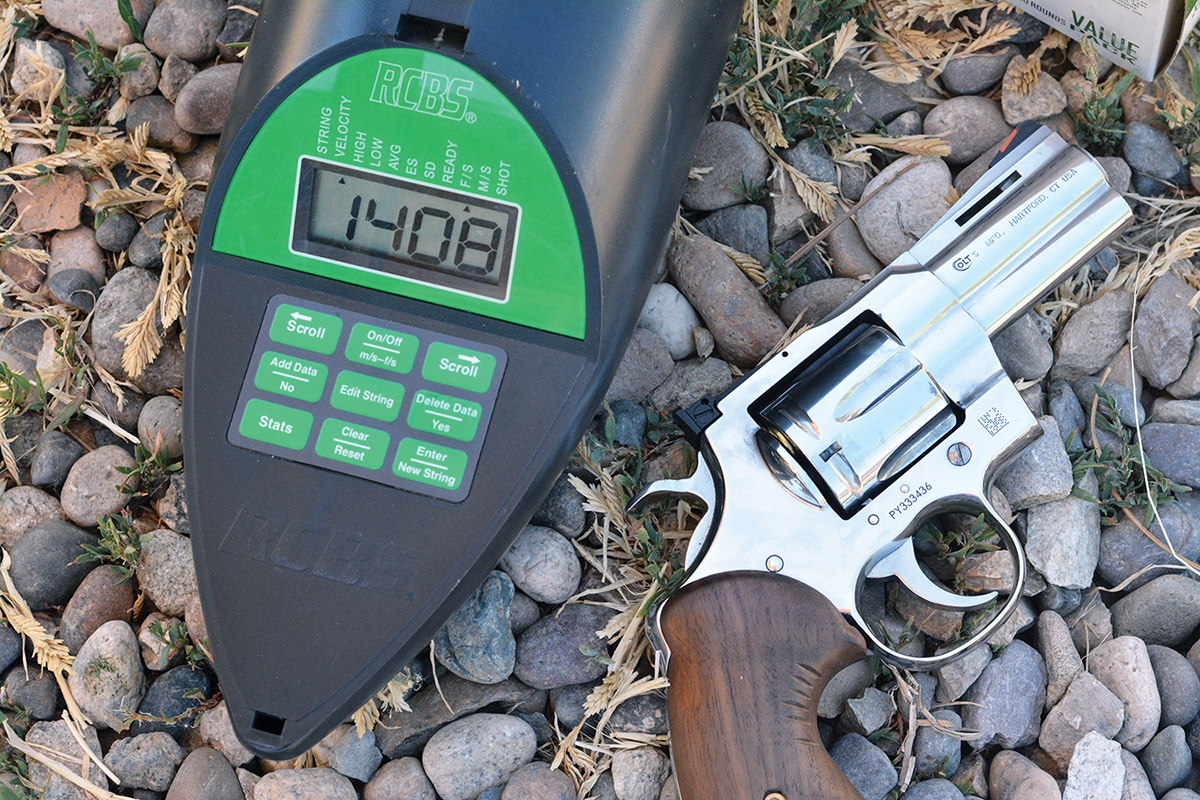
Factory ammunition and Handloads were checked for velocity and accuracy.
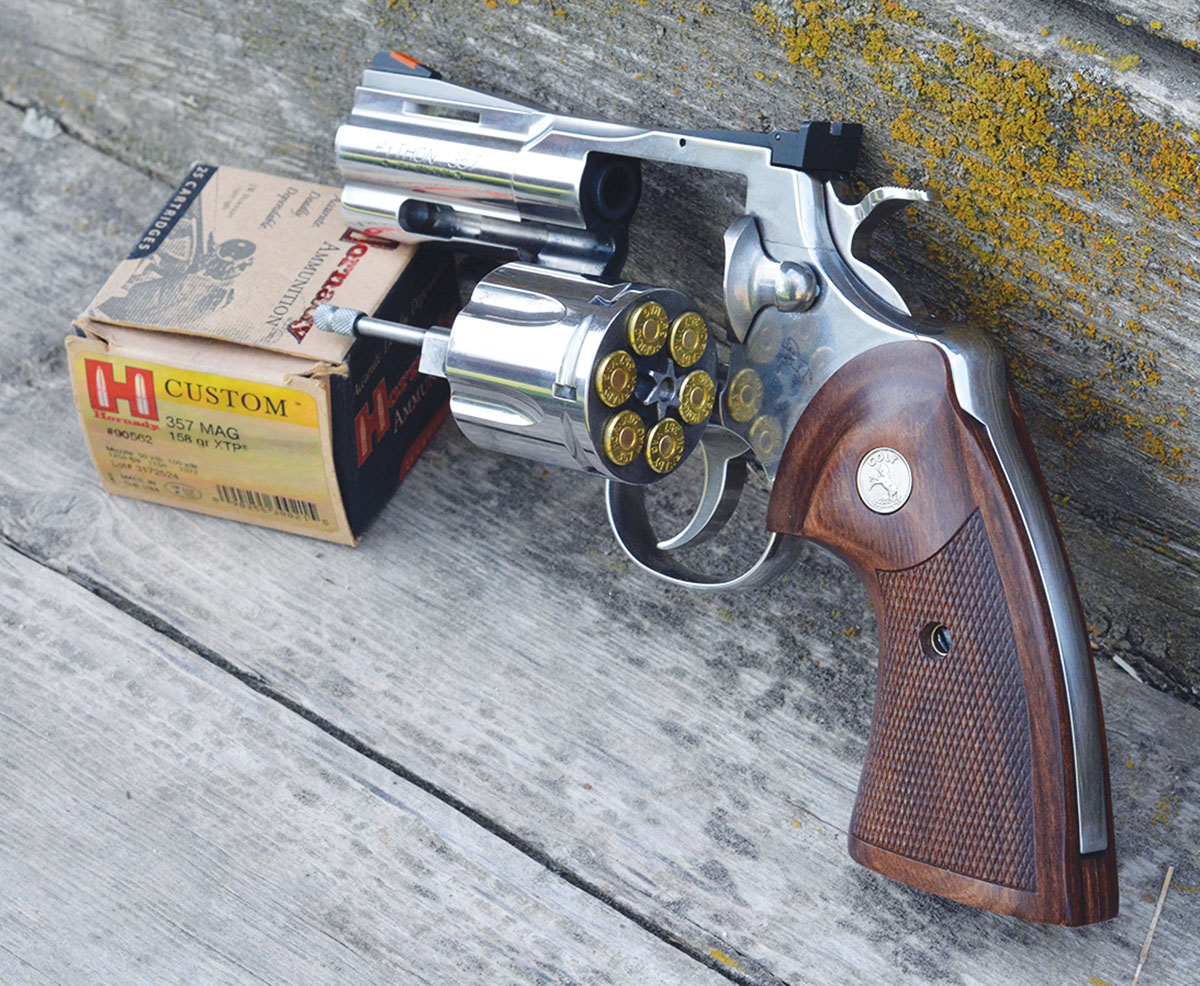
There has been a resurgence of interest in sixguns, and the Python is enjoying brisk sales.
During the post World War II era, Colt further developed their I-frame (aka 41 frame) sixgun, or perhaps what is better known as the Colt Officers Model second model. Originally introduced in 1908, it boasted of New Service style updates with clockwise cylinder rotation and improved cylinder locking system. This gun was generally chambered in 38 Special and earned a top reputation for its overall quality and outstanding accuracy as it dominated in period slow-fire handgun matches. Engineering changes and improved metallurgy were needed for that gun to be chambered for the powerful, high-pressure 357 Magnum cartridge
that became in high demand beginning in 1935 and remains so today. In addition to a thicker top strap, the front of the frame was lengthened to gain strength and durability, the finest “machine gun” steel was employed, and the firing pin was changed from being hammer-mounted to frame-mounted to better control the primer flow associated with 357 ammunition. The first I-frame to be chambered in 357 Magnum was the “Colt .357” (aka as THE THREE-FIFTY-SEVEN) in 1953, and was soon produced simultaneously with the Trooper Model for marketing reasons to law enforcement, etc. Both guns featured a round tapered barrel available in 4- or 6-inch lengths, a fully adjustable Accro rear sight, and a ramp front sight. Guns were shipped with target and service style stocks and with standard and wide hammer spurs. Retail price was $89.50.
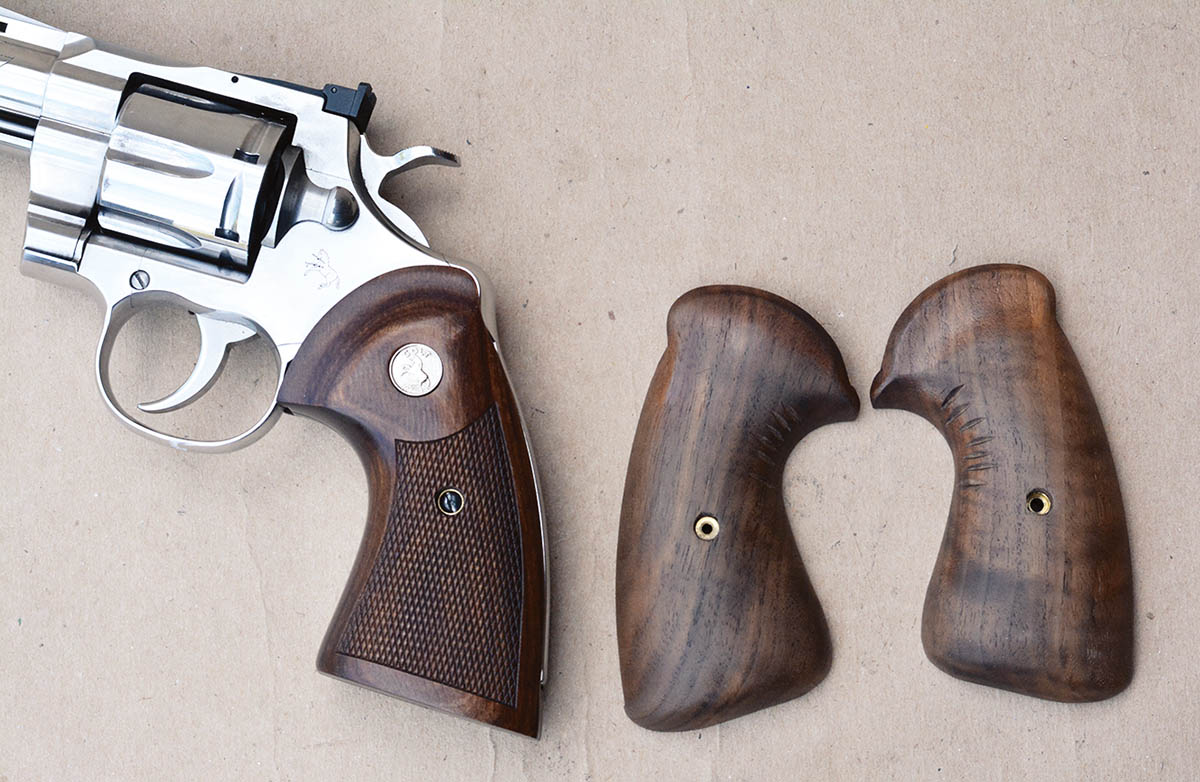
The new Python factory stocks follow the contour of the original Python; however, Herrett’s stocks were installed during most shooting sessions, which significantly improved comfort.
Sales were strong, and Colt immediately began working on a deluxe version of the I-frame called the
Python that was officially introduced in 1955. In addition to a higher level of hand-polished work that resulted in a handsome deep blue finish, the factory workman performed action jobs for a super smooth double-action pull and a lightweight, crisp single-action pull. The Python was indeed a factory-produced, semi-custom six-gun. But the most distinguishing aspect was the barrel that was machined from a solid steel blank and featured a ventilated rib, a unique crown with a polished muzzle and a semi-rounded barrel underlug to help dampen recoil. Despite offering a futuristic appearance, the Python was literally sculptured and aesthetically pleasing to the eye. It was a true work of art. Many revolver manufacturers have tried to copy some aspects of the Python’s beautiful barrel outline with a vent rib or barrel underlug, but generally fall short. While it’s not fair to compare post-World War II quality with pre-World War II quality, most will agree that the Python was Colt’s crown jewel double-action sixgun produced after the war. But it was not just for show, as they proved very accurate. Retail price in 1955 was $125.00. 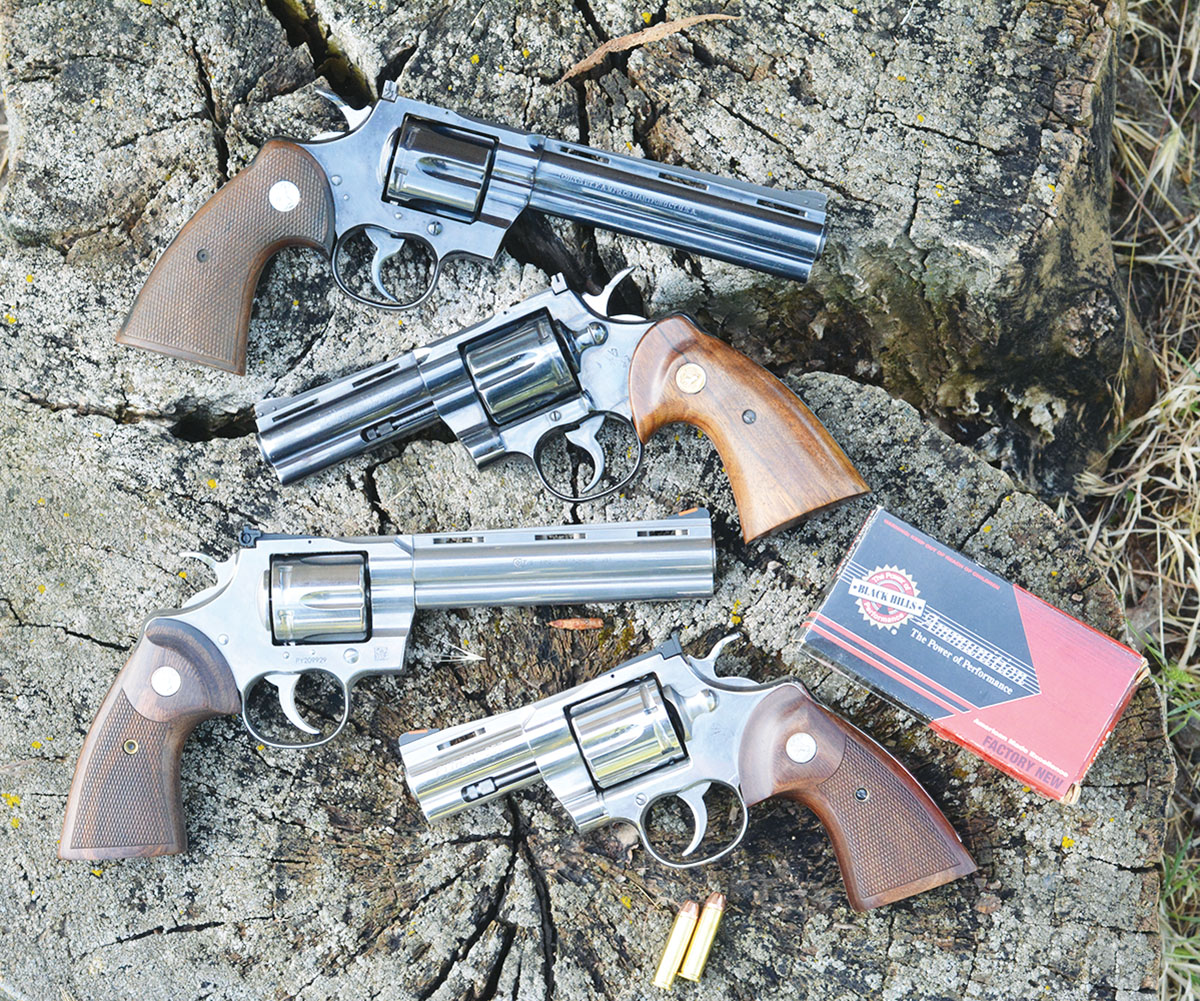
The two Colt Pythons (top) are original production versions produced in 1956 and 1969, respectively, while the two Pythons (bottom) are current production with engineering and design changes.
The Python remained in continuous production from 1955 through 1999, when Colt was forced (for several reasons) to discontinue it; however, a modest number were produced through the Colt Custom Shop until 2005. One reason for its demise was the cost of production, resulting in high prices.
Shooter demand remained strong, and prices for used guns soared, so Colt redesigned the Python with new production beginning in late 2019. This version was designed to be manufactured at a more competitive price and requires very little handwork during production. In addition to being offered initially in stainless steel only, it is now offered in a blue finish, but those guns fall short of the beautiful Royal Blue finish of the original guns.
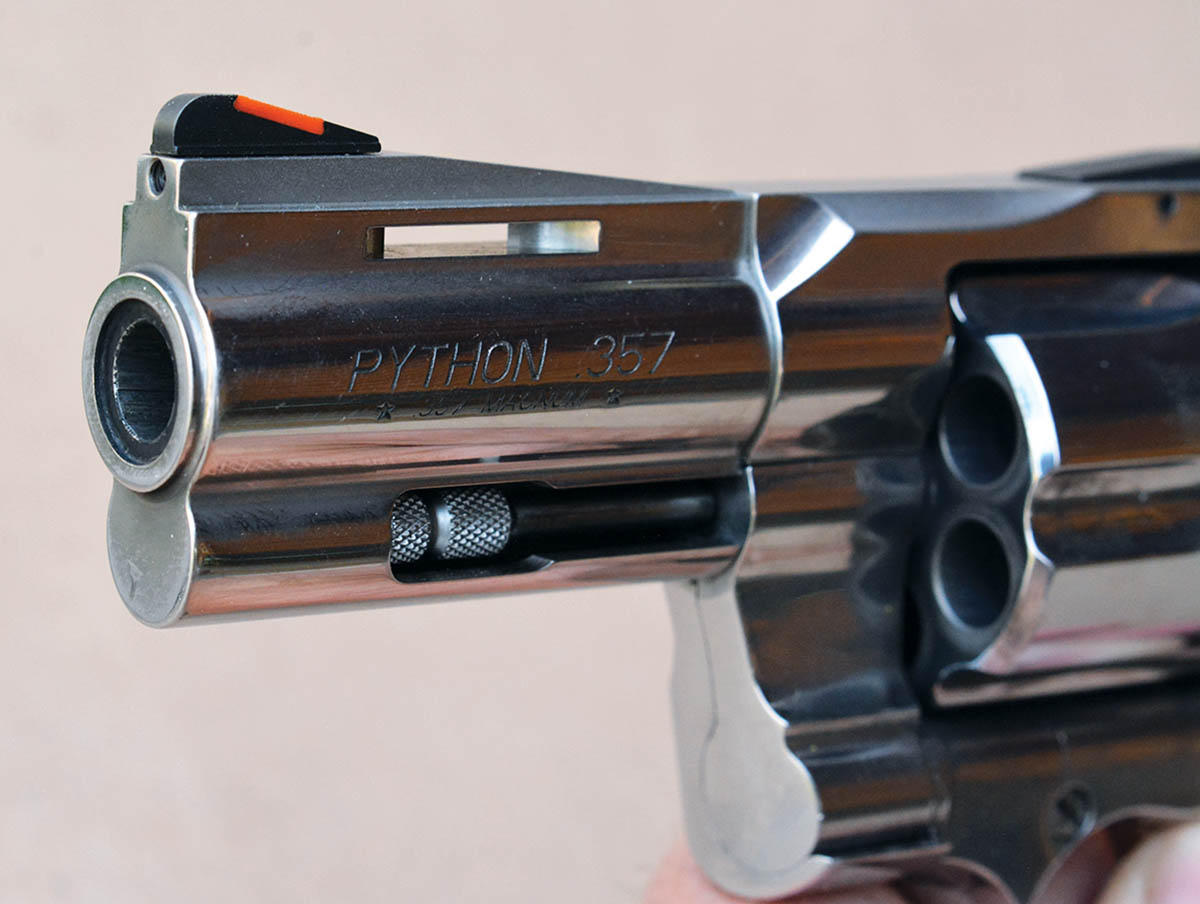
The Python’s crown is deep, while the red ramp front-sight blade is interchangeable.
The newly designed Python is stronger, more durable and has some internal changes to the action. The Positive Lock (allowing the safe carry of six-cartridges) found on original Pythons is now replaced with a transfer bar arrangement. The hammer arc is slightly shorter, resulting in a faster lock time. The trigger has been reshaped to avoid pinching shooters who have large trigger fingers. The top strap is around 30 percent thicker and increases strength and durability. The leaf mainspring has been redesigned for less stacking when the trigger is pulled in the double-action mode. This all results in a different mechanical feel than the original
Pythons that were known for their glass-like action when being cocked and boasted of a wonderful single-action trigger pull.
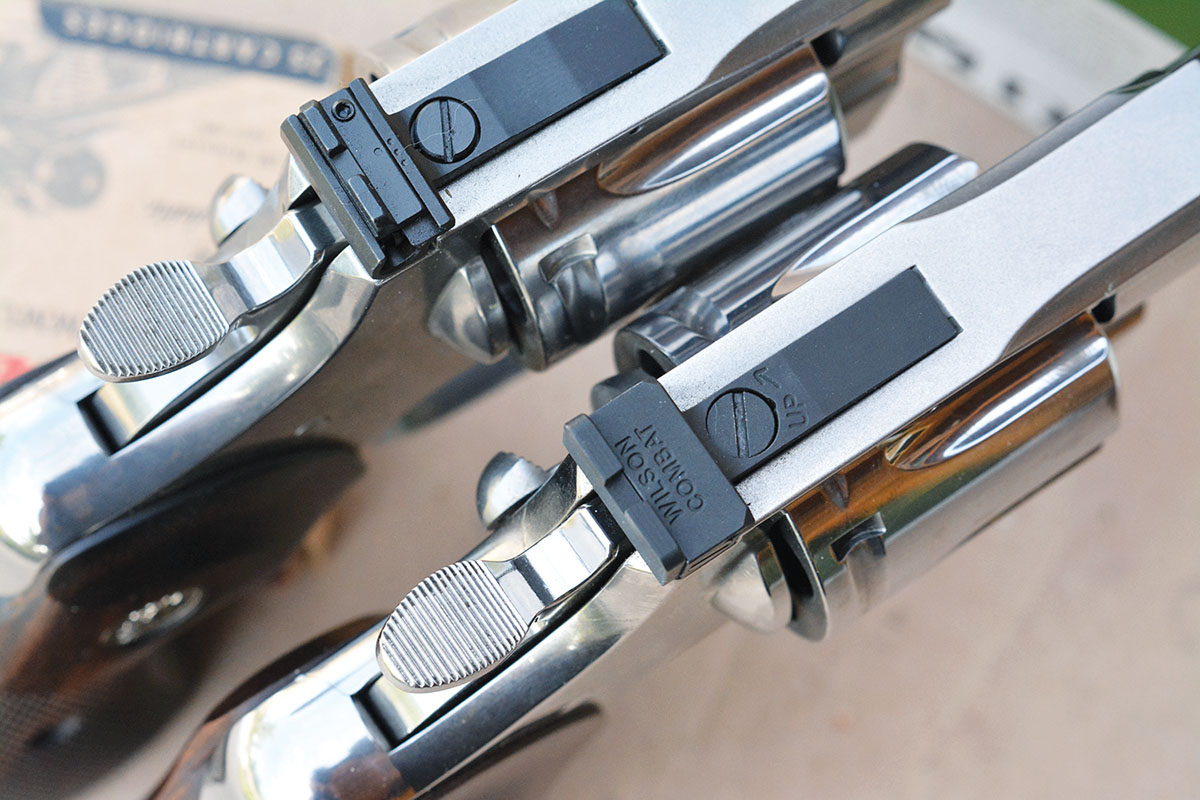
The gun (top) has a currently manufactured Python rear sight. However, the rear sight broke on the test gun (bottom), and was replaced with a high-quality, fully adjustable Wilson Combat version.
Early Pythons were primarily offered in 4- and 6-inch barrels, but were eventually offered in 21⁄2- and 8-inch versions. However, a very small number were produced with 3-inch barrels and command super
high premiums today. The new Python is currently offered with 21⁄2-, 3-, 41⁄4-, 5-, 6- and 8-inch barrels. A stainless steel version with a 3-inch barrel was selected for today’s test gun. The overall profile of the new Python follows the original version; however, it is clearly a modern gun with minimal handwork. It features select MIM parts (a subject that we should discuss another day) and even has a QR code on the right side of the frame that I could live without.
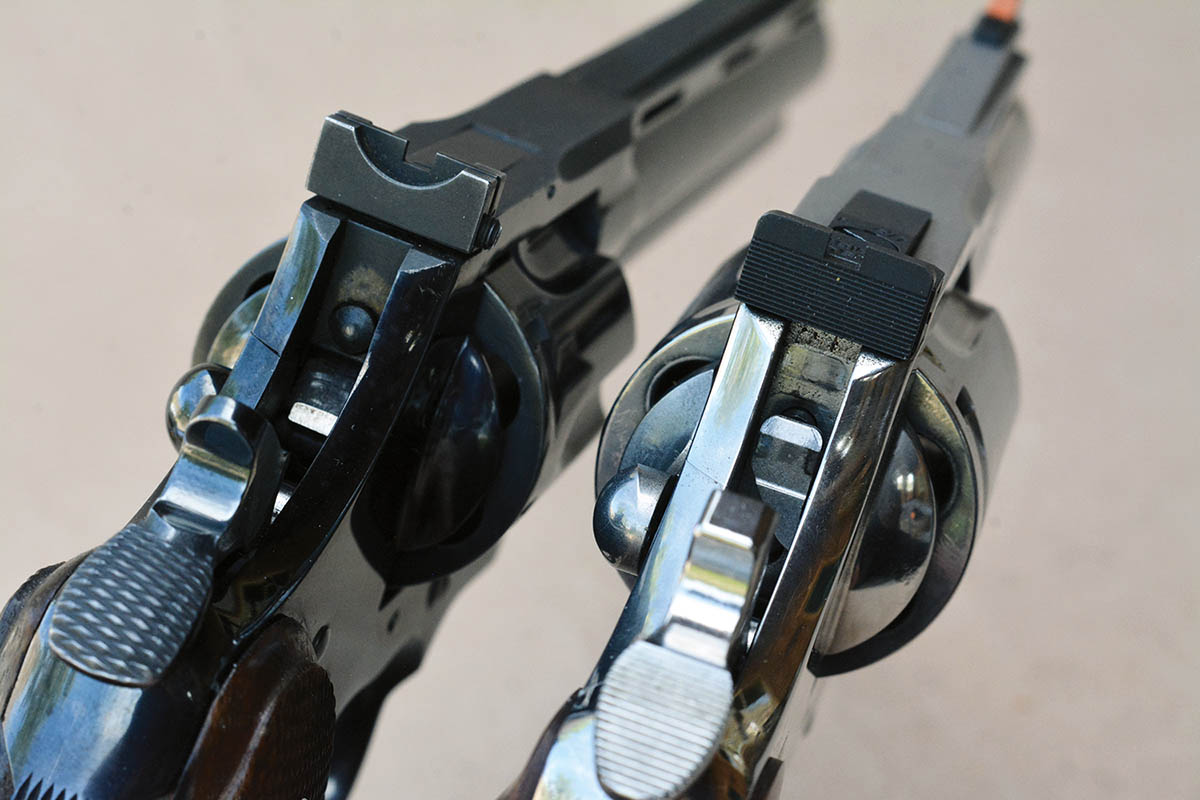
The original Python (left) featured a frame-mounted firing pin, while the new Python (right) also features a frame-mounted firing pin, but includes a redesign of the lock-work to include a transfer bar.
One improvement is the front sight blade that is secured with a set screw (from the front) so that the blade can be interchanged as desired. The rear sight is adjustable for windage and elevation. However, since first testing an early new Python back in 2020, the rear sight seems substandard with less than stellar quality. Not many shots had been fired downrange with this new 3-inch gun when the rear sight decided to break! So, it was replaced with a Wilson Combat version that is fully machined, is of notably better quality and offers a much-improved sight picture. While I get along okay with the profile of factory laminate wood target stocks, a set of walnut stocks from Herrett’s Stocks were installed (for most of the shooting sessions) that were further rounded for improved comfort and looks.
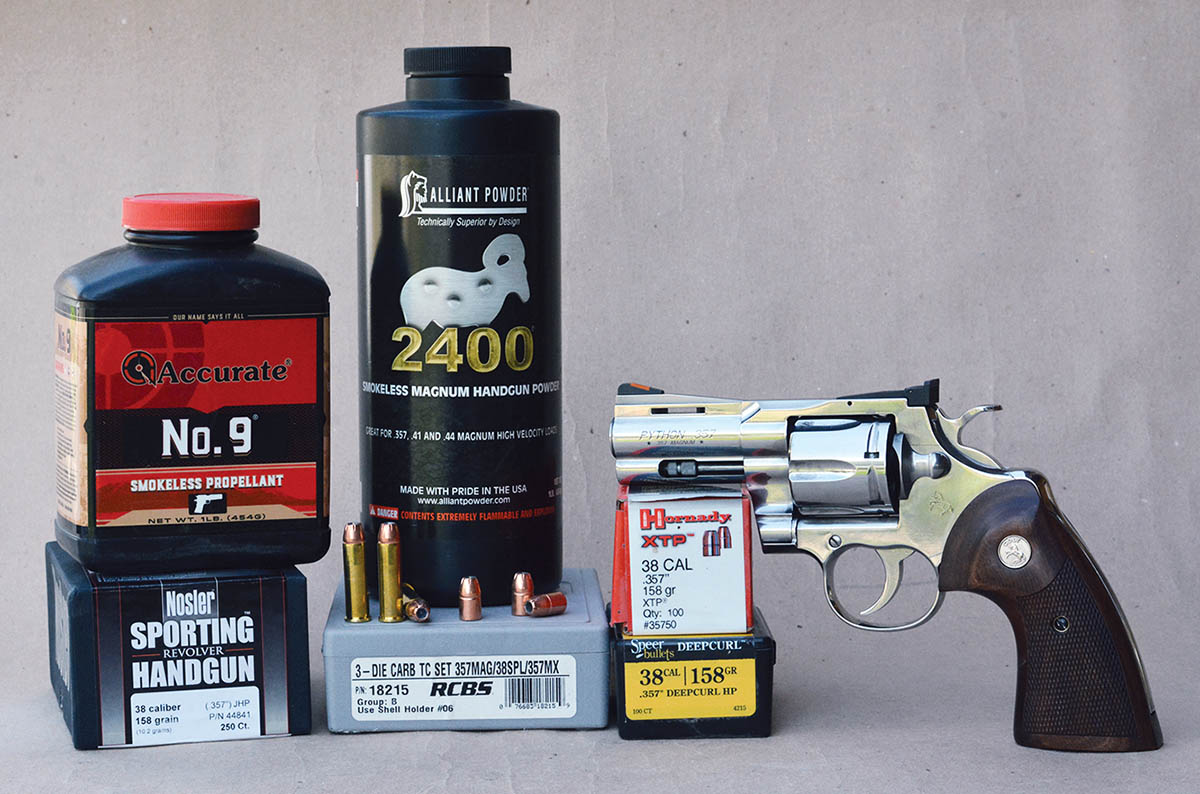
Brian developed handload data using select components for top accuracy and overall performance in the Colt Python with a 3-inch barrel.
My biggest complaint was the excessively heavy single-action trigger pull that broke at 6.1 pounds right out of the box. While this might have helped my concentration while trying to squeeze out all of the accuracy potential from a bench with a sandbag rest, in the real world of shooting from offhand or field positions for accuracy, this is an excessive pull by any standard. Other new Pythons that I have tested had pull weights from 6.5 to 6.8 pounds. Colt really needs to address this issue to help make this sixgun more palatable.
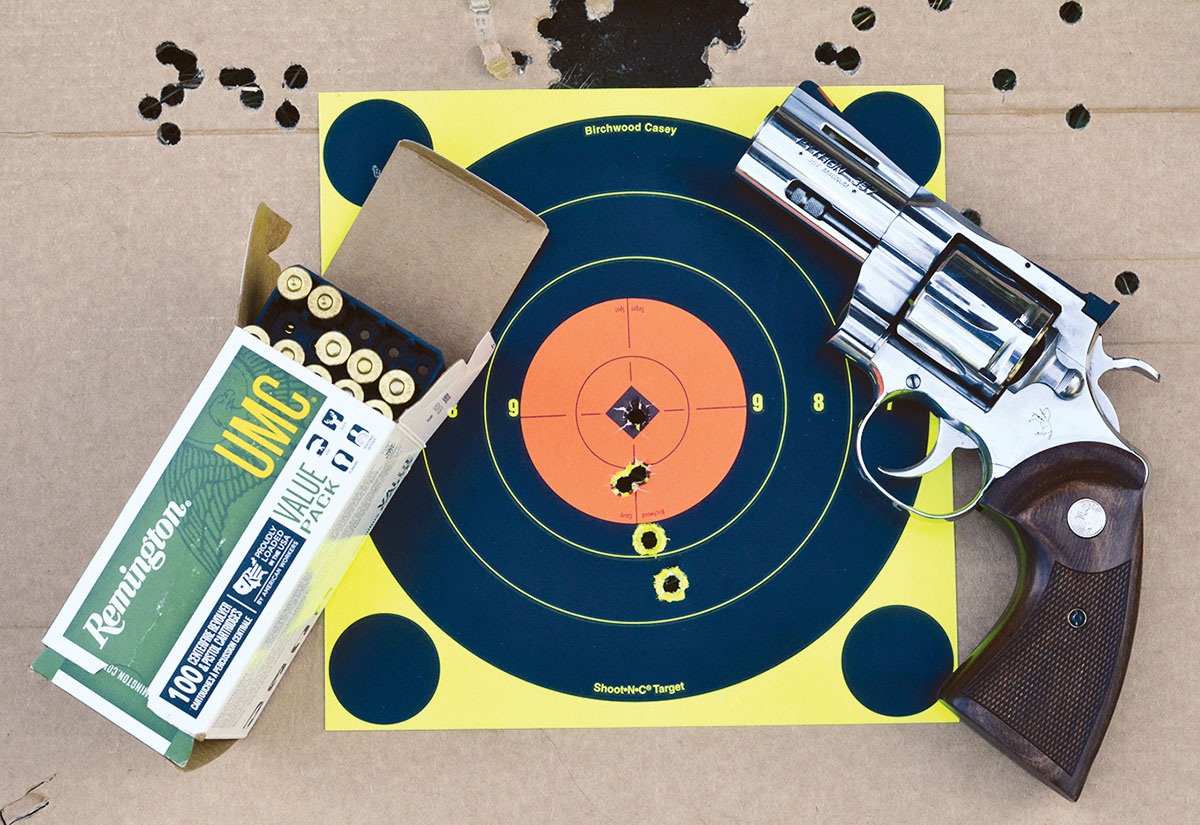
Select light for caliber bullets, such as the Remington UMC 125-grain SJHP factory load, had a tendency to string groups vertically.
The cylinder end-shake is modest, but acceptable, while the barrel cylinder gap measures .004 inch, which is ideal in spite of the SAAMI (Sporting Arms and Ammunition Manufacturers’ Institute) listing a maximum of .012 inch for all revolvers. Chambers all ranged perfectly and there was no abnormal spitting of powder, or metal from the barrel cylinder gap. The forcing cone is cut smoothly and appears to be 11 degrees, while the
rifling and bore are smooth and shiny. Cylinder timing is positive, but the cylinder only locks firmly when the trigger is pulled, and the hammer falls fully forward to the FIRE position – the same as the Officers Model second model did in 1908. As can be seen in the accompanying table, factory loads from Remington, Black Hills, Hornady and Winchester produced an overall aver-age group at 20 yards (with a sandbag rest) of just 2.0375 inches. The tightest group with factory loads came from Hornady Custom with a 158-grain XTP bullet that clocked 1,273 feet per second (fps) and clustered 5 shots into 1.65 inches.
Moving on to handloads, accuracy was improved with cast bullet loads, but more or less duplicated with loads containing jacketed bullets. Five-shot groups averaged from 1.55 to 2.30 inches at 20 yards. The single most accurate load consisted of the Lyman/Thompson 162-grain cast bullet with gas check installed and sized to .358 inch that reached 1,288 fps using 14.0 grains of Alliant 2400 powder, CCI 500 standard pistol primer, and Starline cases. This combination cut a near ragged hole measuring 1.55 inches center to center (rounded).
The new Python is a product of our time when cost becomes hugely important to many shooters, and few people are willing to pay for hand-fit parts and hand-polished finishes! Nonetheless, it is a good gun, and considering the soaring prices for vintage Pythons, it’s a bargain, at an MSRP of $1,699, or about half the cost of a run-of-the-mill original Python. Considering price, overall quality, accuracy and other factors, in my book, the new Python earns an above-average B grade.


.jpg)
.jpg)