

Bullets & Brass
405 Winchester Data
column By: Brian Pearce | October, 26
Q: I am pretty new to handloading. My dad handloaded a lot when I was growing up. But I was too busy with sports and other things to glean his knowledge. I enjoyed hunting and shooting, but did not get too involved in the technical aspect of handloading, and now regret not learning more from him.
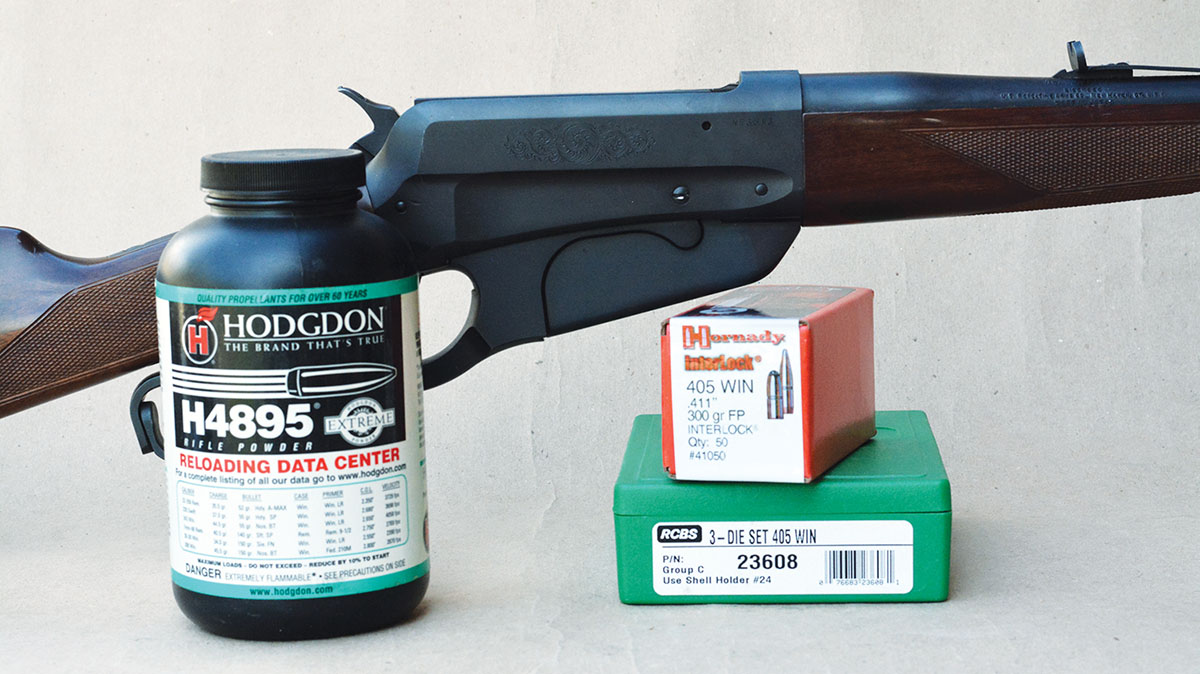
The rifle I am inquiring about today is a Winchester reproduction of the Model 1895 chambered in 405 Winchester. It came with some ammunition (my dad’s handloads) and it shoots amazing! His notes are incomplete, so I don’t even know what powder or charge weight he used in those handloads. Can you suggest data for Hornady 300-grain Interlock SP bullets? I am not trying to hotrod it. I just want to duplicate factory loads and hopefully achieve the same level of accuracy that my dad did.
Thank you in advance. I enjoy Handloader magazine and am learning a great deal from each issue.
T.Y., via Facebook
A: Welcome to Handloader! There are several powders that will give the performance you are seeking with the Hornady 300-grain Interlock SP bullets. I would suggest starting with 55.0 grains of Hodgdon H-4895 powder and working up to a maximum charge of 57.0 grains that will give around 2,250 feet per second (fps) from your Model 1895. Another equally accurate load is 51.5 grains of Accurate A-2015 powder; however, that load produces around 2,175 fps, which is slightly short of factory load velocities.
Naturally, you will want to full-length size the cases, neck expand the case mouth, use a standard large rifle primer and crimp cases with a heavy roll crimp after bullets are seated to the correct overall cartridge length.
357 Maximum Loads that Protect the Top Strap
Q: I have a near-new Ruger New Model Super Blackhawk chambered in 357 Remington Maximum that is still in the box. It is the 71⁄2-inch barrel version. It came with two boxes of original Remington 158-grain JHP loads and Starline brass.
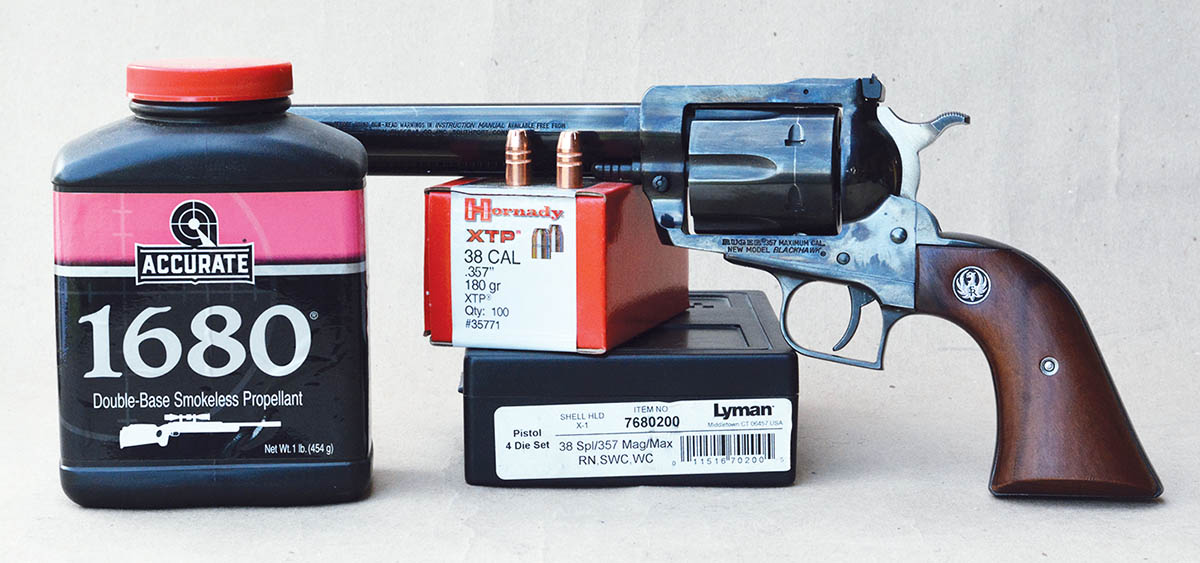
Can you suggest a load that will not destroy the top strap, or at least minimize it?
Jerry F., via Facebook
A: The 357 Maximum was widely known to cut the top straps of all revolvers that were chambered for it, including Ruger, Dan Wesson and others. Part of the problem was the Remington factory loads that were a combination of the powder type, the gas volume and the thin jacket of the 158-grain bullet; however, changing powders and using a heavier bullet does not fully prevent the top strap cutting with full power loads. Frankly, there should have been some engineering changes similar to more modern revolvers that feature titanium frames and feature a special steel insert above the barrel cylinder gap.
With that said, increasing bullet weight and lowering the powder charge will help. I might suggest using 26.5 grains of Accurate A-1680 powder in conjunction with the 180-grain Speer TMJ-Silhouette bullet (which has flickering availability) or the Hornady 180-grain HP-XTP, which will give around 1,440 fps from most sixguns with 71⁄2-inch barrels. Another load includes 23.5 grains of Vihtavuori N-120 powder for more or less the same velocity.
Another great option is to use 215-grain gas-check cast bullets from Lyman mould 358627 with 15.5 grains of IMR-4227 powder, producing around 1,300 fps. If you cannot find that bullet mould, or a commercial cast bullet company that offers it, that data can be used with various 200-grain bullets from commercial casters. However, just be certain that the bullet will allow crimping within the SAAMI (Sporting Arms and Ammunition Manufacturers’ Institute) maximum overall cartridge length of 1.990 inches. Small rifle primers with higher energy are suggested, such as the Remington 71⁄2 or Federal No. 205.
The above loads are within the industry maximum average pressure for the 357 Maximum, which is established at 48,000 copper units of pressure (CUP). While these may not offer the power and velocity you are seeking, they will not cut the top strap excessively with moderate use. Frankly, you cannot achieve the top-level velocities without some degree of top strap cutting.
Lighter Bullets in the 454 Casull
Q: Your firearm knowledge, wisdom and experience are priceless! I have been laid up for 10 years now and am getting better at a glacial
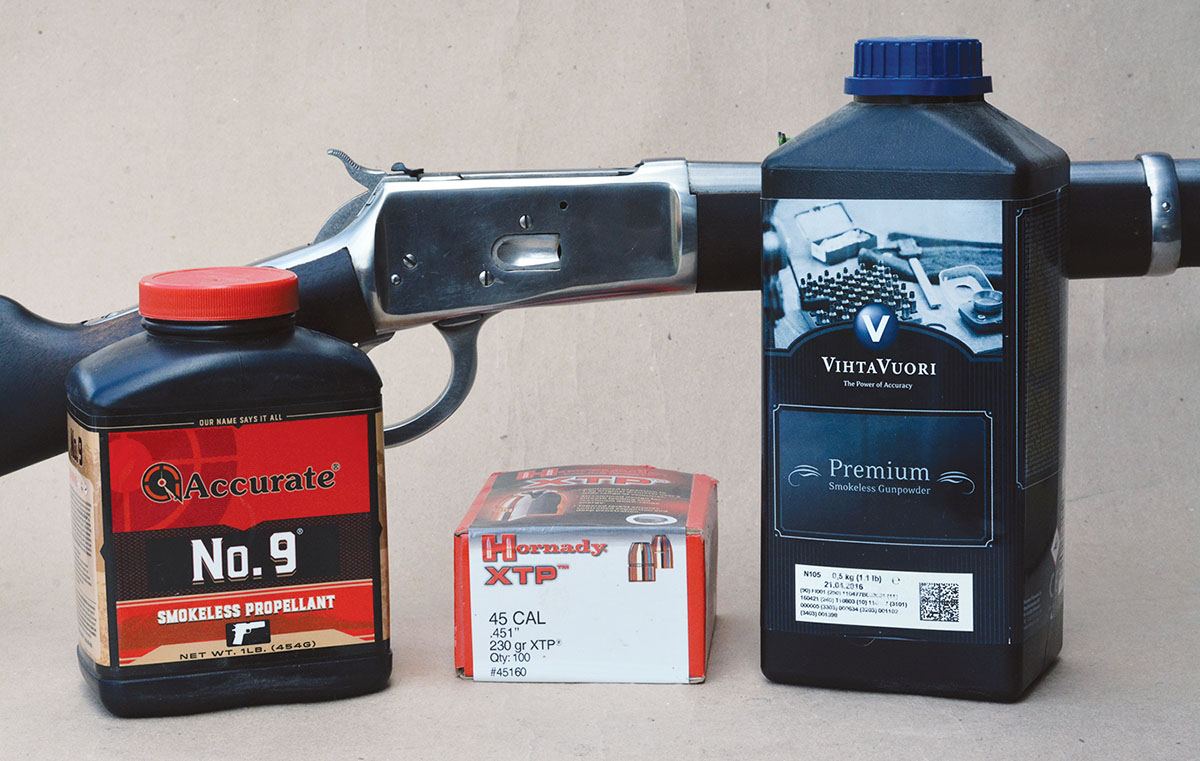
It’s odd that just a couple of weeks ago, I picked up a great deal on a Rossi R-92 chambered in 454 Casull.
I found enough load data for bullets at 240-grain bullet weights and above. However, I would really like load data for Hornady 185-, 200- and 230-grain .451-inch bullets. I have not been successful in finding any such load data. Do you have any suggestions? I am sure that I have enough various powders to use for these medium to lighter weight bullets. Is it possible for me to make up some 45 Colt loads, but I want these specifically for my R-92 454 Casull.
Thank you and Handloader magazine so very much.
D. Mikronis, via email
A: I am glad that you enjoy our magazine, and thank you for reaching out for handloading advice for the 454 Casull in rifles.
There are a couple of concerns associated with using the light-for-caliber Hornady bullets that you mention in a 454 Casull rifle with a tubular magazine. First, those bullets are designed for the 45 ACP and do not have a cannelure to permit a heavy roll crimp, which, for several reasons, is a requirement for the 454 Casull. You could obtain a C-H cannelure tool and apply your own crimp groove; however, the cannelure still may not allow a heavy enough crimp to properly hold bullets when fired in an R-92 rifle with a tubular magazine, or subjected to recoil and prevent bullets from deep seating (at least with powders that do not support the base of the bullet).
Even if you obtain a heavy enough crimp, there is still another concern. The 454 can develop up to 65,000 pounds per square inch (psi) and requires heavy-jacketed bullets to keep pressures down. In other words, bullets with a thin jacket will usually give greater pressure when compared with a bullet featuring a thick jacket and designed specifically for the 454.
With that said, you don’t specify a targeted velocity. I would suggest keeping velocities at around 1,900 fps and not over 2,000 fps maximum with the 230-grain Hornady XTP bullet. Try 28.0 grains of Accurate No. 9 powder for 1,950 fps, or 29.0 grains of Alliant 2400 for the same velocity. Other options include 23.0 grains of Vihtavuori N-105 or 34.0 grains of IMR-4227, with each load producing around 1,900 fps. Naturally, you will want to use a high-energy small rifle primer such as the Federal 205 or Remington 71⁄2. And never use roundnose or ball 45 ACP bullets in the tubular magazine to prevent possible magazine tube detonations.