

45 ACP Revolvers
Lessons from the 45 ACP Wheelgun
feature By: Mike Venturino (Photos by Yvonne Venturino) | June, 26
Usually, when embarking on a handloading project for a specific cartridge, it is a routine affair. About three to five bullets are coupled with three to five propellants. Then the loads are test-fired in five-shot strings. For handguns, a Ransom Pistol Machine Rest is preferred.
After group shooting, the results fall where they may, as I’m seeking only to learn, not to prove a point. This most recent project was not quite so routine.
In Handloader #341 (December, 2022), at the conclusion of the 45 Auto-Rim article on page 63, I mentioned it might be interesting to do a similar one with the same revolver, using 45 Auto cases in half- or full-moon clips. My revolver shelves hold both Smith & Wesson and Colt 1917s chambered for 45 ACP, but the former revolver has a rough barrel that often keyholes bullets. The Colt’s barrel is in great shape and is up to standards in the accuracy department.
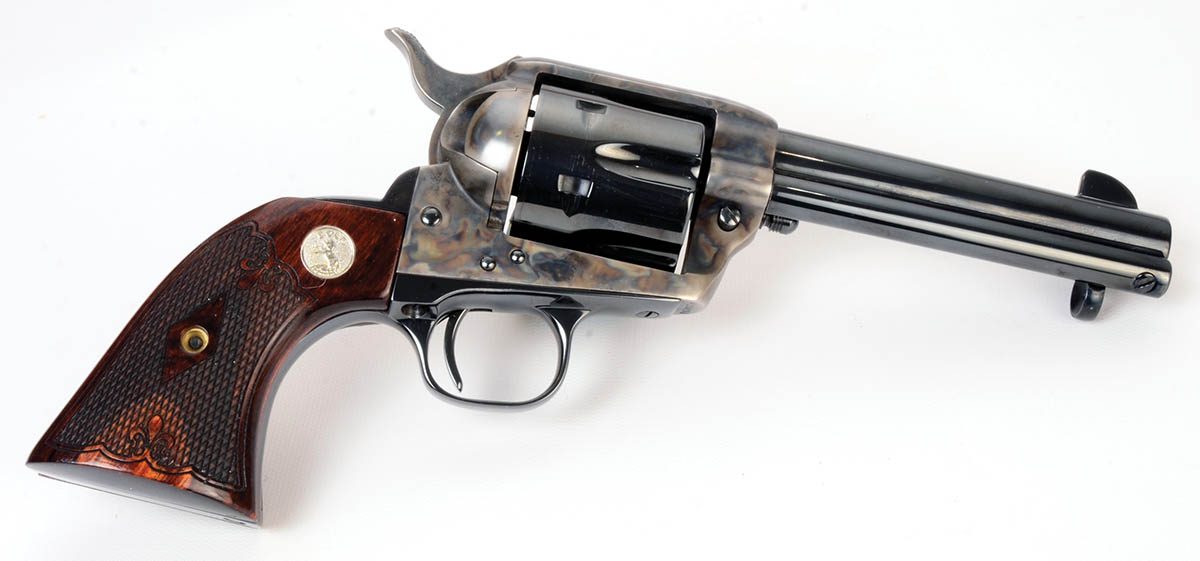
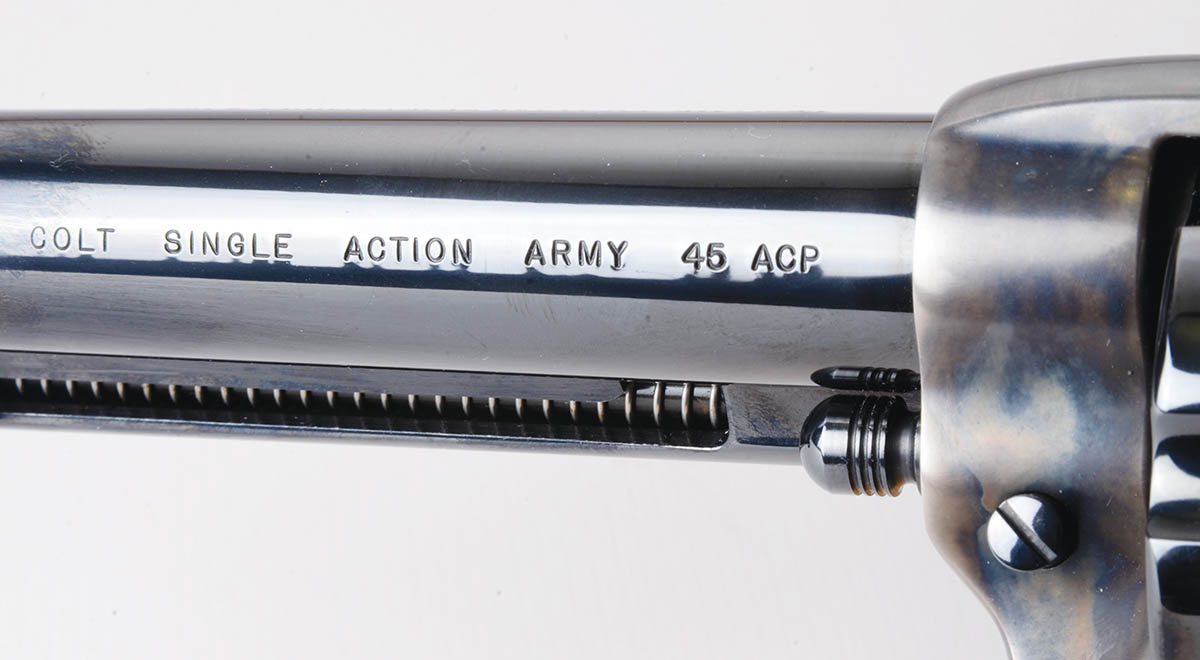
Actually, another revolver purchase spurred me into action on loading for 45 ACP revolvers. I came across a 1990s vintage Colt SAA 45 with both 45 ACP and 45 Colt cylinders. In fact, the revolver is even caliber stamped “45 ACP” as is its factory shipping box. Naturally, I bought it. Colt SAAs chambered for 45 ACP are nothing new. In his book The Calibers of the Colt Single Action Army, David M. Brown relates that in the 1st Generation, Colt produced 44 SAAs chambered for 45 ACP on special order. He also states that most of those 44 SAAs went to military officers, although he doesn’t list references for that statement.
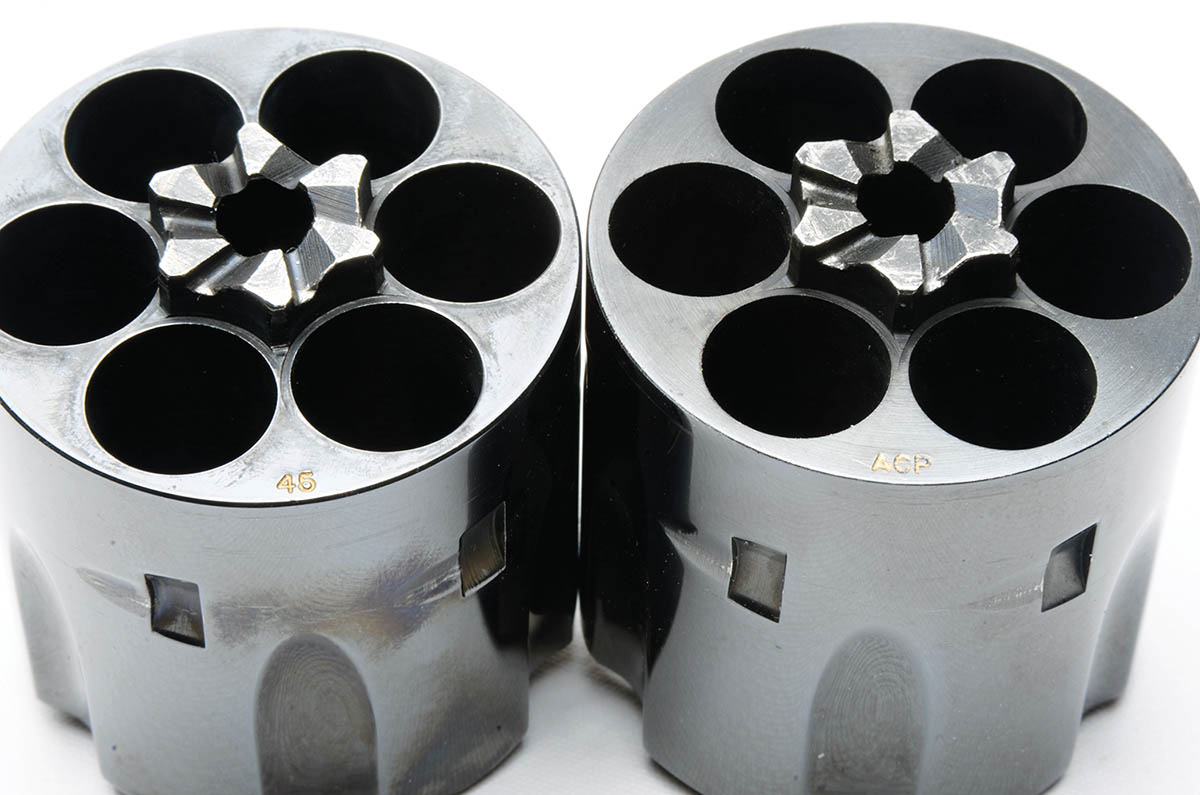
This newly purchased SAA was the first one I’ve encountered that actually has the caliber stamped for the auto round. Obviously, a product of Colt’s Custom Shop, it has their Royal Blue instead of the duller standard finish. It also has a color case-hardened hammer instead of the standard type with bright polished sides. Barrel length is 43⁄4 inches with fixed sights consisting of a blade front and a grooved topstrap for the rear. For the uninitiated, it might be worth mentioning that 45 ACP rounds work well in single-action guns despite being of rimless configuration. Cartridges headspace against the chambers’ ledges just as they do in autoloader barrels. Extraction of rimless cases is by means of ejector rods.
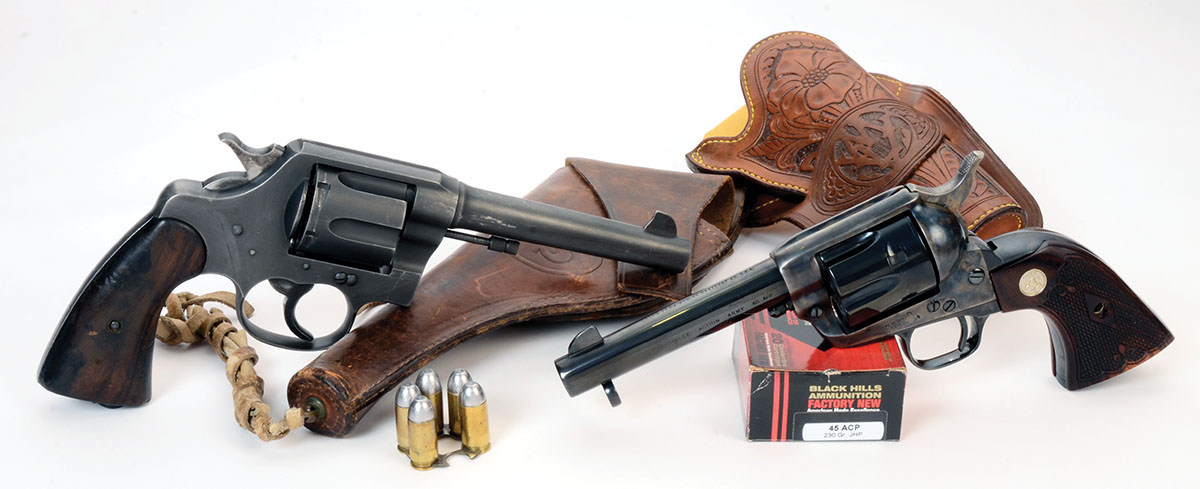
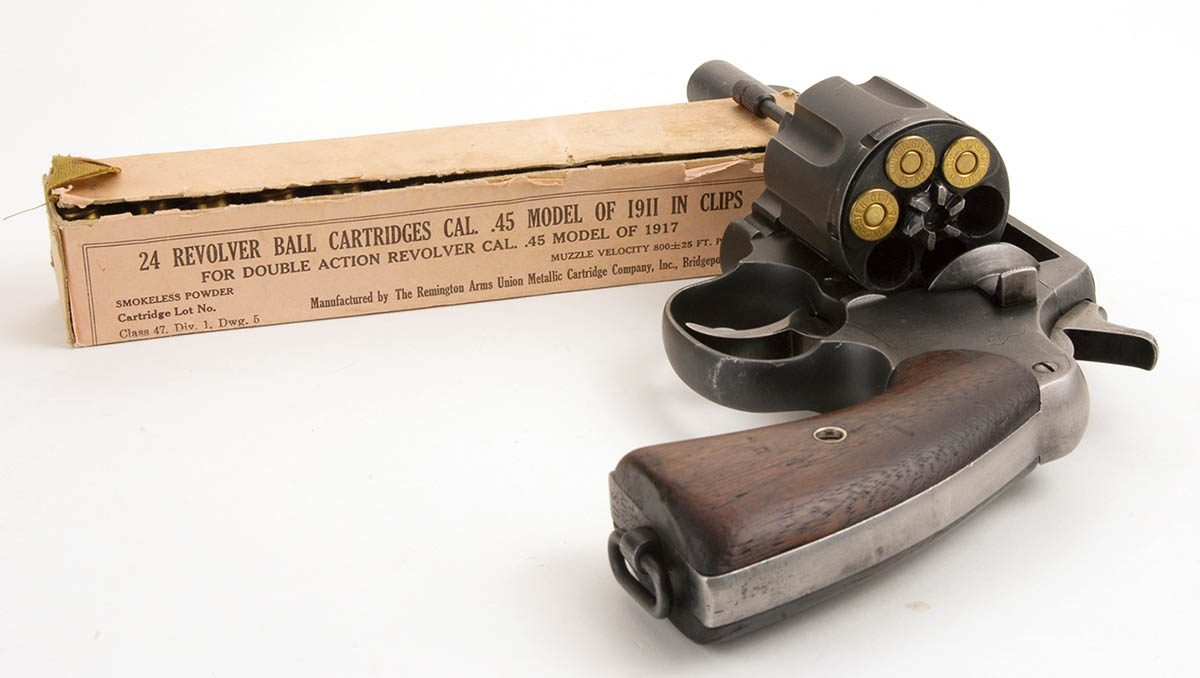
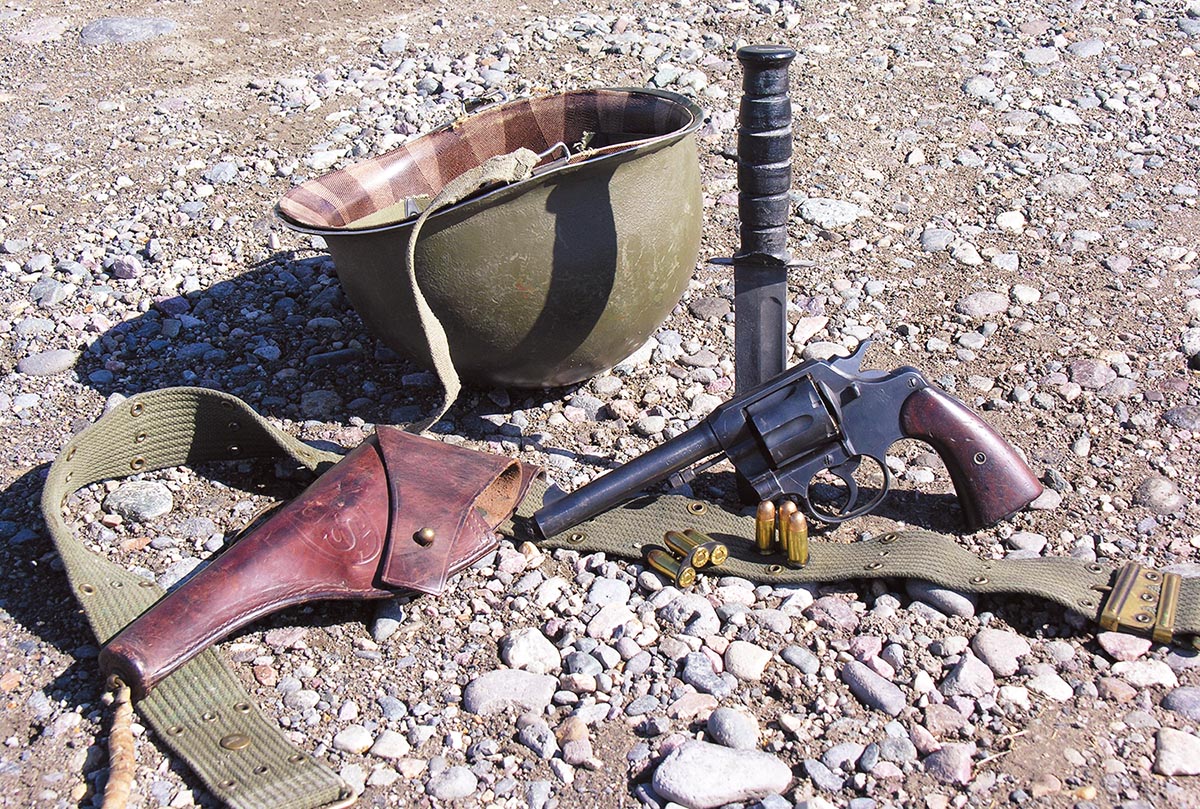
Being a double action with a side swing cylinder, the Colt Model 1917 requires help with cartridge extraction. Its extractor is the star type, therefore needing something to push on when ejecting empty cartridges. During World War I, the U.S. government needed more handguns for troops fighting in France. Someone figured out that the 45 ACP would work in star-type extractors if they were held in three-round spring steel clips, which quickly became nicknamed “half-moon” clips. In fact, especially for these Model 1917 revolvers, 45 ACP cartridges were supplied preloaded in the clips. Consequently, both Smith & Wesson and Colt together supplied over 300,000 of their large frame revolvers chambered for 45 ACP, and post-war, both manufacturers kept their 45 ACP revolvers in catalogs. Colt dropped theirs circa 1944, but Smith & Wesson (S&W) continued to offer 45 ACP revolvers in several models until 1966. In the twenty-first century they resurrected several versions.
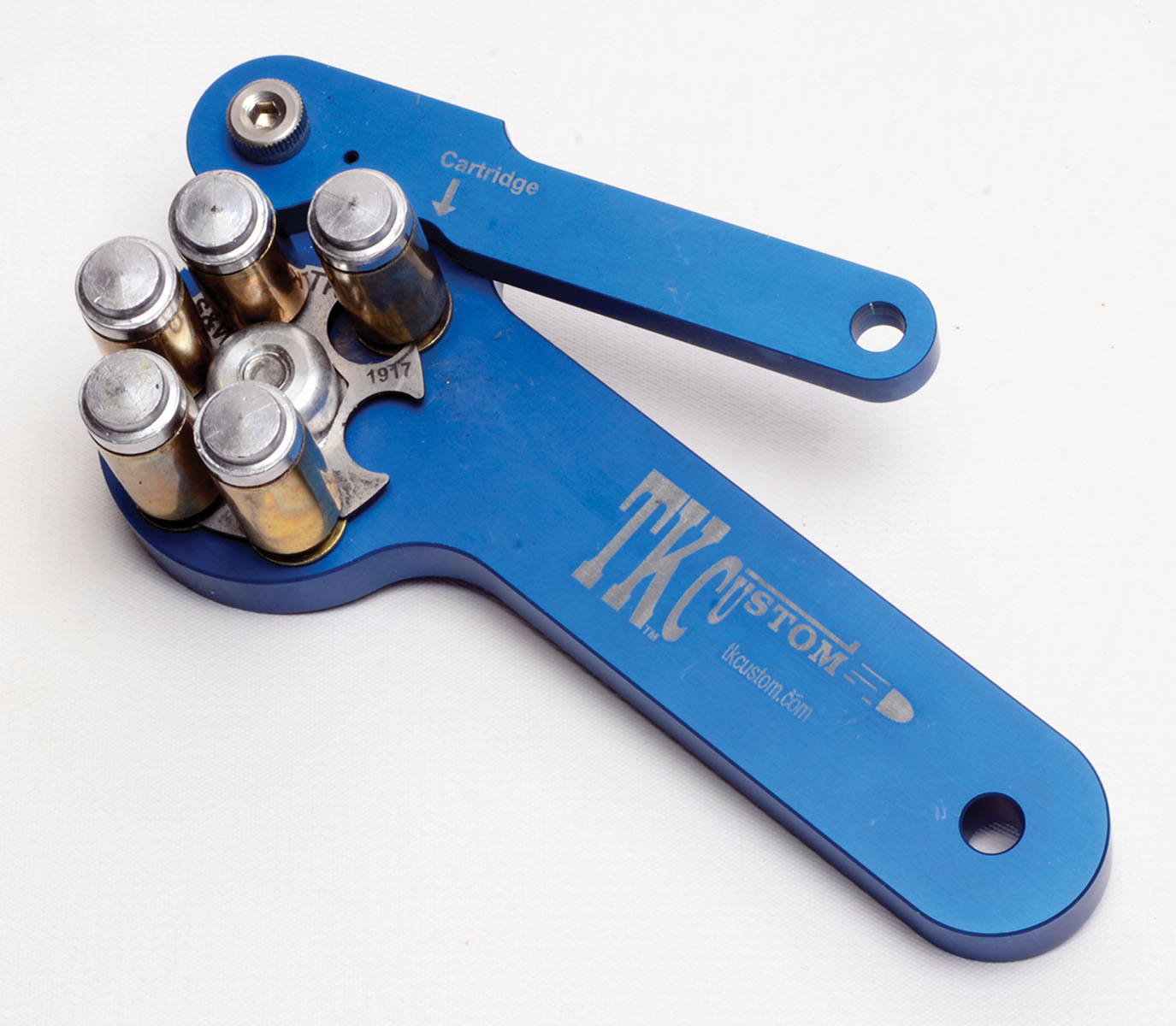
My shooting with the Model 1917 differed slightly. Not enough half-moon clips were on hand. Besides, I don’t like nitpicking about snapping rounds in them and wrestling empty cases out afterwards. Instead, some “full-moon” (6-round) clips were ordered from TK Custom Products (TKCustom.com) along with a loading tool. That little device helped fill each clip in only a minute or so. However, only five rounds were loaded for group shooting and chronographing.
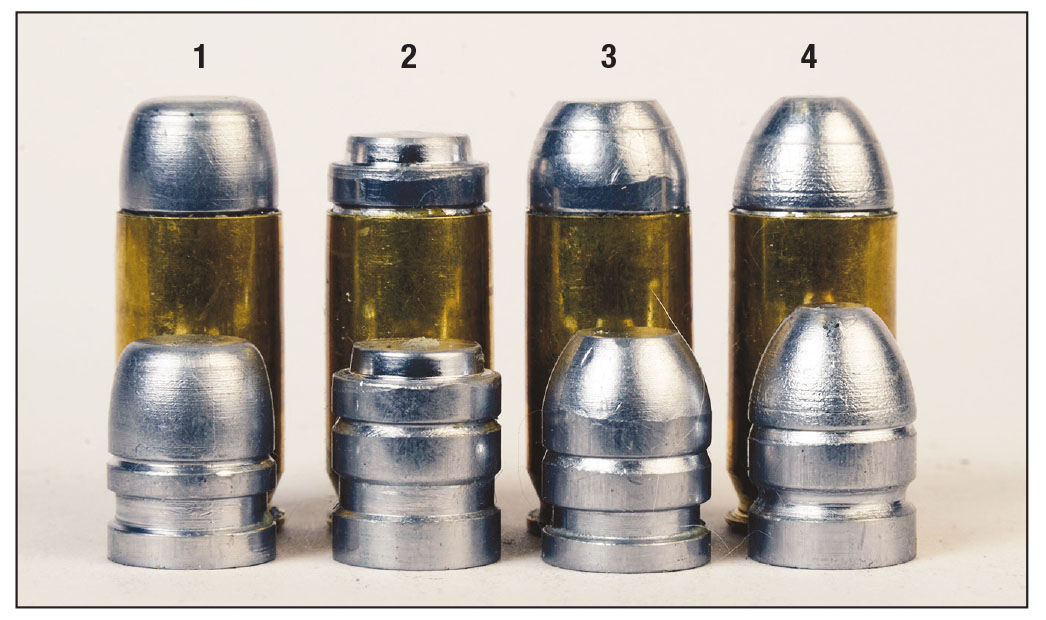
For a variety of handloads, five propellants and four cast bullets were chosen. Two cast by me and two from commercial suppliers. Four hundred rounds were assembled in the normal manner; once-fired Federal cases were cleaned, full-length sized, belled sufficiently for bullet bases to start, and then seated. At this point, it was obvious that rounds loaded for the 1917 could be roll crimped normally due to the full moon clips holding them in place. However, that wasn’t going to work with the SAA because its chambers’ headspace ledges required prominent case mouths. Not wanting to develop separate handloads for each revolver, I decided to use a specialized crimping die with which I had no previous experience.
This is where my project deviated from routine. Neither of my test revolvers would shoot a group. At 25 yards from the machine rest, clusters ran from six inches to about two feet! I was flummoxed. My first suspect was my machine rest mounting. The bridge plank that the machine rested on for 22 years cracked last year, and this was the first test with its replacement. That was easy to check; five rounds were fired from the 1917 as it was still mounted at that point. Those Black Hills 230-grain FMJs grouped into three inches; not a great group, but tight enough to discount problems with the machine rest.
Either I misused the first crimping die in my inexperience with it, or it is defective.
The next step was assembling a few rounds with two different bullets with W-231 powder, as it’s noted for its accuracy potential. A Lyman taper crimp die was used to lock bullets firmly in cases. Those two test groups measured about 21⁄2 inches each. So, in a rather frustrated state, I sat down at my loading bench again. Actually, at first, it was at the bullet casting bench. My supply of suitable 45 ACP commercially cast bullets were now depleted. So for this second experiment, the chosen four cast designs were RCBS 45-230CM for a 230-grain roundnose/flatpoint (RN/FP), Redding/SAECO 453 for a 230-grain wadcutter (WC), Redding/SAECO 954 for a 230-grain RN/FP, and my old favorite 45 Colt bullet NEI 324 for a 250-grain RN/FP. Those are the nominal catalog weights for the four cast designs. My actual weights with 1-20 tin-to-lead alloy in the same order are 230, 233, 239 and 252 grains.
There might be some questions in readers’ minds about including a 252-grain bullet in testing 45 Auto revolvers. Truly, I seldom deviate from reloading manuals’ listed maximums, and load data for such a heavy bullet in 45 Auto is scarce. That said, I reduced powder charges to what I considered safe compared to the same powders with 230-grain bullets. I’m glad the 252-grain bullet was included, for it showed potential in both revolvers. All bullets were sized .452 inch and lubed with DGL.
Also, a word is necessary about the availability of Redding/SAECO 453 and NEI 324 designs. Both of these fine cast bullet designs are unavailable from their original sources. NEI is a defunct company, and Redding/SAECO has dropped Number 453 from their catalogs. However, there is an alternative. Accurate Molds (AccurateMolds.com) of Centerville, Utah, has over 700 cast designs in its mold catalog. Each can be ordered and appear in your mailbox in about two weeks. They offer very similar, if not exact copies, of the two unavailable molds I commonly use.
When preparing the second batch of 45 ACP handloads, another, albeit slight, stumbling block was encountered. A wise handloader will always load a single sample cartridge for each projected test batch and check its function in firearms in which it will be used. (I learned that the hard way.) The Colt Model 1917’s chambers allowed all four cast bullets to seat properly. However, the Colt SAA would not accept rounds loaded with either Redding/SAECO bullet. The nose of the 239-grain RN/FP nose was too bulbous to fit into the chamber’s ball seats. (The portion of the chamber in which bullets are seated when a round is chambered.) With the Redding 233-grain WC, its square-shaped nose was also too wide to pass by the chambers’ headspacing edges. Disappointing, but at least my reloading chores were reduced somewhat.
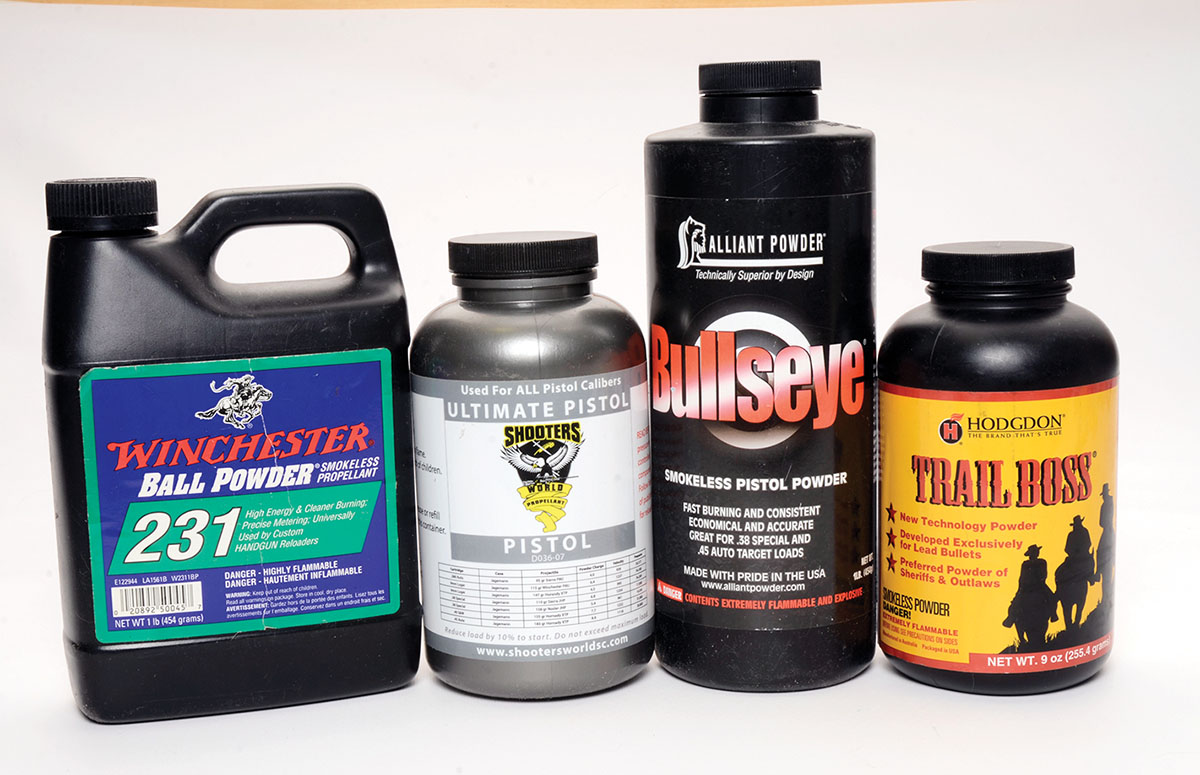
The four propellants chosen were Bullseye, Trail Boss, W-231 and Ultimate Pistol, the
Trail Boss was a poor choice. It’s meant to occupy space in old black powder cartridges with large volume, such as 44-40, 45 Colt and such. I have used it in 45 ACP cases for light loads to save wear with my 1918 vintage Model 1911 and the same idea was with the old Model 1917 in mind. However, with the 1911 autoloader, velocities were fun in the 750 feet per second (fps) range, but with both revolvers, chronograph readings were in the low 600 fps range. Likely the low velocities are due to barrel/cylinder gaps a large .008 inch for the ancient 1917 and .004 inch for the newer SAA. The difference in those gaps is likely the reason velocities from the 1917 were usually a bit lower than the SAA despite its 3/4-inch longer barrel. While on the subject of revolver dimensions, the cylinder chamber mouths were all measured with plug gauges. The Model 1917 had five chambers measuring .455 inch, with the sixth jumping up to .457 inch. Diameters of the SAA’s 45 ACP cylinder were interesting – three were .451 inch and three were .452 inch.
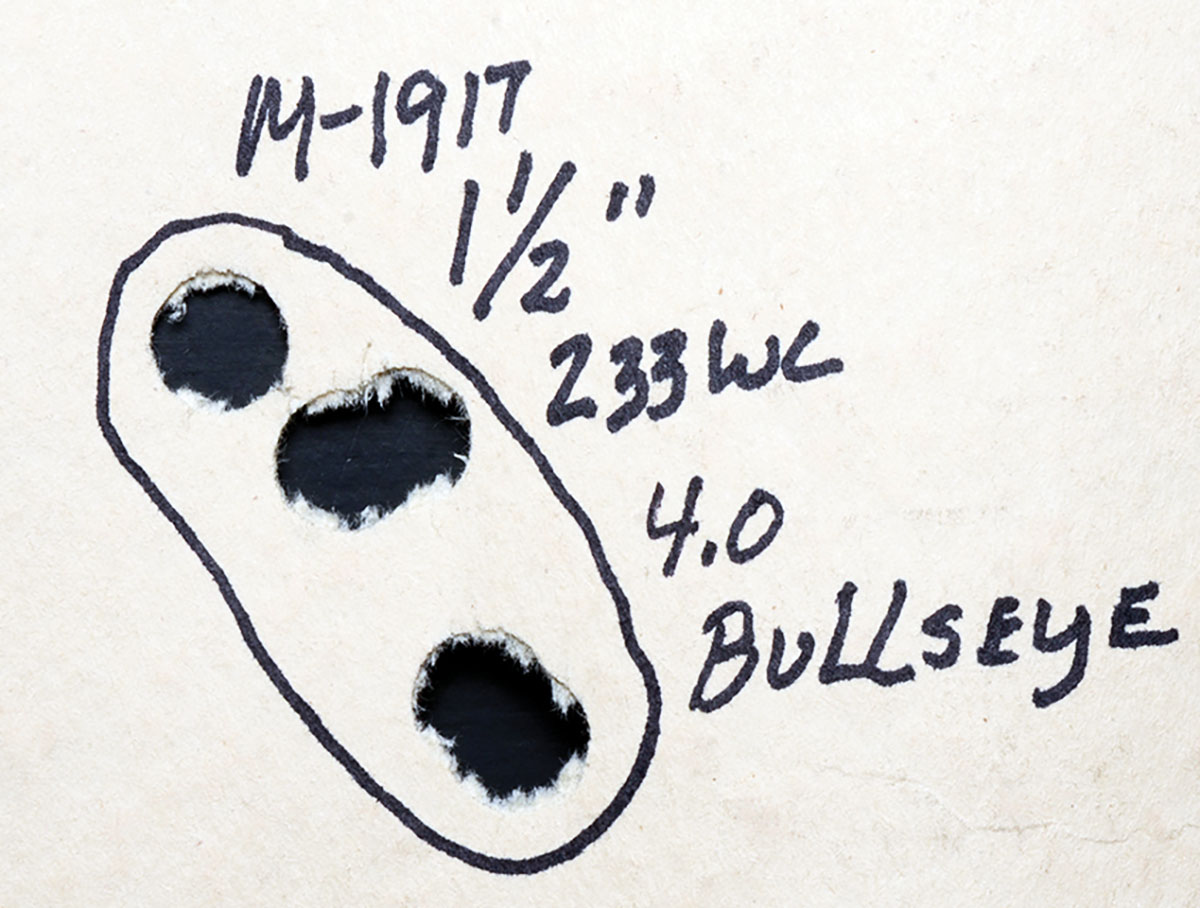
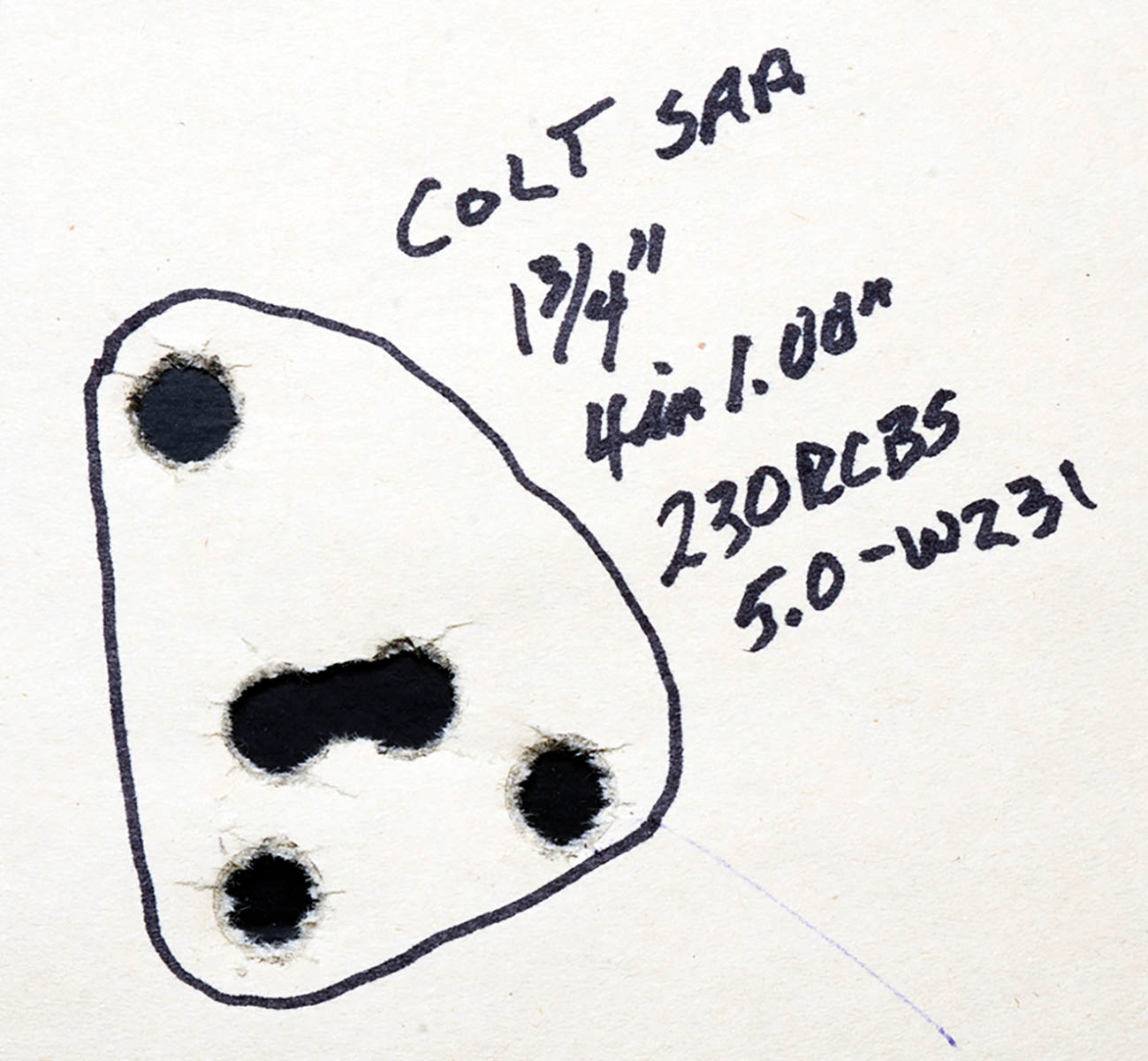
These disparities in cylinder chamber mouths could possibly be the reason why flyers ruined some otherwise very fine five-shot groups. This happened with five of 14 loads fired in the Model 1917 and four of nine loads fired in the Colt SAA. Here are a couple of examples. The Model 1917 with the 230-grain RCBS RN/FP over 5.0 grains of W-231 grouped five shots into 2.75 inches, but four rounds clustered into only 1.63 inches. The same load in the SAA was 1.75 inches for five rounds – not bad at all – but four of those five rounds were in a mere 1.00 inch. The accompanying load table will show groups for all loads test fired.
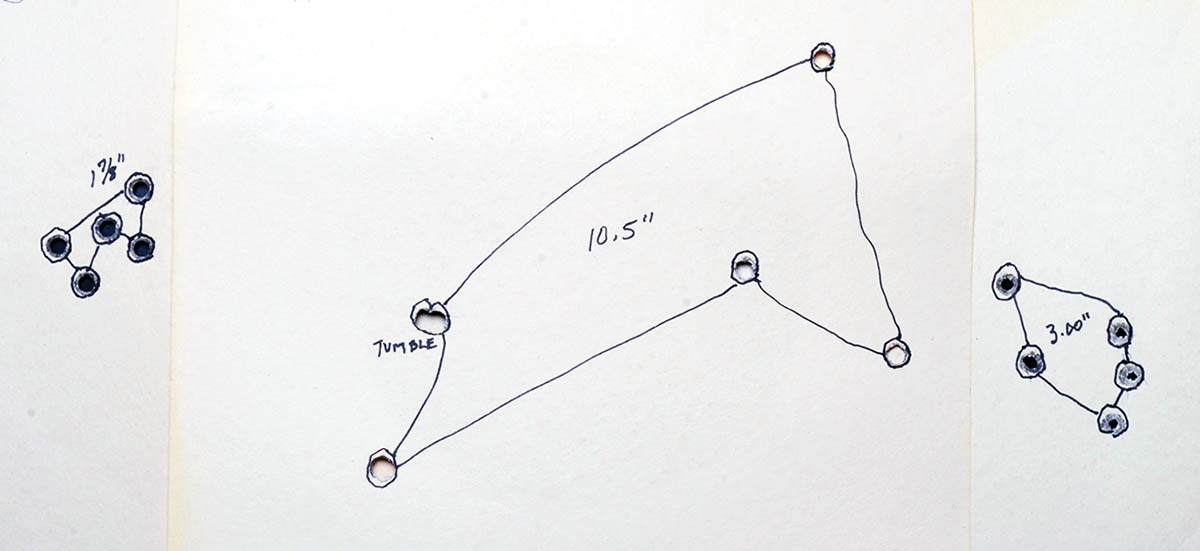
Here is one other deviation from routine. With the Model 1917, the load of 4.2 grains of Trail Boss with 230-grain RCBS RN/FP shot a group of 10.5 inches with no two rounds close to one another. However, the group fired immediately before that one was only 1.88 inches, and the one after it was three inches with four in 1.75 inches. From the Colt SAA the mystery load was only two inches with four shots in 1.00 inch. I have no idea what caused the extra-ordinarily large group.
The work for this article was for education, and something was certainly learned with the SAA was that its chambers were bored at a minimum length. Even some factory loads would not seat deep enough for the cylinder to rotate and cast bullet lubes do leave a bit of fouling and sometimes unburned powder. The SAA’s chambers had to be swabbed a few times to remove “gunk” for positive round seating. Also learned was that Ultimate Pistol powder by Shooters World deserves to be tried out in other calibers and handguns.
The last thing determined was that a 230-grain RN/FP with the same nose design as the old NEI No. 324 250-grain bullet might be ideal not only for 45 ACP revolvers but could very well serve for all .45 caliber rounds such as 45 Auto-Rim, 45 Schofield and 45 Colt. I felt this way to the point that such a mold with triple cavities is on the way from Accurate Molds as this is written.
.jpg)