Login


Wolfe Publishing Group
    Menu

    460 S&W Magnum & T/C Encore ProHunter

    The Dream Team


    Two decades ago, Smith & Wesson introduced the speedy 460 S&W Magnum in its X-Frame revolver. Nowadays, when used in a carbine-length barrel, it’s tough to top in states permitting the use of straight-walled cartridges for deer. When Smith & Wesson’s Herb Belin set out to create an “unsurpassable” handgun cartridge in 2002, that goal was achieved with the 500 S&W Magnum and the oversize X-Frame revolver to fire it. Time to market? One year. That was only possible due to the collaboration with Pete Pi of Cor-Bon Ammunition. But why stop there?
    From a carbine, the 460 S&W Magnum is capable of fine accuracy and  devastating terminal ballistics, but requires much legwork and dedication, given its punishing recoil. From the test barrel, the best accuracy was  attained using the Barnes 200-grain XPB, hardly surprising since it was  created for the cartridge.
    From a carbine, the 460 S&W Magnum is capable of fine accuracy and devastating terminal ballistics, but requires much legwork and dedication, given its punishing recoil. From the test barrel, the best accuracy was attained using the Barnes 200-grain XPB, hardly surprising since it was created for the cartridge.
    If you’re the titleholder of the largest production revolver, why not pursue the fastest option, too. Such was Belin’s impetus for designing the 460 S&W Magnum, which debuted in 2005. Belin’s goal was lofty; from an 83⁄8-inch barrel, he sought to reach 2,500 feet per second (fps) with a .45-caliber bullet. That mark wasn’t achieved. However, attaining upward of 2,300 fps with a 200-grain projectile earned Smith & Wesson much-deserved accolades and delivered hunters a matchless blend of speed for flat trajectory and less wind deflection, as well as increased on-target energy, power and accuracy, all from a production revolver. 

    Handloading the 460 S&W isn’t straightforward, and it’s recommended that the handloader not deviate (i.e., substitute) from trusted, published data.  Attention to detail, from case manufacturer and primer type to bullet design, are critical for safety and optimal performance.
    Handloading the 460 S&W isn’t straightforward, and it’s recommended that the handloader not deviate (i.e., substitute) from trusted, published data. Attention to detail, from case manufacturer and primer type to bullet design, are critical for safety and optimal performance.
    What happens when it’s used in a carbine? What should you know when assembling handloads for one? All will be addressed in this article.

    For astute cartridge aficionados, you likely knew that the cartridge Belin sought to best with the 460 S&W Magnum was the renowned 454 Casull, which has a SAAMI (Sporting Arms and Ammunition Manufacturers’ Institute) maximum average pressure (MAP) of 65,000 pounds per square inch (psi). Again, requesting the assistance of Cor-Bon, while simultaneously enlisting Hornady Manufacturing Co., the cartridge now known as the 460 S&W Magnum was delivered in short order. Thanks to the X-Frame’s long cylinder, the cartridge’s maximum case length was set at 1.800 inches, or 0.417-inch longer than that of the 454 Casull, and the maximum cartridge overall length (COL) was limited to 2.275 inches. Its MAP matches that of its chief competitor.
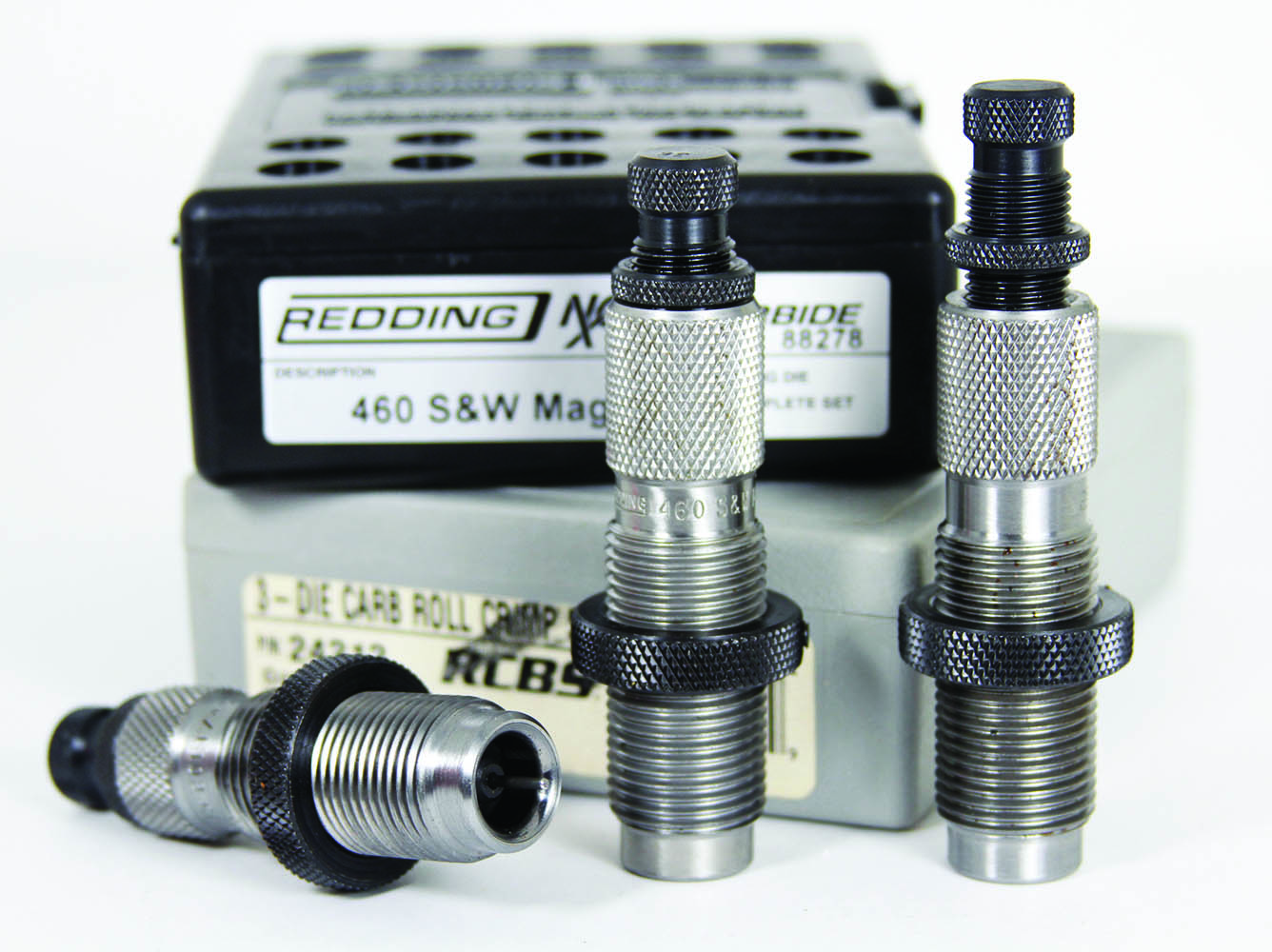
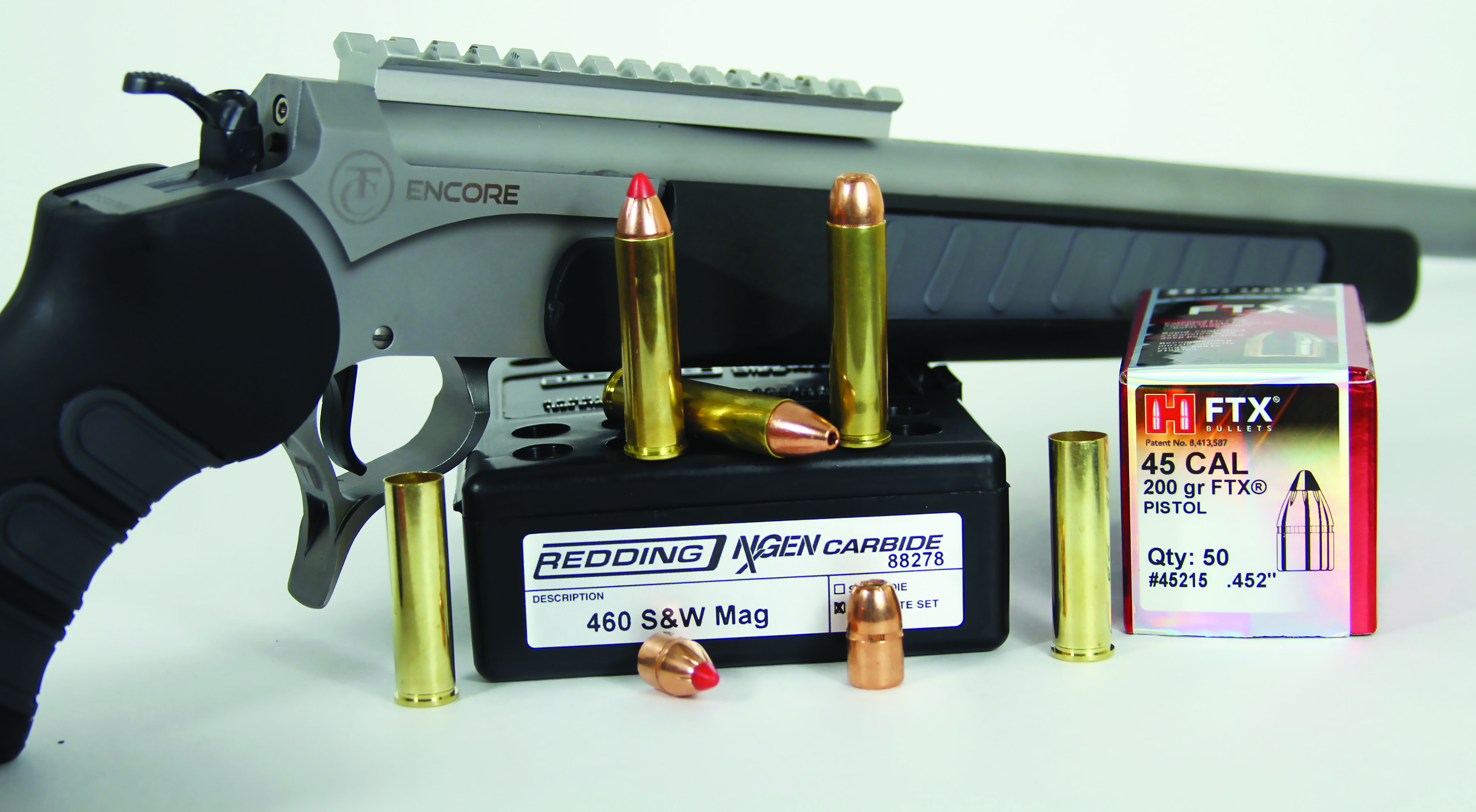
    Most large diemakers offer three- and/or four-die sets in 460 S&W Magnum. Some, such as the Redding NxGen Carbide set pictured, are  assembled with a 45 Colt/454 Casull sizer die.
    Most large diemakers offer three- and/or four-die sets in 460 S&W Magnum. Some, such as the Redding NxGen Carbide set pictured, are assembled with a 45 Colt/454 Casull sizer die.
    The cartridge’s rimmed, straight-walled design has several benefits. First, revolvers and single shots chambered in 460 S&W Magnum can fire 45 Schofield, 45 Colt, 454 Casull and 460 S&W Magnum ammunition interchangeably, though the latter is generally the most accurate. Talk about versatility. 

    What’s more, 0.451-0.452-inch diameter bullets, which are what the 460 S&W Magnum uses, are available in myriad weights and configurations, ranging from less than 200 grains up to 395 grains. Not all are well-suited for the 460, particularly if it’s to be used for big-game hunting; many succumb to the high-velocity impacts, which result in inadequate penetration and/or significant meat loss. More on this later. Best of all, given the cartridge’s prodigious speeds, bullets experience less drop and wind deflection downrange, as well as boosted on-target energy. Other than the expense of ammunition and components, there’s not much to criticize. 

    Frankly, despite its astonishing ballistics from the X-Frame revolver, the 460 S&W Magnum is handicapped by it. It’s not alone, though. All revolvers leave the untapped potential of the cartridges they chamber on the table. How? Specifically, it’s the barrel-cylinder gap, which bleeds velocity-building gases, and the reduced-length barrel. The latter prevents full consumption of the slow-burning propellants common to “magnum” revolver cartridges. Thanks to its cavernous case using 50-plus grains of propellant in some recipes, it’s unlikely that any revolver cartridge is more adversely affected than the 460 S&W Magnum. However, in a carbine, it’s a beast.
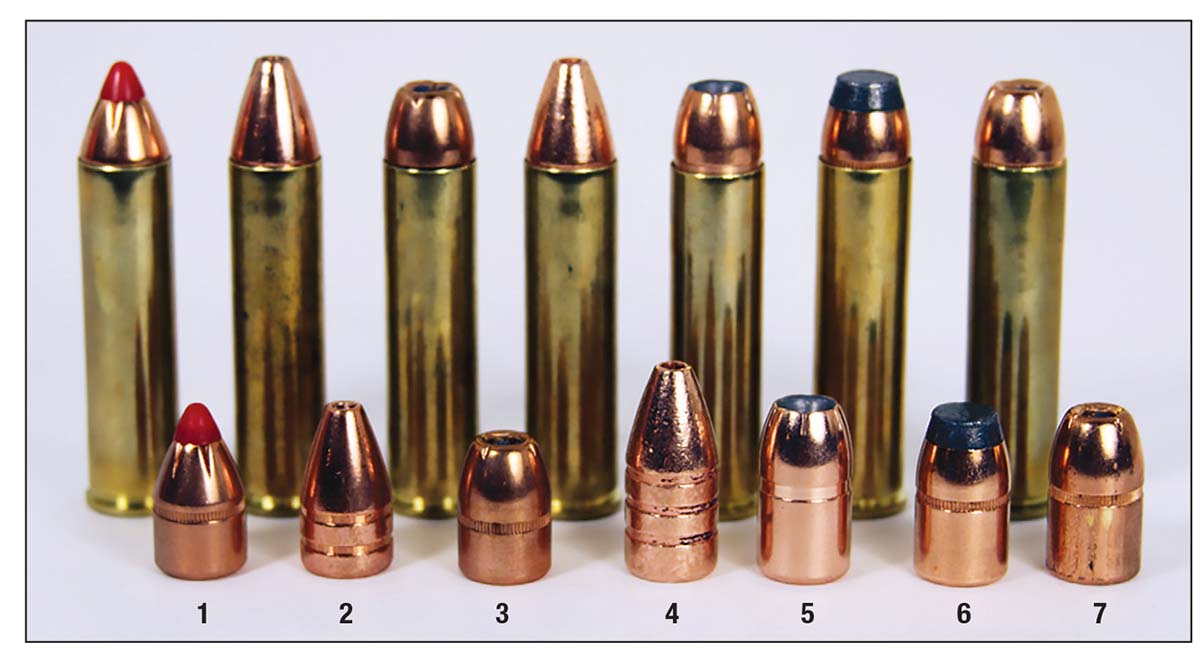
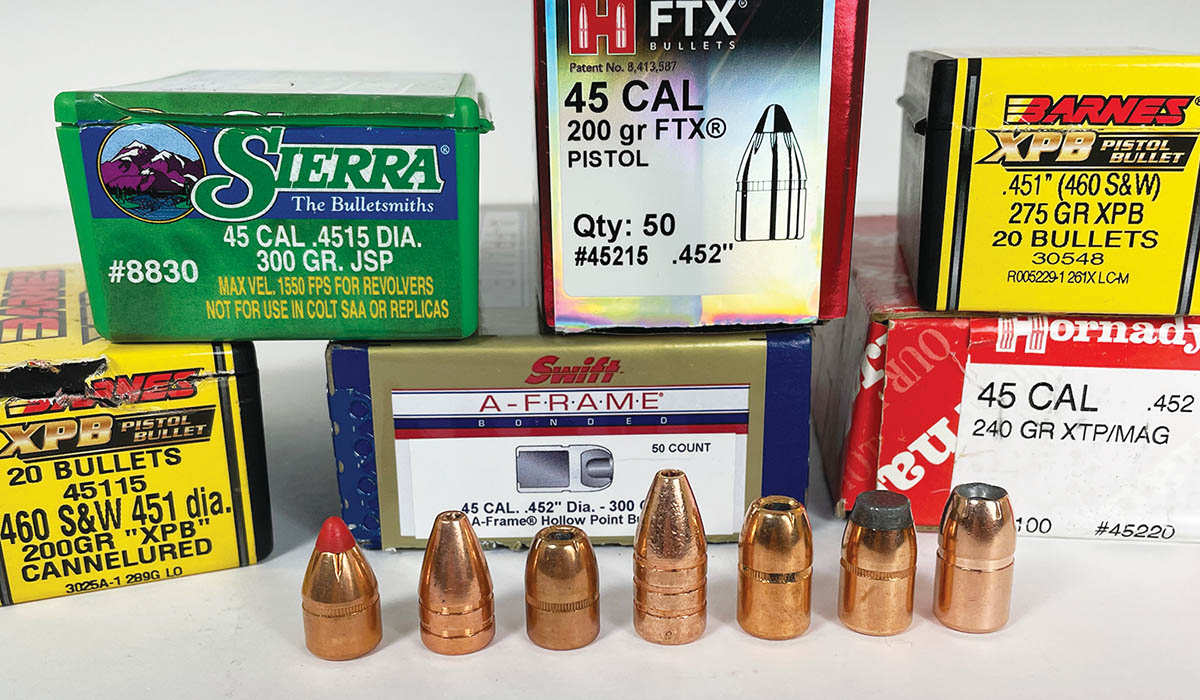
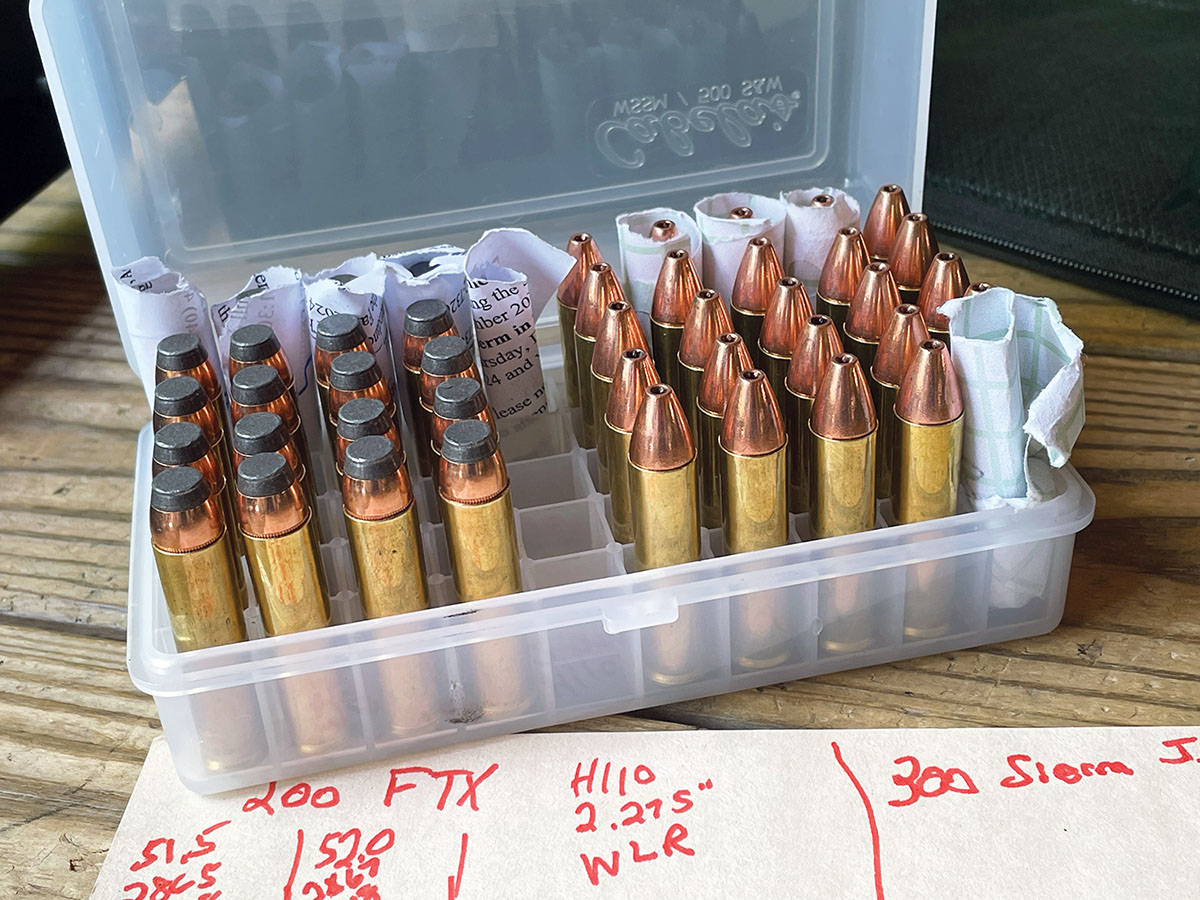
    Although there are innumerable .45-caliber bullets, many are unsuitable for use with the 460 S&W  Magnum. Among the best options are: (1) Hornady 200-grain FTX, (2) Barnes 200-grain XPB, (3) Hornady 240-grain XTP Mag, (4) Barnes 275-grain XPB, (5) Swift A-Frame Revolver 300-grain HP, (6) Sierra Sports Master 300-grain JSP and (7) Hornady 300-grain XTP.
    Although there are innumerable .45-caliber bullets, many are unsuitable for use with the 460 S&W Magnum. Among the best options are: (1) Hornady 200-grain FTX, (2) Barnes 200-grain XPB, (3) Hornady 240-grain XTP Mag, (4) Barnes 275-grain XPB, (5) Swift A-Frame Revolver 300-grain HP, (6) Sierra Sports Master 300-grain JSP and (7) Hornady 300-grain XTP.
    The problem is, since its mid-2000s debut, few makers have added the 460 to their long-gun lineups, and for good reason: demand. Sure, the 460 is a far-reaching, hard-hitting cartridge (especially from a carbine), but there are other “rifle” cartridges that are equally good, or better, and fulfill the same role(s). They’re missing the cumbersome rim. The 450 Bushmaster is an exemplar. Frankly, it’s equally as capable for most tasks, yet more versatile, and the ammunition is typically less costly as well.

    Bullets suitable for the 460 S&W Magnum have diameters between 0.451 and 0.452 inch. The best are those that are made specifically for the cartridge or the 454 Casull.
    Bullets suitable for the 460 S&W Magnum have diameters between 0.451 and 0.452 inch. The best are those that are made specifically for the cartridge or the 454 Casull.
    Changing laws could breathe new life into the 460 S&W Magnum, though. Many states (or localities within a given state) that once required the use of shotguns (with slugs) and/or muzzleloaders now permit straight-walled, center-fire cartridges meeting the caliber and case constraints. Originally, this focused on existing handgun cartridges; however, soon hunters were inundated with wildcats, rediscoveries and newly introduced rounds. While many, including ammunition makers, sought to create or promote the ideal cartridge for said use, it’s been here since 2005.

    Few modern, straight-walled cartridges offer what the 460 S&W Magnum does in a long gun, but it’s been plagued by a lack of firearms and high ammunition cost. Long chambered by Bighorn Armory in its lever-actions, as well as limited runs of single-shot Ruger No. 1s, a cost-conscious, factory, single-shot carbine option has been absent for years. Fortunately, Thompson/Center (T/C) Arms has returned and is offering an Encore ProHunter barrel. As with the original Encore ProHunter “Katahdin” carbine barrel, the new version is 20 inches in length. Between the new old stock I used for load development and newly manufactured barrels (with 5R rifling, among other things), there should be a sufficient supply for hunters and recreational shooters alike.

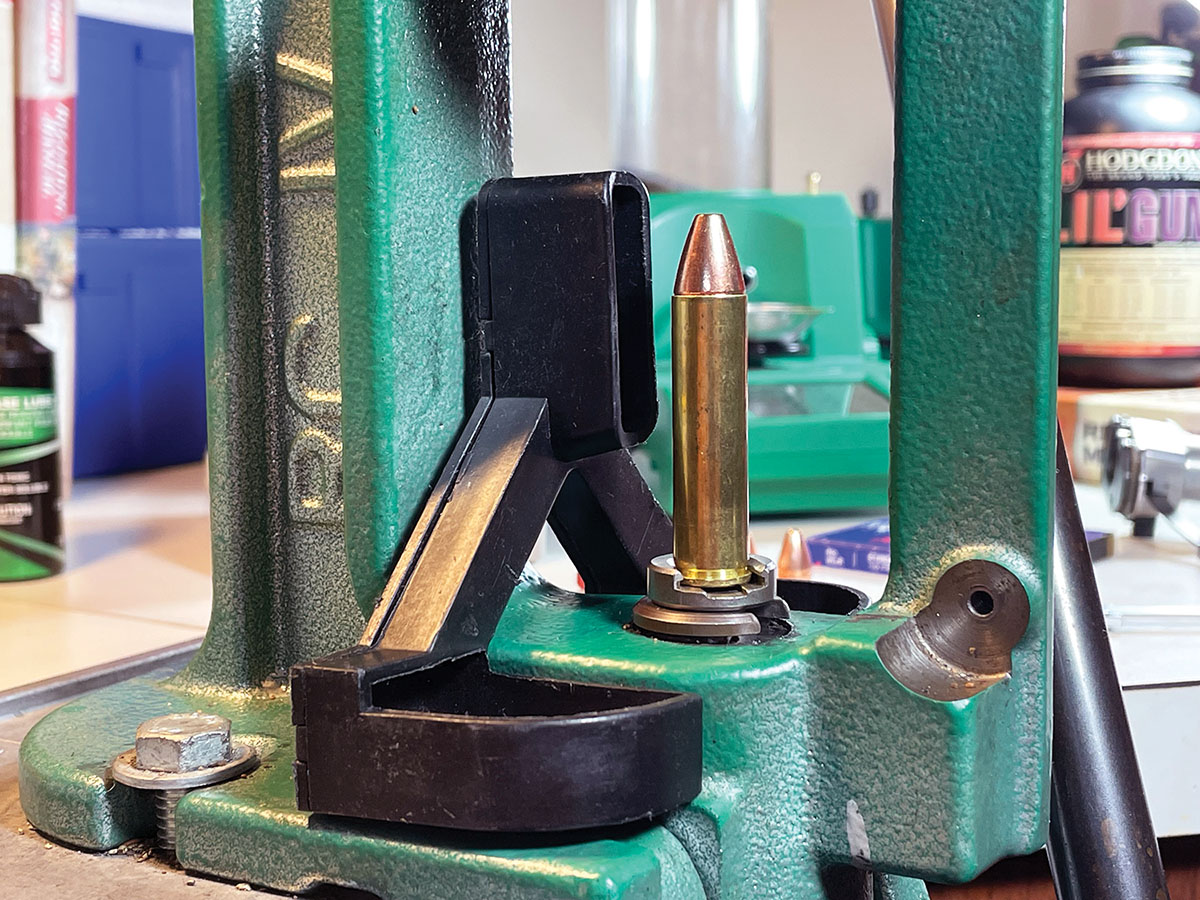
    When it comes to handloading the 460 S&W Magnum, note that it’s not a beginner’s cartridge. Although it shares similarities with other rimmed, straight-walled cartridges, there are far more things to consider, especially when employed in a carbine. As for dies, three- and four-piece sets are available in carbide, steel and titanium variants and for ease of use, cost and durability, I prefer the former. Redding, RCBS, Hornady, Lee and others make dies for the 460 S&W. New cases for the 460 S&W Magnum aren’t plentiful; essentially, you’ll need to select between Hornady and Starline. I cannot recommend enough that you adhere to the recipe’s case recommendation exactly. This also applies to primer. Some formulas call for a large rifle primer, while others use its magnum sibling. Do not deviate.
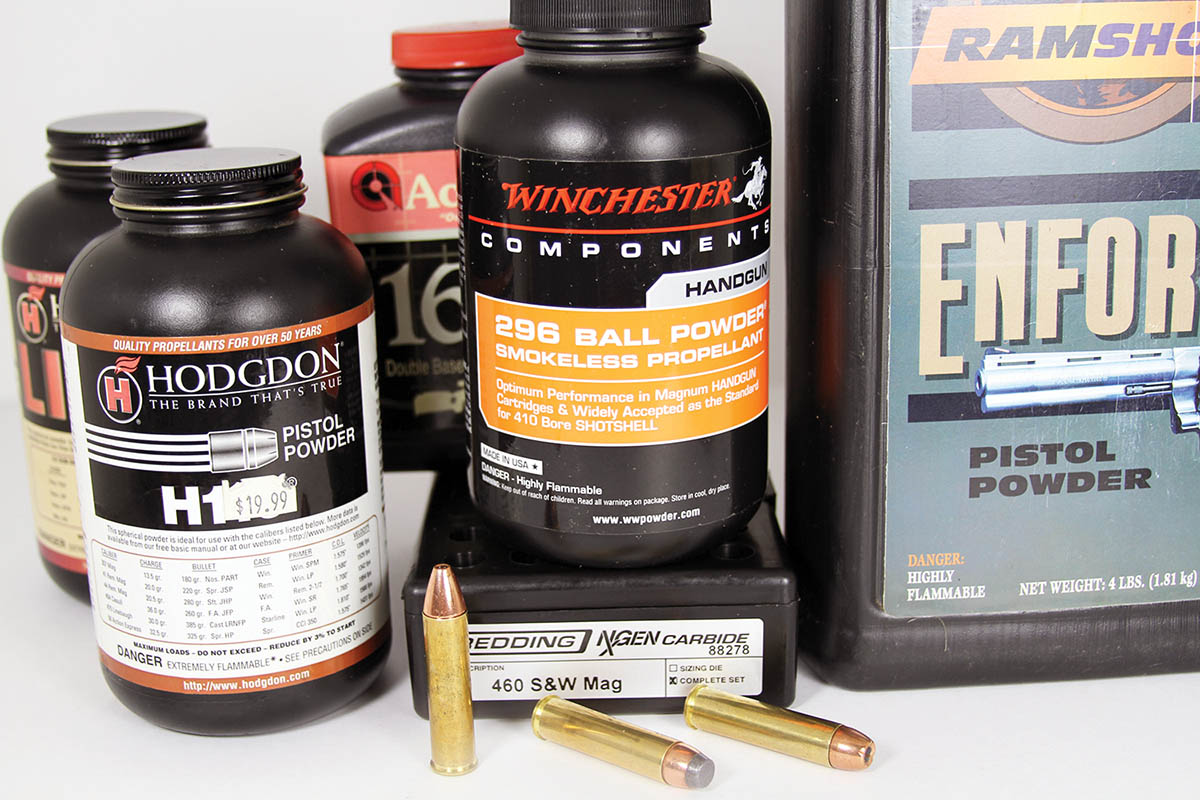
    A wide range of propellants are suitable for use with the 460 S&W Magnum, though the number decreases as projectile weight increases. Most are slow-burning handgun and shotgun propellants.
    A wide range of propellants are suitable for use with the 460 S&W Magnum, though the number decreases as projectile weight increases. Most are slow-burning handgun and shotgun propellants.
    Propellants suitable for the 460 S&W Magnum are quite varied. Most are considered “magnum handgun” and slow-burning, including: Ramshot Enforcer, Hodgdon H-110, Winchester 296 and Accurate No. 9. Atypical choices are: Hodgdon Lil’Gun, CFE BLK, Longshot and H-4198; Accurate 1680, 4100 and 5744; and IMR-4198. Lower-recoil, reduced-velocity loads can be created using Titegroup and Trail Boss. When available, Alliant Power Pistol,2400 and 300-MP are also good choices. Since I primarily use all-copper or stout, copper-jacketed bullets weighing 200 to 300 grains, my favorites are the first four listed and Lil’Gun. From a carbine-length barrel, these propellants shine.

    As mentioned elsewhere, the 460 S&W uses 0.451- to 0.452-inch diameter bullets, which are diverse. Most are, however, not suitable when used in a carbine. Bullets in the aforementioned diameters are also used in the 45 Colt and 454 Casull, among others, but any designed for the Colt are no-gos for hunting; excessive expansion is guaranteed when impacting at the 460’s elevated velocities. Even projectiles that are fitting for the 454 Casull will fail. Note in the accompanying table how fast the .45-caliber projectiles are exiting from the Encore’s 20-inch barrel. Fast, huh?

    Given the 460 S&W Magnum’s ultra-high velocities in a carbine, the best options for big-game hunting where expansion is desired or required by law will be those that are homogenous (ex. all-copper) or have a lead-alloy core that’s mechanically locked or bonded to the jacket. The latter is preferable, as most non-bonded, “traditional” cup-and-core bullets simply cannot withstand velocities well in excess of those for which they were designed.
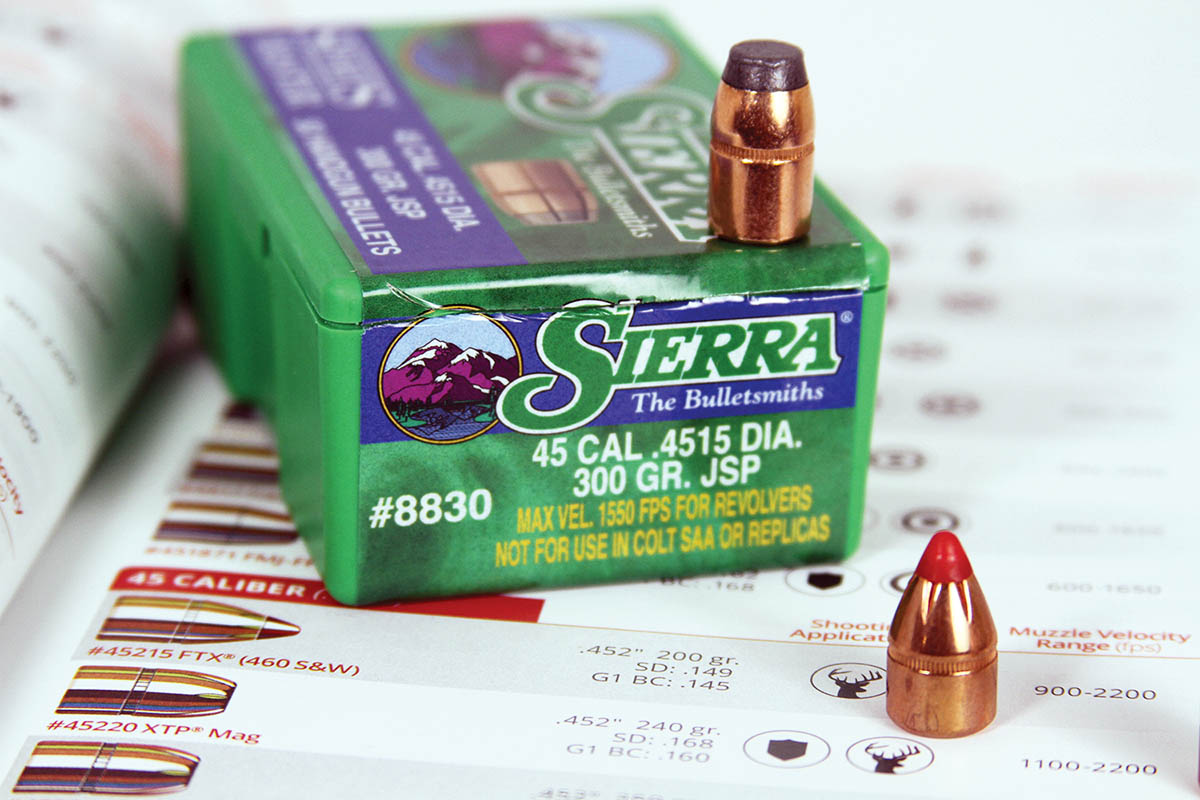
    Velocities from a carbine in 460 S&W Magnum are much higher than from a revolver. Therefore, it’s prudent to determine the upper velocity limit before using them afield. If the information cannot be found in the handloading  manual, online, or on the packaging, contact the manufacturer directly.
    Velocities from a carbine in 460 S&W Magnum are much higher than from a revolver. Therefore, it’s prudent to determine the upper velocity limit before using them afield. If the information cannot be found in the handloading manual, online, or on the packaging, contact the manufacturer directly.
    A perfect example is Sierra’s Sports Master 300-grain jacketed softpoint, which, according to the company’s website, was “designed for hunting, specifically for large bears,” and “it is not, however, recommended for deer-size game because of its hardness.” In speaking with knowledgeable Sierra staff, that additional velocity changes things. From a carbine, it would be a reliable deer bullet, albeit causing significant damage to edible meat. What’s more, the 240- and 300-grain XTP Mag bullets from Hornady have a suggested velocity range topping out at 2,200 fps. Handloads consistently exceeded 2,500 and 2,200 fps, respectively, from the 20-inch barreled Encore. Still, their stout construction gives them the best chance of withstanding a high-velocity impact.

    Given the 460’s stout recoil, and despite most long guns for it being single shots, a solid roll crimp is appropriate. Bullets meant for the round will have a crimping ring. Additionally, if you’re using a lever-action, the tubular magazine demands the use of Hornady’s FTX bullet, or a jacketed softpoint or a jacketed hollowpoint. Do not use a rigid, pointed projectile.

    Hard-cast and non-expanding, mono-metal (monolithic) bullets, such as those from Lehigh Defense, are options, too, but only if permitted by law in the area you’ll be hunting. Some can successfully argue that, for close-in feral hogs, such as at feeders, they’d be the best bet.
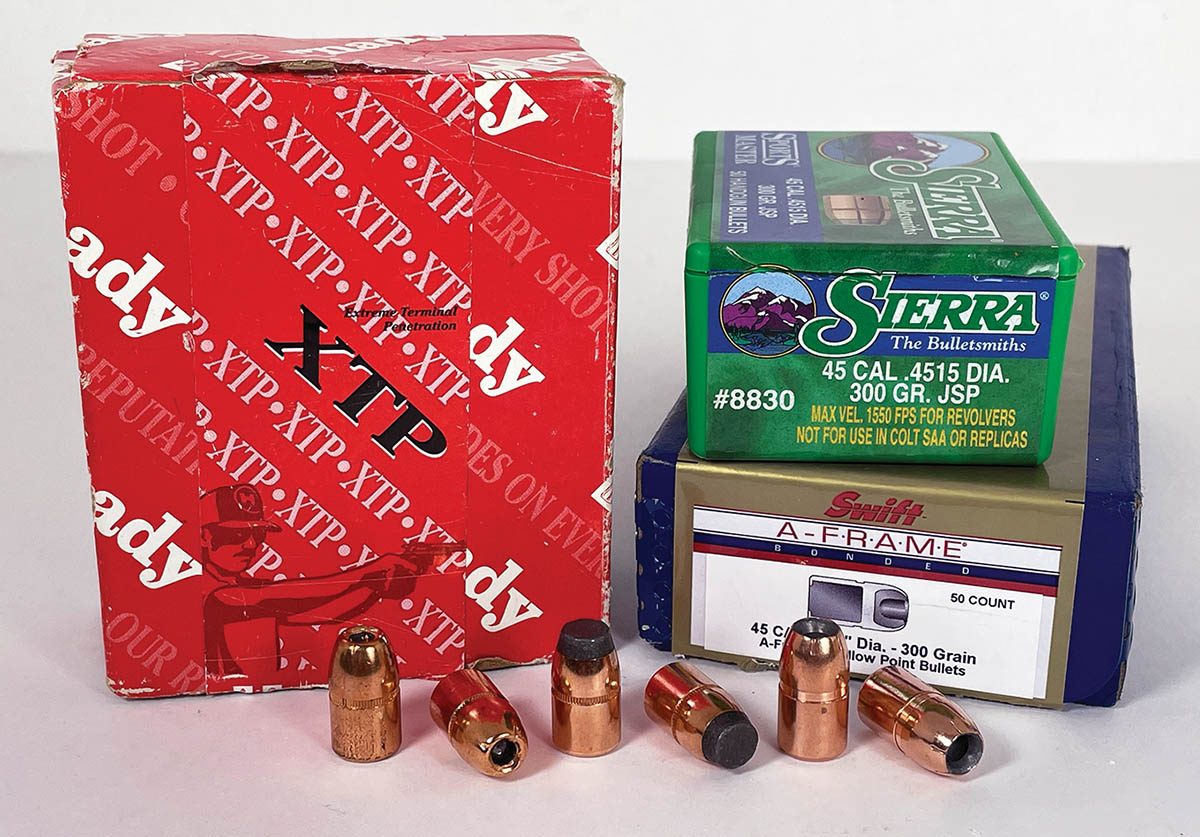
    Jacketed, lead-core bullets are greater in diversity and, in general, less costly, making them perfect for practice. Only those that are bonded or have a stout mechanical lock should be employed on big game when propelled from a 460 S&W Magnum-chambered carbine.
    Jacketed, lead-core bullets are greater in diversity and, in general, less costly, making them perfect for practice. Only those that are bonded or have a stout mechanical lock should be employed on big game when propelled from a 460 S&W Magnum-chambered carbine.
    All testing for this article was conducted using a T/C Encore frame matched with a Smith & Wesson era 20-inch Katahdin barrel, topped with a Vortex Diamondback HP 4-16x 42mm scope securely mounted using an EGW base and four SSK Firearms TSOB rings. Overkill? Nope. Extensively firing a lightweight, 460 S&W Magnum-chambered T/C Encore from a rest, in this case a Caldwell Lead Sled Solo, will cause the scope to migrate. Instead, you might optto lap the rings and use resin, or another means to help hold them. To each their own.

    Immediately obvious upon firing the Encore is that, from a lengthy barrel, the 460 S&W has an alter ego. In fact, the numbers displayed on the Garmin XERO C1 PRO Chronograph are hard to comprehend at first. For instance, even without a maximum charge, the Barnes 200-grain XPB exceeded 2,800 fps. That’s 300 Winchester Magnum territory when a bullet of identical weight is used. Hornady’s 200-gr. FTX attained the same. Now think about having that level of performance when a bruiser Midwest buck steps out at 300 yards. Gravy. Best of all, thanks to the absence of an action (i.e., bolt, semi, etc.), said Encore is exceptionally short and maneuverable. How about nearing (or even surpassing) 2,200 fps with 275- and 300-grain projectiles. Give the 460 S&W Magnum’s propellant an opportunity to fully burn while not shedding gases, and it is easy to achieve. That makes bullet selection far more critical.

    As seen in the accompanying table, the 460 S&W Magnum is capable of good accuracy across the range of weights; however, there were standouts. The pre-R5 barrel from the Smith & Wesson era certainly showed a preference for Barnes’ all-copper XPBs, and especially the 200-grain version. Hornady’s 200-grain FTX also clustered tightly, though I would be reluctant to use them on big game close-in due to the increased velocity.
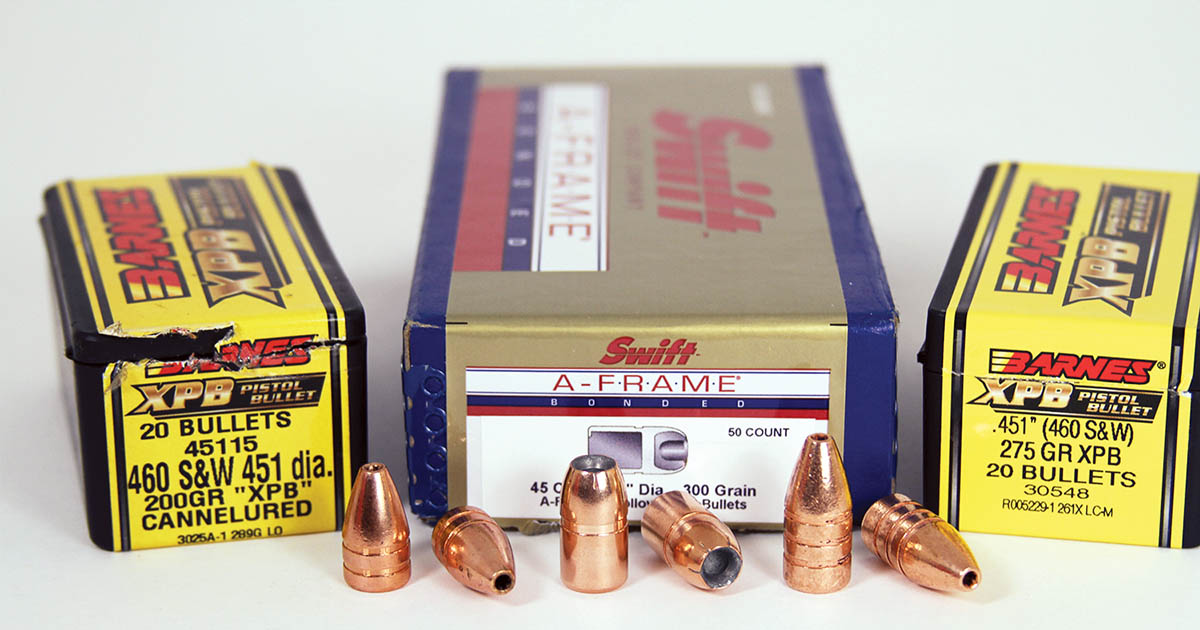
    With better containment of expanding gases and increased propellant use, velocities from a carbine barrel can be substantially higher than with a handgun. For big-game hunting, the best options are homogenous in construction, such as the Barnes XPB, or bonded, including Swift’s A-Frame Revolver.
    With better containment of expanding gases and increased propellant use, velocities from a carbine barrel can be substantially higher than with a handgun. For big-game hunting, the best options are homogenous in construction, such as the Barnes XPB, or bonded, including Swift’s A-Frame Revolver.
    Belin set out to create, and achieved, the fastest production revolver. He didn’t know it at the time, but in introducing the 460 S&W Magnum, future hunters would be blessed with one of the finest straight-walled cartridges for dropping distant deer and nigh most of the world’s huntable species, for that matter. Add in the fact that the same firearm (revolvers and single shots) can fire 45 Colt and 454 Casull interchangeably, and you have a real winner.

    Fans of T/C Arms, and especially of the Encore, can rejoice because the company’s former owner, Gregg Ritz, and other investors acquired the assets of T/C Arms from Smith & Wesson in 2024. Once purchased, and with much fanfare, operations began in Rochester, New Hampshire, its former home. The company’s headquarters is currently located in Farmington, the town adjacent to Rochester, but its engineers, machining center and investment casting all still take place in Rochester. Returning to their roots, smart.

    As for the company’s initial offering, the Encore and specifically, the ProHunter made the most sense. According to Ritz, it also declared, “we’re back.” First unveiled in 1997, the versatility of the single-shot, break-open Encore is unmatched. The single-shot platform can be configured as a handgun, carbine, rifle, shotgun and muzzleloader, and it’s been offered in 140 chamberings. It’s ideal for the cartridge tinkerer, such as myself.
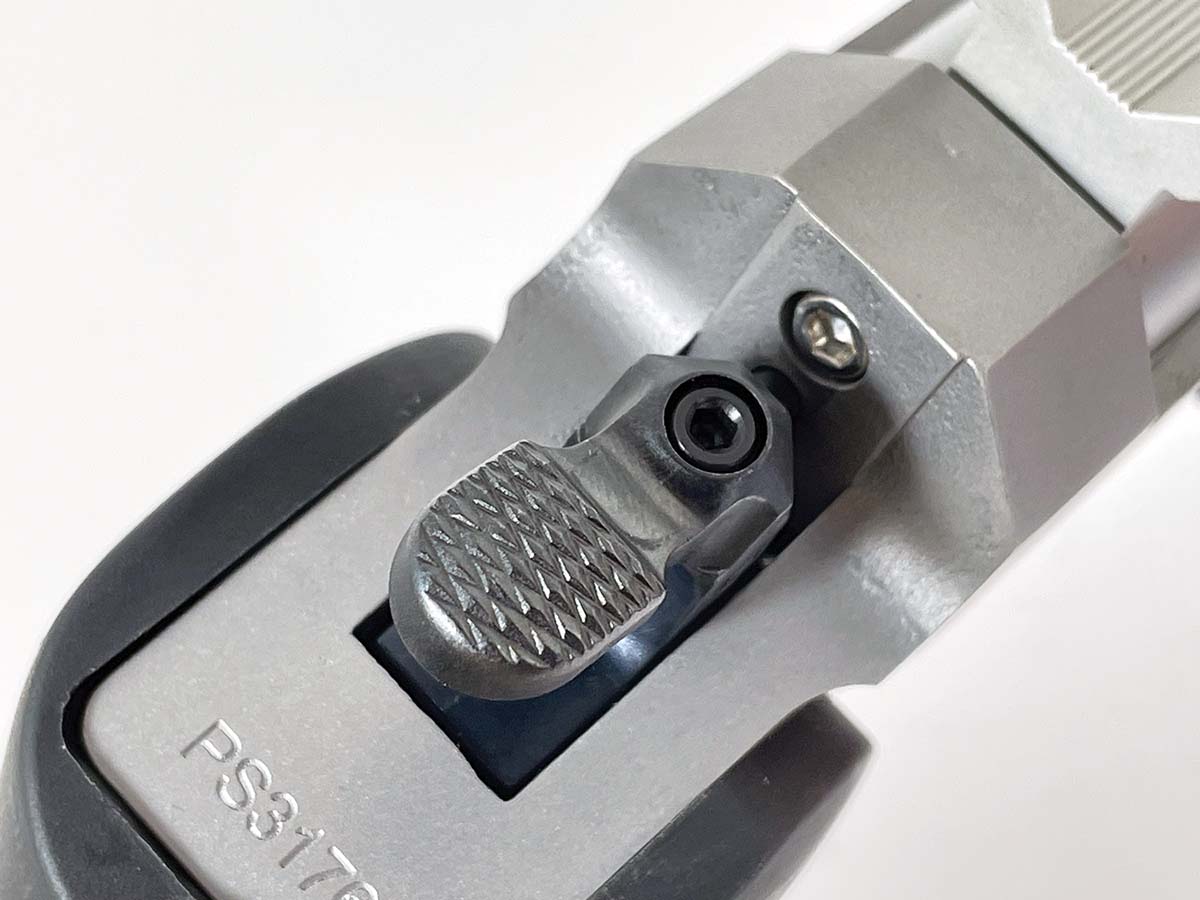
    Among the changes to the T/C Encore is the  textured swing hammer, which increases purchase when a scope is mounted.
    Among the changes to the T/C Encore is the textured swing hammer, which increases purchase when a scope is mounted.
    Ritz also understood that the original Encore ProHunter could benefit from upgrades, many of which weren’t possible until now. As an example, the critical hinge pin used to be created in multiple operations. Not anymore. The company’s Eurotech CNC machines are capable of completing the process in one machine, thereby improving chambering. “Tolerances,” according to Ritz, “are maintained to a thousandth of an inch.”

    What’s more, the new Encore ProHunter has a refined trigger, thanks to the nitride treatment on the trigger and sear. On the sample sent for evaluation, the trigger exhibited no discernible creep and broke at 3 pounds, 15.3 ounces, much better than those on the originals. Said finish is also on the firing pin and bushing, as well as the newly designed Speed Breech XT muzzleloader breech plug. 
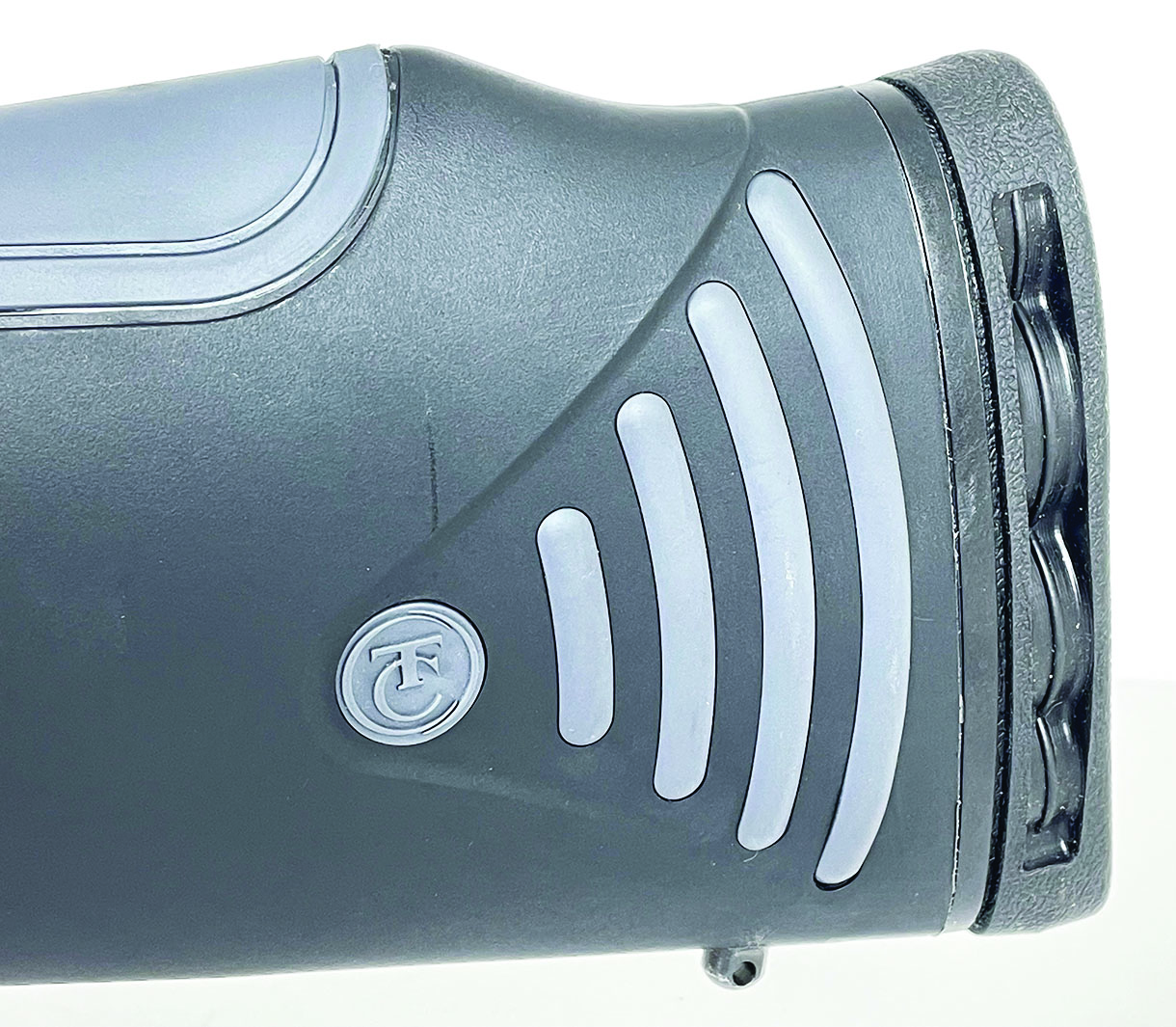
    Single-shots, such as the T/C Encore are  generally lightweight. To mitigate felt recoil, the new arms have FlexTech stocks with Limbsaver AirTech recoil pad and Energy Burners.
    Single-shots, such as the T/C Encore are generally lightweight. To mitigate felt recoil, the new arms have FlexTech stocks with Limbsaver AirTech recoil pad and Energy Burners.
    Green Mountain provides the bored barrel blanks, and T/C finishes them in-house. All center-fire barrels are threaded at the muzzle and feature 5R rifling, which debuted in 2007 on the T/C Icon bolt-action rifle, but wasn’t previously used on Encore barrels. Reduced copper fouling and bullet deformation are purported benefits. Since rifled “slug” and muzzleloader barrels are most often used with bullets contained within sabots, and thus benefit from sharp rifling, 5R rifling isn’t used on them. The fluted, button-rifled, brush-honed barrels feature match-grade crowns. Centerfire and rifled slug barrels measure 26 inches, while muzzleloader barrels are 28 inches. As with the originals, the current Katahdin carbine barrels measure 20 inches. I confirmed that both old and new Encore barrels can be used with the new Encore ProHunter receiver; everything fit seamlessly. 

    The new ProHunter has a swing (rotating) hammer that can be offset to the left and right, and the FlexTech stock has a LimbSaver AirTech recoil pad and Energy Burners to reduce recoil. Reportedly, this equates to a 70 percent reduction.

    Unlike in the past, complete Encore ProHunter rifles aren’t being sold; instead, the consumer buys the frame and barrel separately. An exception is muzzleloaders. Rather than sell dealer direct, the company is working with six of the largest distributors. Ritz acknowledged that demand is currently exceeding supply, but the company is looking to scale. Quality, however, is the foremost consideration. He reported that Encore handgun frames will be available by the time that this published.

    As for barrels, according to a February 6, 2025, Facebook post, center-fire calibers will range from 204 Ruger to 500 S&W Magnum, and will include hot numbers such as 22 ARC, 6.5 Creedmoor, 350 Legend, 360 Buckhammer, 400 Legend, 450 Bushmaster, and, the subject of this article, 460 S&W Magnum. Of course, the standard cartridges will be available as well. As Ritz pointed out, T/C has never offered some of the aforementioned chamberings, but the 350, 360 and 400 accounted for 50 percent of sales. Again, they’re straight-walled cartridges for deer hunting. Additionally, there will be .45- and .50-caliber muzzleloader barrels, as well as smoothbores in .410 bore and 20- and 12-gauge.

    Ritz shared some insight that cannot be mentioned here, but suffice it to say, he has big plans. He achieved great things when heading the company before S&W’s acquisition, and I have no doubt that he’ll do it again. Fortunately, for fans of T/C and, especially, the Encore, it’s back and better than ever.


    Wolfe Publishing Group