

From the Bench
Throw in Water, Return to Ordnance Department
column By: Art Merrill | June, 26
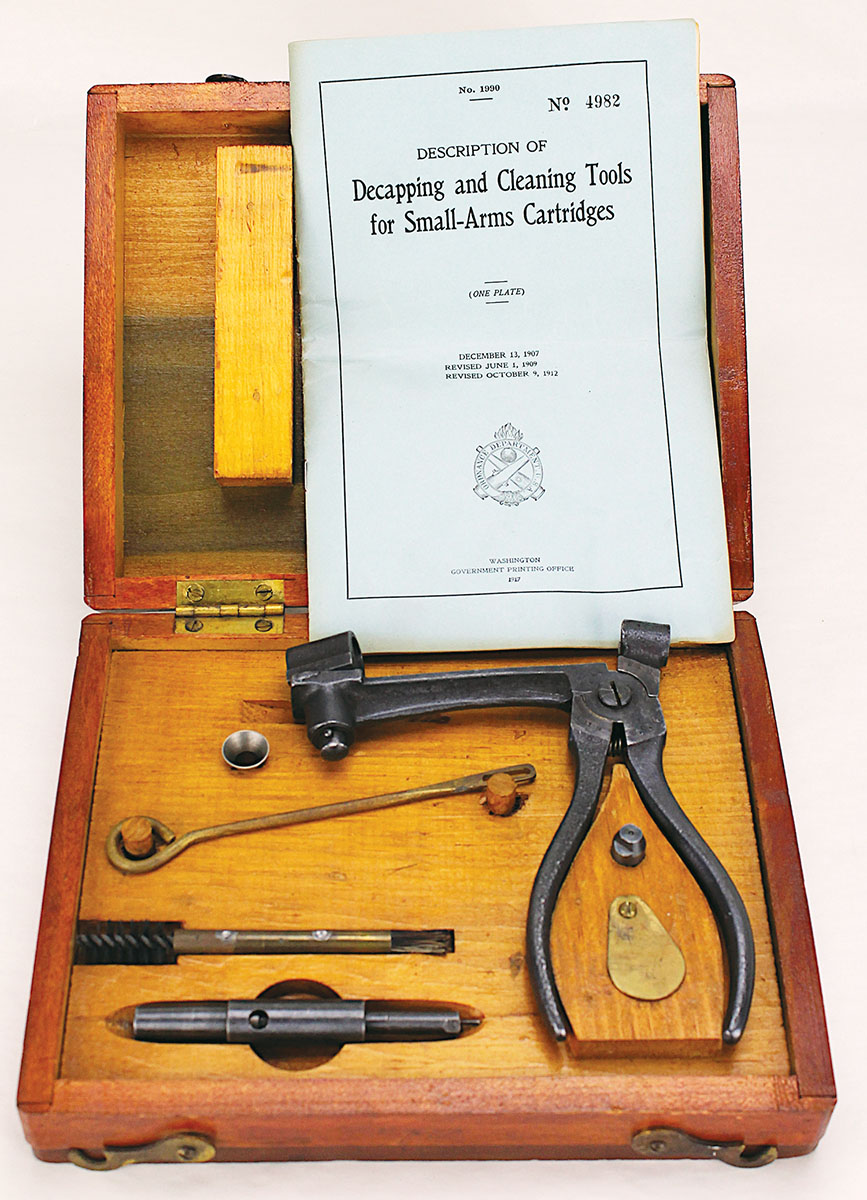
At a recent cartridge collector’s show (no, I’m not a real collector, I attended with a friend who is), I stumbled onto a unique piece of Americana that would perhaps interest most handloaders as a historical curiosity. Eminently practical and useful for its purpose more than a hundred years ago, this piece has been eclipsed by time and the sometimes wasteful, bigger-better-faster-more attitude that underscores our lives here in the future.
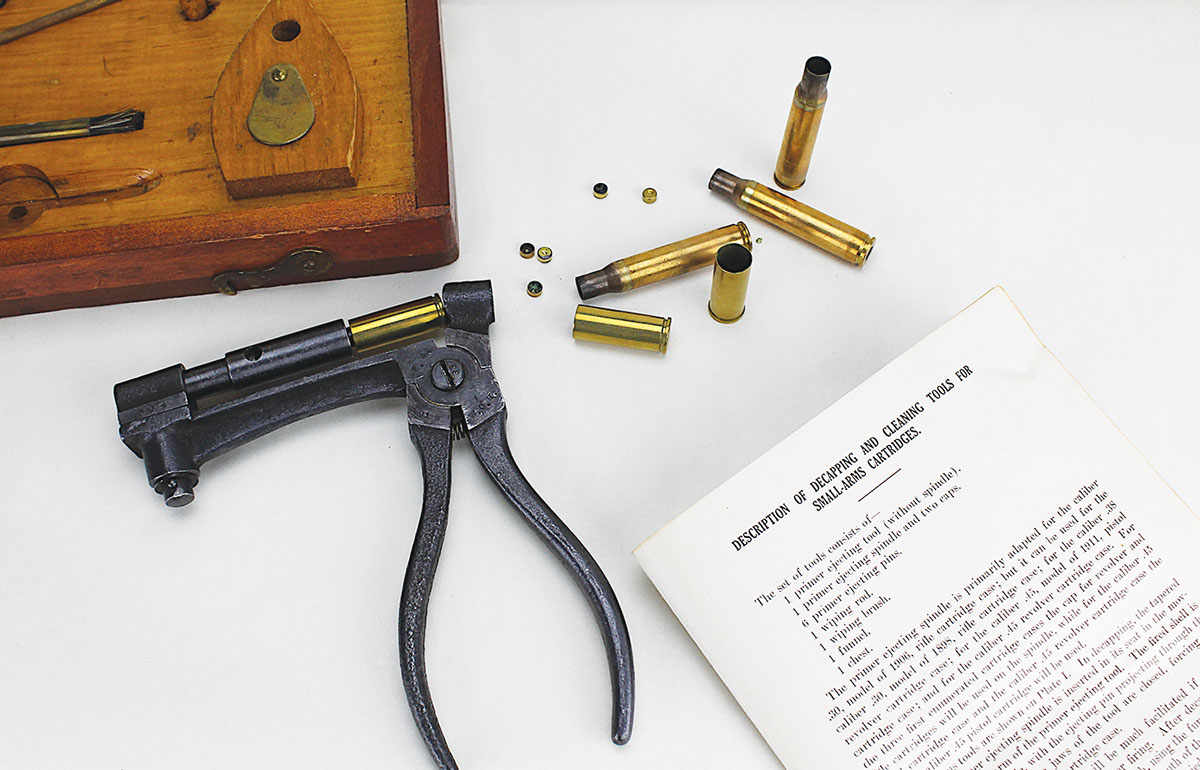
“DECAPPING & CLEANING TOOL OUTFIT” painted onto the top of the roughly 9x7-inch wooden chest in faded military stenciling tells us the function of the tools within, but the War Department’s 1912 Description of Decapping and Cleaning Tools for Small-Arms Cartridges pamphlet inside the chest offers only a cursory overview on how to use them. Puzzling out how to use the tools, as well as researching the reason for making up such a single-purpose kit,
turned out to be a fascinating hands-on experience delving into American military history and American military fiscal thinking.
Judging by the first-printing date on the enclosed pamphlet, these kits, manufactured at Frankford Arsenal in Philadelphia, were initially issued to “Regular Army and Organized Militia of the United States” (according to the pamphlet) by the Ordnance Department in 1907, with issue apparently continuing at least through World War I. Not full-on cartridge-reloading kits; the tools are only designed to de-prime and perform a perfunctory cleaning of fired 30 U.S. Army (30-40 Krag), 30-06, 38 Long Colt, 45 Colt and 45 ACP cartridge cases.
Those were the days when marksmanship training included practice with so-called “gallery loads” that launched bullets at lower velocity and with less recoil, in addition to shooting standard-issue ammunition. Those were also frugal days, and after firing, the cases had to be de-primed, cleaned and returned to the Ordnance Department, which repurposed (in today’s parlance) the cases, assumably for dummy rounds but also, perhaps, to reload as gallery loads. This explains why the kit does not include any other reloading tools.
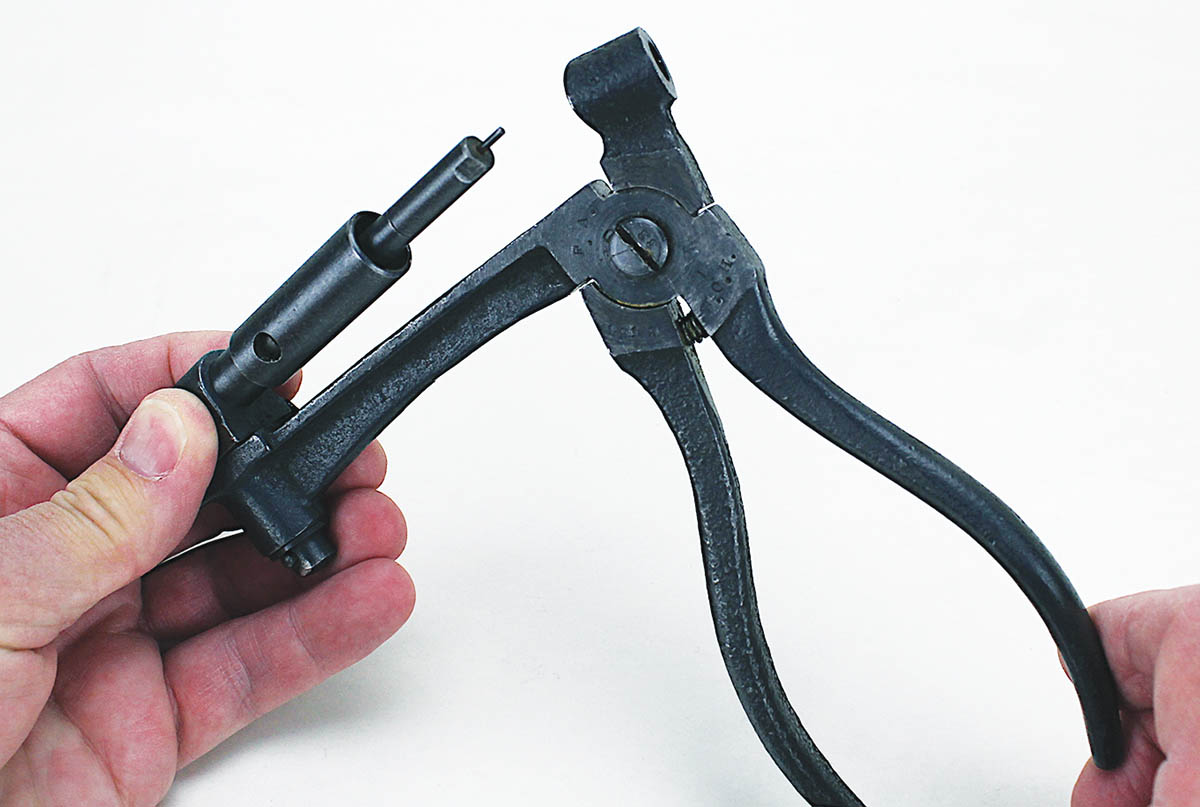
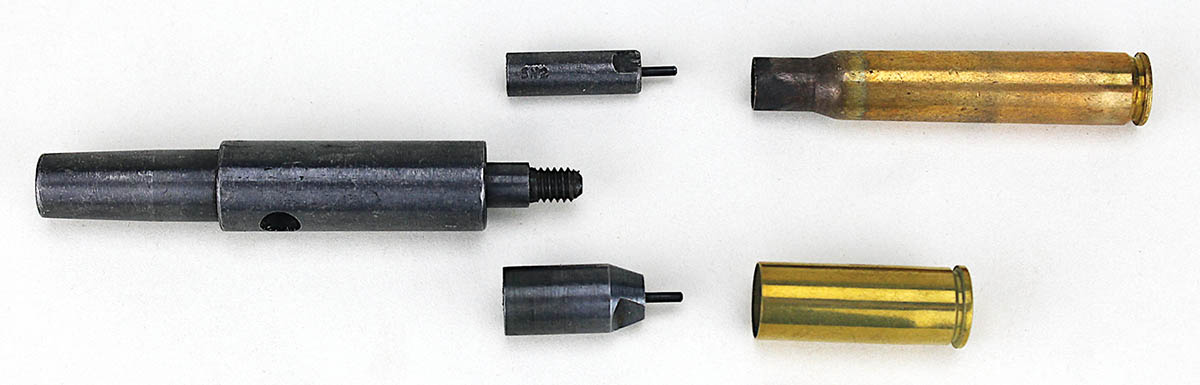
The tool set is composed of a tong-type primer ejecting tool, a spindle threaded for two caps (one for 30- and 38-caliber cases and one for 45-caliber cases), two of the original six primer ejecting pins, one wiping (cleaning) rod, one wiping brush and a funnel.
A number of stampings appear on the primer ejecting tool, one of which, “1919,” we may reasonably assume to be the year of manufacture. “F.A.” logically indicates Frankford Arsenal, and “W.O.H.” the initials of an inspector or the arsenal commandant (whose names in the year 1919 I was unable to determine). The number 33 appears on three parts, so it may be a serial number, while “5A2,” “5B3” and “5C4” appear to be assembly numbers. Additionally, an enigmatic number 83 is stamped into the movable socket attached to the primer ejecting tool arm.
“The cleaning of the shells will be much facilitated if they are thrown into water immediately after firing,” the pamphlet suggests. Water also served to dissolve the corrosive primer salts of the day that weakened brass. I found one kit accessory to be a bit puzzling upon first examination: What is the purpose of the tinned brass funnel? The answer is a bit of over-the-top frugality that may actually have been counterproductive. The pamphlet directs using the funnel “to prevent rapid wearing out of the [wiping brush] bristles on the mouth of the case.” It doesn’t seem likely that manufacturing a brass funnel would be less expensive than replacing a small bristle brush, but I wasn’t there, so ¿quien sabe?
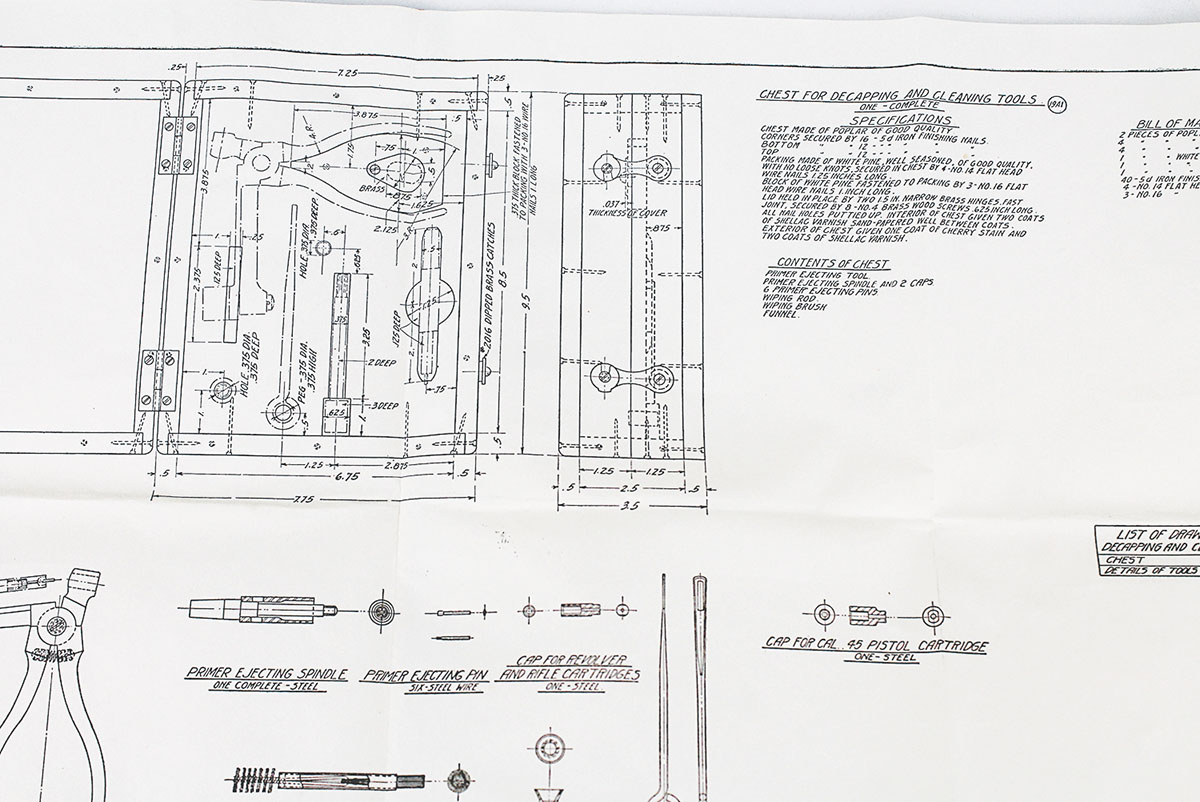
Some of these kits survive more or less intact, and at least some are still in flawless working condition, as I demonstrated, which is pretty remarkable when one considers their age and that they were certainly used by inexpert hands. Perhaps not so remarkable: Every piece in the cherry-stained poplar chest is quality-made of steel and brass – no plastic or pot metal here. A tri-fold sheet bound into the pamphlet describes the wooden chest in exhaustive detail, down to the physical orientation and number of nails, wire nails and screws used in its manufacture, and the exact dimensions and depths of the tool cutouts, as well as an inventory and precise illustrations of the tools.
A fairly extensive online perusal shows kits – like this one with an undamaged chest and that include the original pamphlet and all the (non-rusty) tools – have a value in the $300 to $500 range, but they are, of course, worth whatever a collector of such things will pay. I am not an avid collector of such things but I have satisfied my curiosity. The kit will likely go on the table at the next local gun show, and I will move on to the next adventure.