

Propellant Profiles
Shooters World – The Patriot
column By: Rob Behr | June, 26
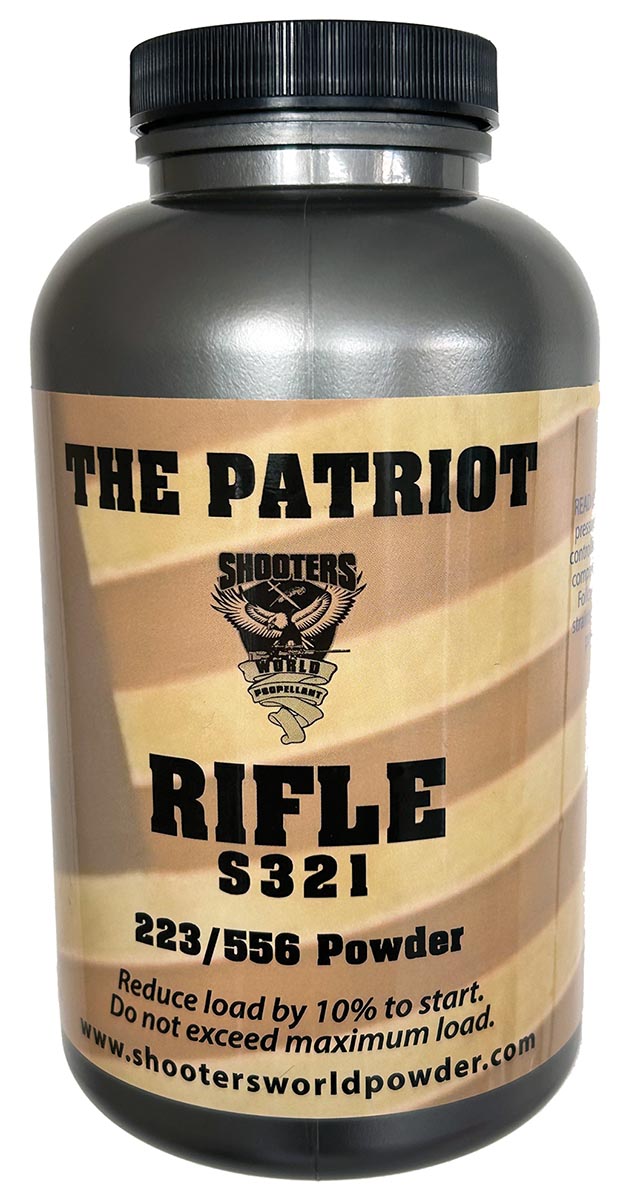
The Patriot is manufactured in Somerset West, South Africa, by Rheinmetall Denel Munitions (Pty) Ltd. Outside the United States, this powder is part of the SOMCHEM line of canisterized propellants and designated as S321. With a bulk density of .975g/cc and a burn rate that Shooters World compares to Hodgdon H-335, The Patriot promises a nearly ideal burn rate for 223 Remington and 308 Winchester.
Physical Characteristics
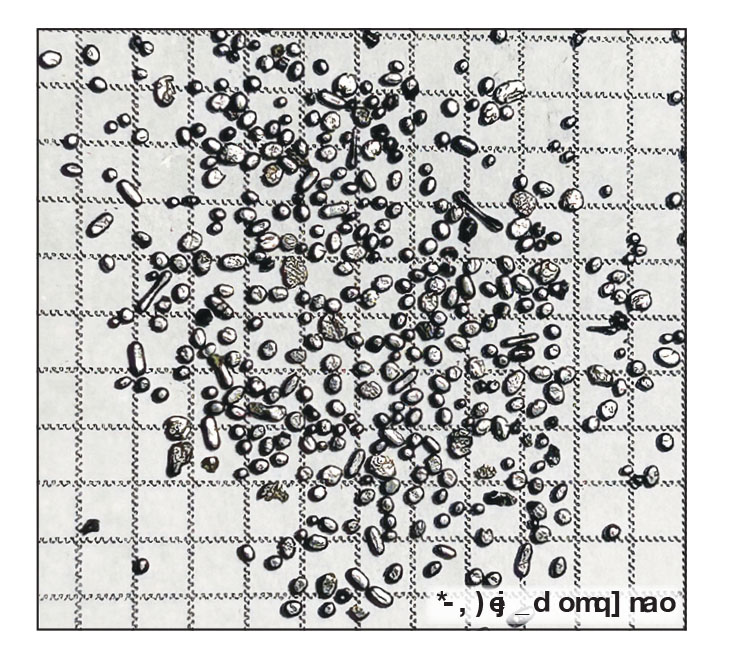
When I dumped out a small sample of The Patriot for photography, I was startled by its lack of uniformity. It was concerning enough that I compared the grains to a second bottle of The Patriot, and then, for good measure, I opened another bottle of SOMCHEM propellant that is slated for a later story. All three pounds of powder had the same surprising variety of grain shapes and sizes.
Some of the shapes were spherical, which is typical for a double-base propellant. These spheres, however, differed dramatically in diameter. The smallest one from the sample measured .0145-inch. Some grains appeared to be flattened and squarish. Because of the wide variety of shapes, I simply selected the one that stood out from the rest. It measured 0.0145 inch thick and 0.042 inch across its length. I did not measure the ones that looked like clubs, the elongated grains that looked like barbells or the rounded cylinders. There were just too many shapes and sizes.
Temperature Stability Testing
I always start my testing with the frozen cartridges. It just makes sense. Fire three in rapid order, let the barrel cool back down to ambient temperature, and repeat until all nine have been fired. Based on those initial shots, The Patriot looked like a real winner, producing an extreme spread of 10.9 feet per second (fps) and a standard deviation of 4.5 fps. The average velocity was 2,630 fps.
The cartridges heated to 120 degrees produced an average velocity of 2,655 fps, an increase of just 1.33 percent. over the frozen cartridges. Rosy as that number seems, there was a moderate shift in the extreme spread between the hot and cold cartridges. The warm cartridges had an extreme spread of 35.3 fps, which is an increase of 224 percent over the frozen cartridges.
Accuracy Testing
I rarely compare the accuracy of one powder against another because there are so many variables involved. My experience is that almost any powder with a burn rate appropriate to the cartridge can be coaxed into producing reasonable accuracy. In this instance, the two powders produced virtually identical groups at 100 yards without any coaxing.
In all, I fired five groups using Berger 168-grain Target BT bullets and 41 grains of The Patriot. Considering that this was not a load I worked up, but simply selected from Shooters World data, the performance seems promising. The average of these five groups was 0.820 inch, with the smallest group just more than half an inch.
The Cooper proved more finicky.
The smallest group I got using a 55-grain Berger flatbase varmint bullets was .631 inch. The largest was 1.3 inches. That is just part of the challenge of handloading. I’m confident I could work up a load that would shrink those groups, but in this instance, the Cooper just didn’t get along with The Patriot.
Fouling Cleanup
Before going to the range, I cleaned my Cooper thoroughly using Montana Xtreme Copper Killer. At the end of testing, the rifle had only had 18 rounds down its newly cleaned bore, and I did not expect much fouling. I had originally intended to use the 308 for this, but it finally dawned on me that my testing of H-335 in that rifle had ruined the test parameters. So, it was the Cooper or bust, even with its low round count.
The dry patch came out with some black fouling on its leading edges that tapered off to light gray. There were no unburned powder grains. It took five patches and a little more Copper Killer to have a completely clean bore. Overall, the powder seems to have burned quite cleanly.
Data
There are two solid sources of data for The Patriot. The first is from Shooters World and can be found at ShootersWorldPowder.com. The SOMCHEM handloading data site is extremely thorough by American standards. It offers data on flame temperature, which by the way is 4,810 degrees Fahrenheit, specific energy and relative heat of explosion. Honestly, it is worth going to the site just to access these often discussed (at least by serious handloaders) but rarely published propellant characteristics. Data for S321 can be found at somchemreload.com/propellants/s321.
The Takeaway
Overall, the powder performed quite well. The weird powder geometry threw me at first, but The Patriot produced consistent velocities even when subjected to heat and cold. It proved to be accurate, especially in my 308 Winchester, and was easy to clean up at the end of the day. There is also another charming aspect to this propellant. I compared The Patriot’s pricing on several sites. By and large, it is about $10 less than a pound than H-335. Now I like it even more.
.jpg)