

Bullets & Brass
9.3x62mm Mauser Data
column By: Brian Pearce | April, 26
Q: I have enjoyed the content of Handloader magazine for many years, and especially your insight and details of developing loads for handgun cartridges. Today, I am hoping you can help me with a less popular rifle cartridge, the 9.3x62mm. Many years ago, I acquired a one-of-a-kind, high-grade European example built on a commercial Mauser 98 action. I have no idea of the manufacturer, but it is engraved and fitted with a stunning stock. It has literally been too nice to hunt with, so a few years back I purchased a Ruger No. 1 in the same caliber.
For a period, I used the 286-grain Nosler Partition bullet pushed with 57.0 grains of Norma 202 powder, but I have not been able to find that powder for many years. I purchased a pound of Alliant Reloder 15 that has a similar burn rate, and it gave good performance. After developing loads, that powder suddenly dried up too. I need a replacement powder and hope to find an extruded version with a similar burn rate, and that will offer similar muzzle velocity while retaining the outstanding accuracy that I was obtaining with both rifles. What do you suggest?
J.M., via Facebook
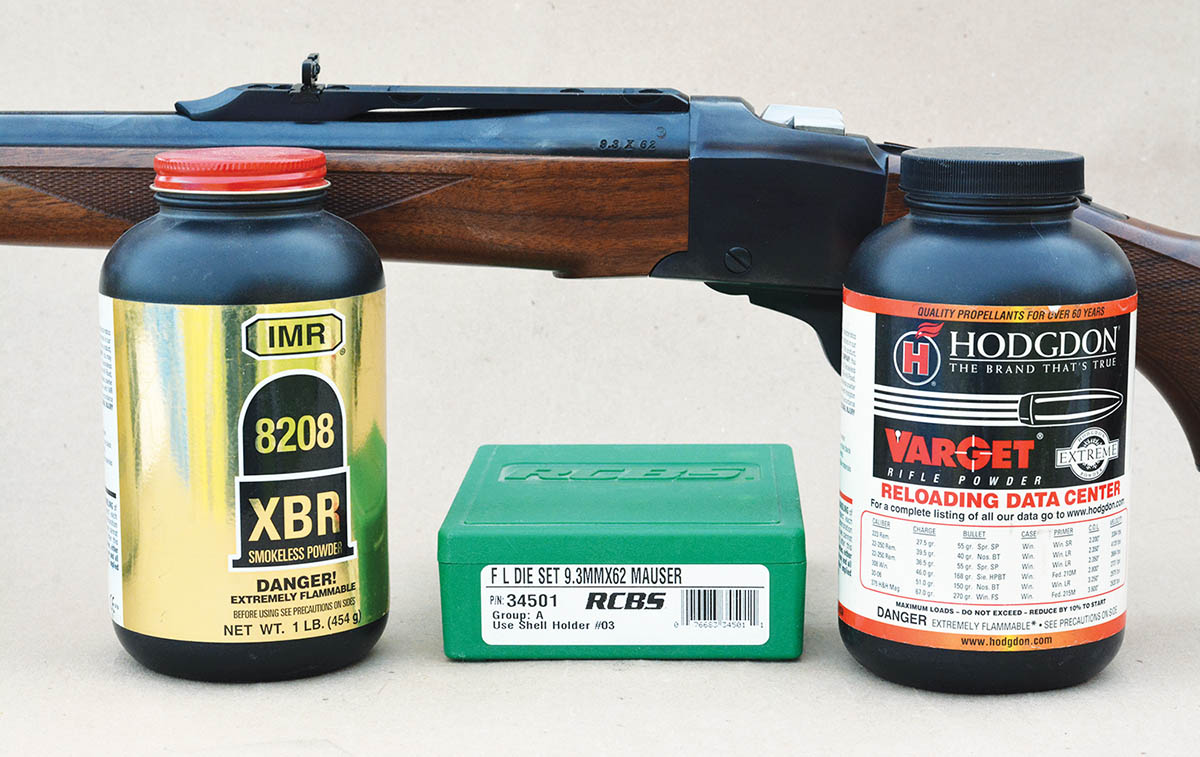
A: Although the 9.3x62mm Mauser was introduced around 1905, it remains a truly outstanding big-game hunting cartridge that I, too, have used in the field on a variety of European game. It is nice to have several domestic companies such as Hornady, Nosler, and others offering brass, components and ammunition.
I believe Hodgdon Varget will be a good place to start. Your targeted velocity of 2,200 feet per second (fps) will be reached with 56.0 to 56.5 grains. Another outstanding option is IMR-8208XBR, with 51.0 to 51.5 grains being the appropriate powder charge. I would ignite these loads with a standard large rifle primer, such as the Federal 210 or CCI 200.
Colt Army Special 32-20 Loads
Q: I have a Colt Army Special that was manufactured around 1920 and chambered in 32-20 Winchester. It has a 6-inch barrel and is in near-new condition with a perfect bore. The problem is that the modern data in current reloading manuals is either low velocity cowboy-type loads or loads that are clearly over pressure and designed for the Thompson Center single-shot pistols and contain .308 inch bullets.
I would like to improve performance, but am not looking to outrun the 327 Federal Magnum. I have two different cast bullets on hand that include the Rim Rock 115-grain RNFP and the 116-grain Lyman mould 311316 with gas check. Both are sized to .313 inch. I would like a load that can push either bullet at 1,000 fps and the Lyman bullet at around 1,200 fps for field use. I have most of the popular revolver powders on hand for loading the 44 Special, 45 Colt, 357 and 44 Magnums. Do you think I am trying to push this old Colt too hard? I value your opinion and would appreciate your thoughts.
C.W., via Facebook
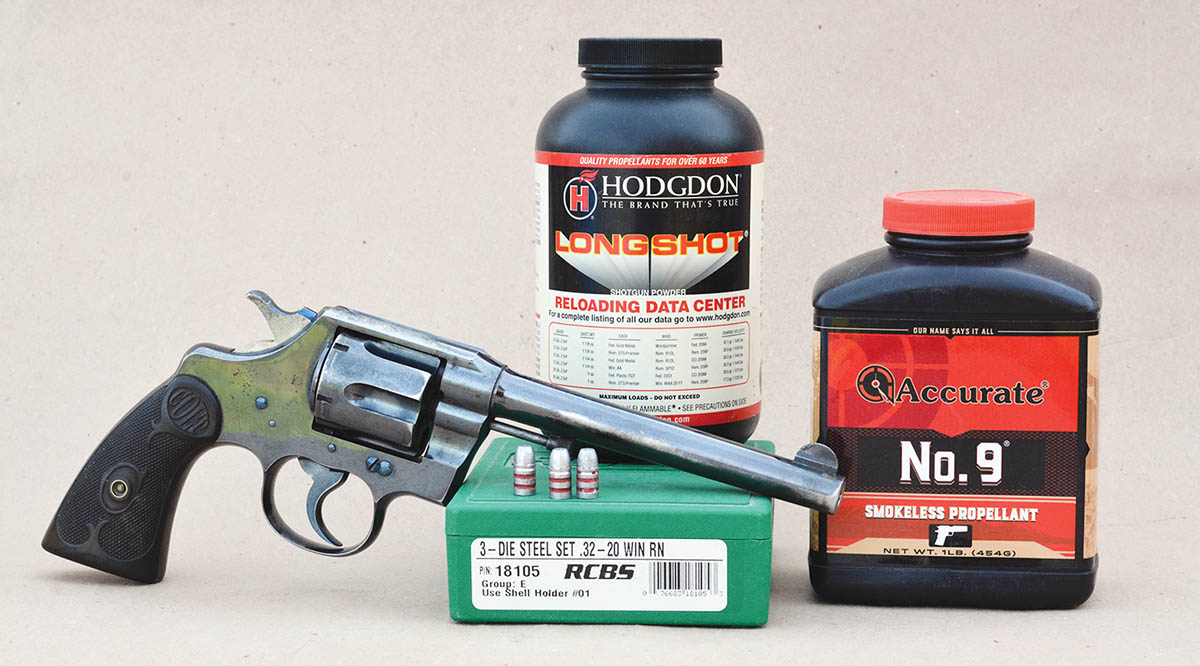
A: Your Colt double-action sixgun is built on the I frame and is fairly robust and durable. In the post World War II era, Colt beefed up the frame in a couple of critical areas and upgraded the steel when it created the Model .357 and Trooper series, as well as the Python 357 Magnum in 1955.
The velocities that you want to obtain are completely within reason. For your 1,000 fps load, try 6.1 grains of Accurate No. 5 powder, 5.1 grains of Hodgdon Longshot or 4.6 grains of Alliant Unique. All of those loads are within the SAAMI maximum pressure limit of 16,000 CUP.
Moving up to a +P style load at 1,200 fps, try 10.0 grains of Accurate No. 9, or 9.5 grains of Alliant 2400. Another notable load is 6.5 grains of Hodgdon Longshot for around 1,150 fps. While this load falls just short of your 1,200 fps goal, it is very accurate and offers reduced muzzle report. The above data was assembled using CCI 400 primers, but can also be used with CCI 500 small pistol primers.
257 Roberts +P Data for My Rifles
Q: I always enjoy the technical information in Handloader magazine. Today, my question is regarding 257 Roberts data for two rifles that I own, including a Remington Model 720A and a Remington Model 760. I acquired both rather recently to go with my post ’64 Winchester Model 70 Featherweight in the same caliber. A local gunsmith told me not
to shoot +P loads through either of the Remington rifles, as they were made in the 1940s and 1950s. He
indicates that guns manufactured prior to 1970 should only be used with standard pressure non-+P loads. I’m not sure that I trust his advice, so I thought that I would ask your opinion.
Years ago, I remember reading your “Pet Loads” article on the 257 Roberts, but I have misplaced that particular issue. Searching online, I could not find that issue of Handloader. So, what are your thoughts? Are my rifles safe with +P data? My second question is, assuming that it is safe with +P loads, what powder would you suggest for top velocities using the 100-grain Nosler Ballistic Tip bullet? Thank you for any advice you can offer.
Jason B., via YouTube
A: Both of your Remington rifles are completely safe to be used with 257 Roberts +P data. Your Model 720A rifle is based on the large Enfield action that is fairly rare but also strong. But to further support that both rifles are safe with +P loads, both were chambered in 270 Winchester, which has a SAAMI maximum average pressure of 65,000 pounds per square inch (psi) or 52,000 copper units of pressure (CUP). By comparison, the 257 Roberts in +P persuasion has a SAAMI maximum average pressure of 58,000 psi or 50,000 CUP. The +P designation first began being used in 1974. However, it was not until the early 1980s that Winchester introduced a +P 257 to the SAAMI specifically for strong and modern rifles like yours.
For comparison, in non +P persuasion, the 257 has a maximum average pressure of 54,000 psi or 45,000 CUP, which are intended for some of the very early rifles with less robust actions.
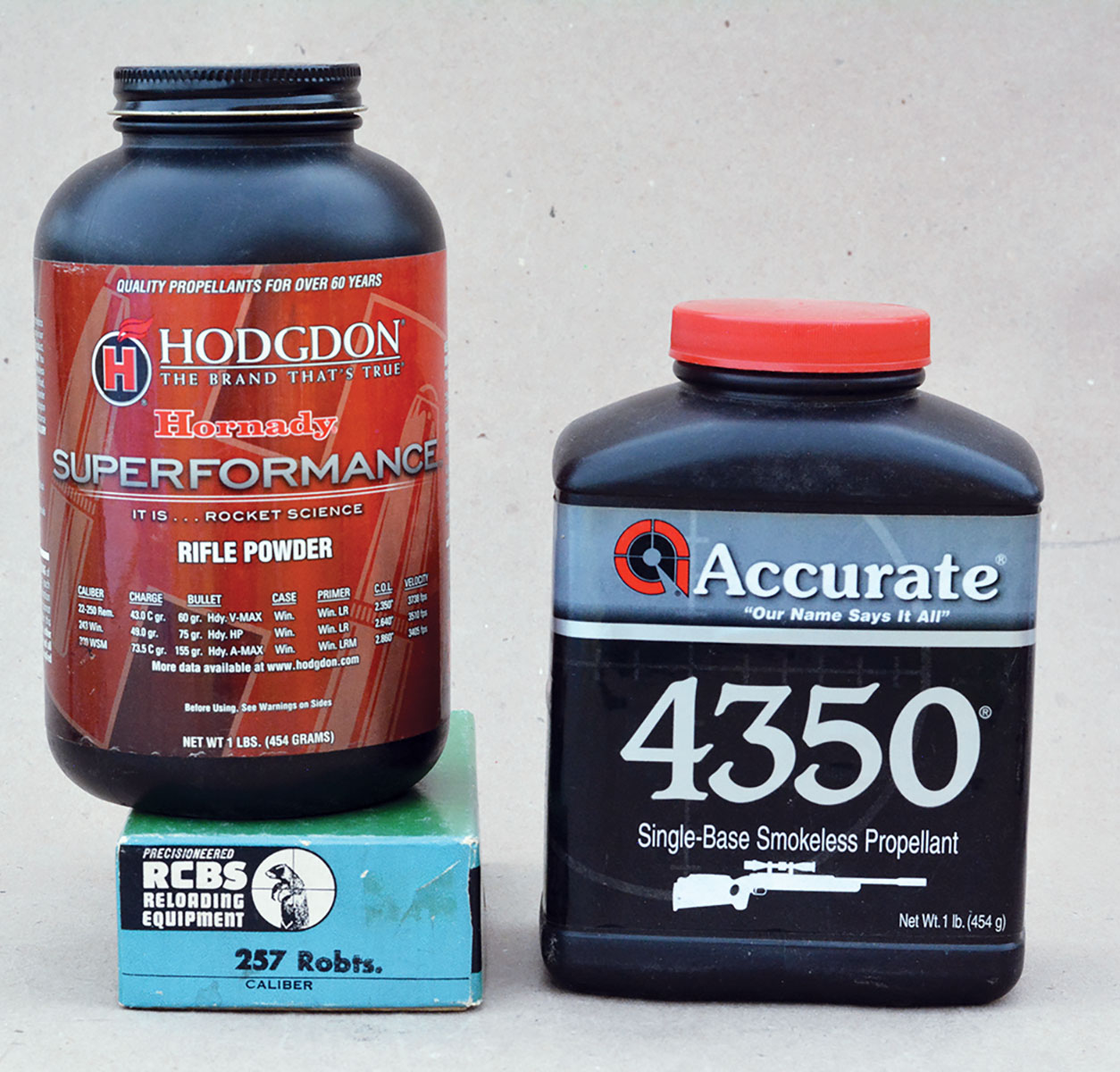
As to handloading data, there are several powders that will give top velocities with the 100-grain Nosler Ballistic Tip. You don’t specify what powders are available to you, so I’ll offer several options. Try 50.0 grains of Hodgdon
Superformance for 3,176 fps, 47.0 grains of Accurate A-4350 for just over 3,100 fps or 46.5 grains of Accurate A-2700 for 3,135 fps. These velocities were obtained from a 22-inch barrel and were primed using CCI BR-2 primers. The above loads are maximum, so it is suggested to start 5% below and then increase charges while watching for signs of excess pressure. Incidentally, my “Pet Loads” article on the 257 can be found in Handloader No. 329 (December, 2020).