

In Range
Bullet Ideas, Old and New
column By: Terry Wieland | April, 26
The late Bob Hayley introduced himself to me twenty years ago as a guy who produced “the weird, the wacky and the wonderful” in the way of bullets, brass and loaded ammunition for people with – shall we say? – esoteric tastes.
Bob insisted he could get any old gun shooting again, regardless of how it was chambered or bored, centerfire or rimfire, black powder or smokeless. I never stumped him, no matter what strange blunderbuss I brought to his door.
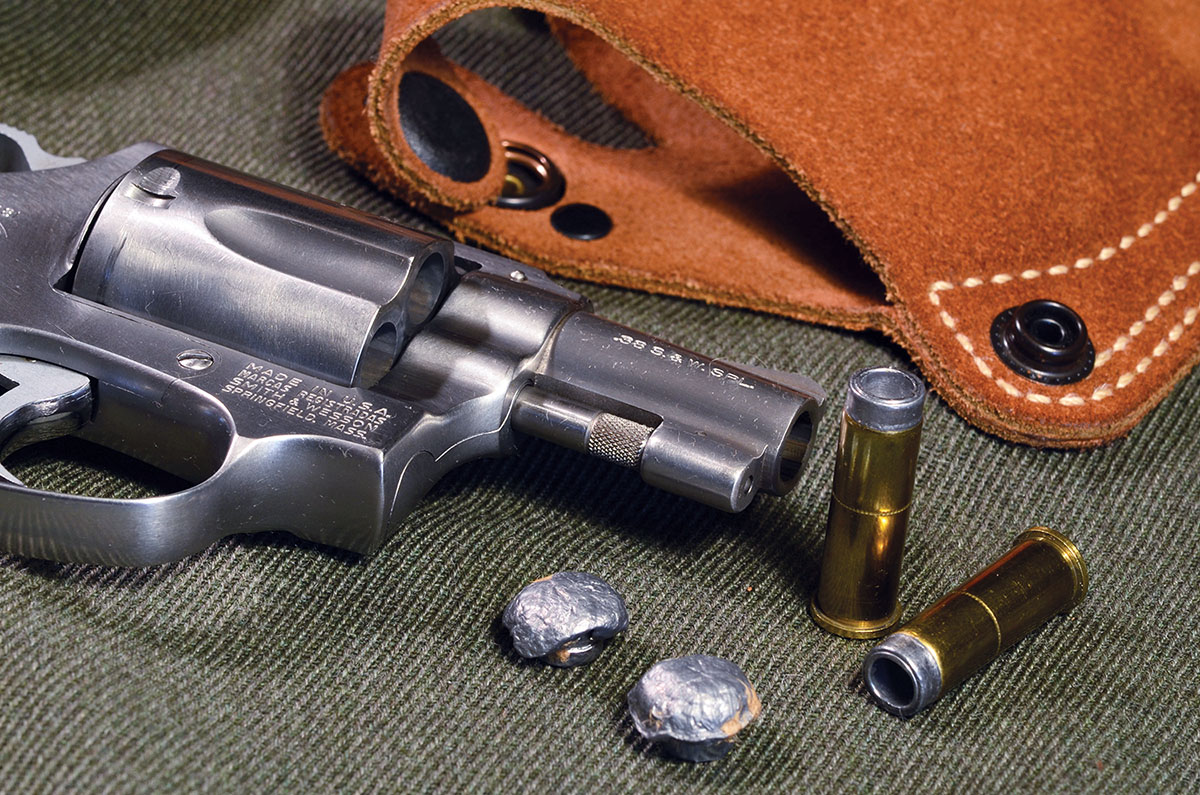
His skills were not limited to casting and loading. He also designed bullets, often based on old designs that would still be perfectly good if you could find any. One I became involved with was his “Man-Stopper,” a pistol bullet made from pure lead with a cavernous hollow mouth. This was not a new idea. It originated in England in the late Victorian era and was loaded in the military 455 Webley and later 38 Webley. When expanding bullets were outlawed by the 1899 Hague Convention, it was abandoned.
Word was, it continued in use in various far-flung outposts of the empire where the locals were obstreperous. Putting down a rebellion did not constitute actual warfare, more like police work, and hence was not subject to finger wagging from the Hague.
From Pathans in the Khyber Pass to Cape buffalo in the Serengeti, the British valued stopping power, and they knew a lot about it.
John “Pondoro” Taylor was a great admirer of large-caliber bullets cast of pure lead. These expanded beautifully, yet held together like chewing gum and, with all that weight, penetrated deeply. They were, he wrote, “great killers.” Which they were, at suitably low velocities. Raise the velocity too much, however, and you get serious lead fouling in the bore. This can be alleviated by alloying with tin and antimony, but this makes the lead brittle and frangible. These are the problems and contradictions that have plagued bullet designers and ammunition companies for 130 years, and they are with us yet.
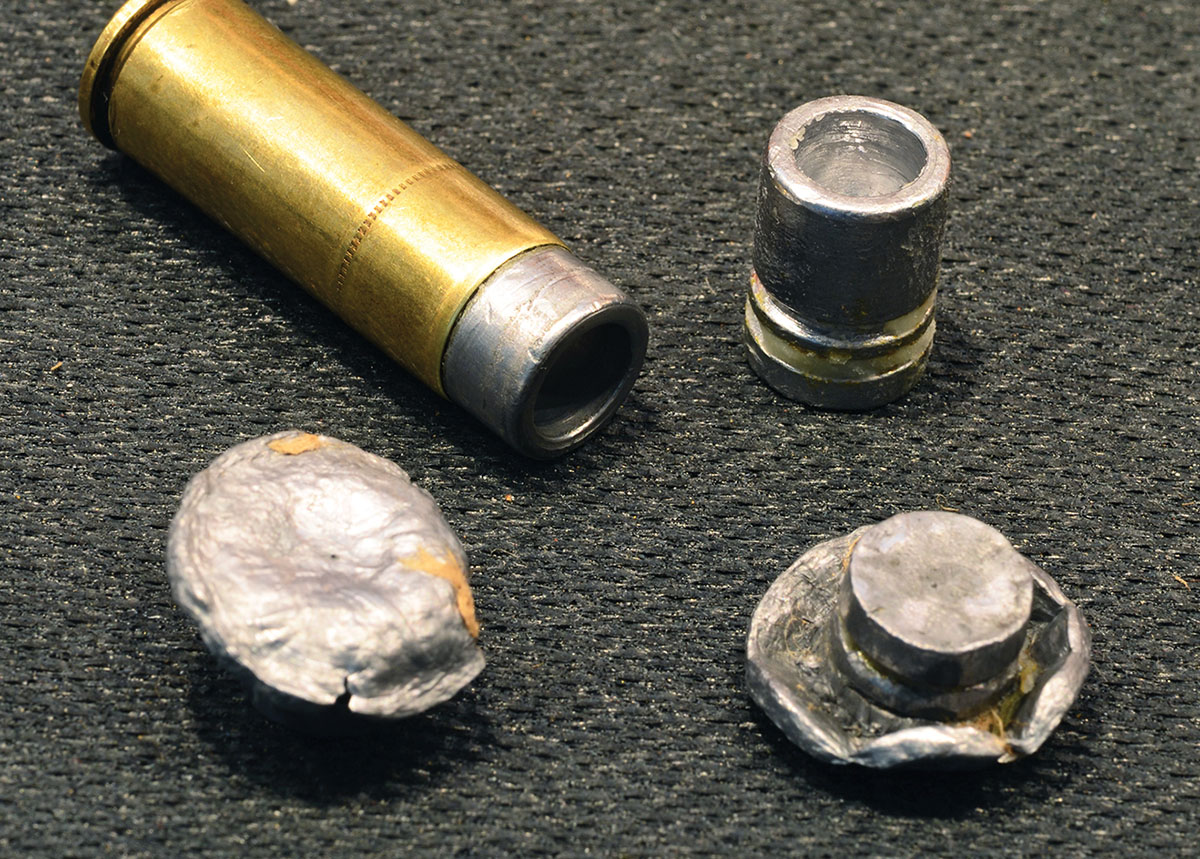
In essence, the problem is this: How to make a bullet that will withstand high velocity, not cause undue bore fouling (either lead or cuprous), expand on impact, and yet hold together, regardless of striking velocity. Expansion provides initial shocking power while weight retention ensures penetration to the vitals and a lethal wound.
Up until 1939, rifle velocities were kept in the 2,500 to 3,000 feet per second (fps) neighborhood, and bullets with lead cores and jackets of copper or gilding metal (a copper-zinc) alloy worked well enough. At least, no one complained much. After 1945, things changed.
With magnum cartridges popping up everywhere, both rifle and handgun, hunters and lawmen began to pay attention to terminal bullet performance as never before. In the years immediately following the war, many folks got into the bullet business, with varying degrees of success. Hornady, Speer, Sierra and Nosler all appeared on the scene. Handloading took off, and formal benchrest shooting became an established shooting sport.
But nobody’s ever satisfied. Everyone who ever pulled a trigger seemed to have an opinion on what was needed and how to get there, and if you think wackiness was born with the internet, take a look at some of the ideas from the 1960s.
One thoroughly laudable development after the war was the emergence of Gun Digest, edited by John T. Amber. Under Amber, it became an annual event, expanding and improving every year. So successful did Gun Digest become, its parent company introduced a handloading equivalent, also under Amber, called Handloader’s Digest, an annual roundup of equipment, components and techniques, with a sprinkling of feature articles.
The first edition, in 1962, had an extensive section listing makers of component bullets that went for a dozen pages. It included the usual names of Winchester, Remington, Hornady, et al, but there were many others, few of which are still around. Each offered anywhere from one to a half dozen different designs, and these reflected the individual ideas of guys who thought they had the answer. And did they? You be the judge. Well, actually, the handloading public was the judge, and it was a resounding “No!” for most of them.
First up, first in line and beating their chests as always, were the Herters George and Jacques of Waseca, Minnesota. They had several jacketed designs, all guaranteed (!) to be the finest the world had ever seen. One was called the “Wasp Waist Sonic,” and it was exactly as described: It had a narrow waist, flaring out to a skirt, and resembled the ideal female figure. This was supposed to alter airflow, reduce resistance, increase velocity, enhance accuracy and “50 per cent reduction in group size at 400 metres,” and, for all I know, cure dandruff. I don’t know anyone who ever used any, and I don’t recall seeing any field reports.
Another Herter offering was the imported Swedish “banana peel” bullet, which had internal striations on the front half of the jacket, ensuring it expanded “like peeling a banana.” There was also “Herter’s Famous Partition” bullet, remarkably similar to the Nosler that had preceded it.
Herter’s was probably more famous for its catalog and its outrageous claims than for any actual product, which ranged from fishing rods to bows to gunstocks to pemmican mix, to the world’s finest fruitcake made to an old Herter recipe, and a Herter-authored wilderness cookbook.
Other bullet ideas and manufacturers: Baldwin offered .22 bullets in both target and game configurations, Cladaloy Bullet Co. had handgun bullets cast from an “exclusive zinc-based alloy” coated with copper that allowed high-velocity loads with cast bullets; Gardiner bullets were available with either thin or thick jackets, which was an innovation; Husk bullets had small-caliber bullets in gilding-metal sabots or “husks” which fell away as the bullet left the muzzle, allowing you to shoot .22 bullets from a .308; Harvey Prot-X-Bore bullets had a zinc washer at the base to clear fouling and leave a protective coating in the bore; Marco Hydraulic bullets had a small dab of grease ahead of the nose that promoted “explosive” hydraulic expansion; Oregon Industries had copper-jacketed bullets made “to exacting specifications by blind and other handicapped workers.”
Sisk Bullets, long established and highly regarded for .22 bullets, made one astonishing claim: A 40-grain bullet for the 22 Hi-Power “for game as large as deer.” Southwest Products made what they claimed to be the finest pistol bullets in the world, swaged from “Secalloy” rod they cast themselves from a secret lead alloy.
As you can see, while a few of these companies survived, some of their ideas did too. Jackets of different thicknesses are offered today by Hawk Bullets, while the .22-bullet-in-a-sabot was adopted 20 years later by Remington, for factory ammunition.
Bob Hayley picked up on the notion of casting bullets from zinc when the anti-lead lobby really got going a decade ago, but ran into so many difficulties he gave up on it.
Bob’s “Man-Stopper” was an unqualified success, however, and he was making them in .38 and .45 calibers, with plans to order moulds in .44 and .32, when his work was cut short by the cancer that eventually killed him. Shortly after I tested the “Man-Stopper” and wrote an article about it here, in 2015, he told me he was selling so many that he could not keep up. That article can be found in Handloader (No. 298, October-November 2015).
In the tests I carried out, the Man-Stopper worked beautifully in a snub-nosed .38, guns that are notoriously difficult to fit with bullets that expand properly at their low velocities.Incidentally, while Bob’s Man-Stoppers are gone, you can achieve much the same effect by loading .32- or .38-caliber wadcutters, with hollow skirts, upside down. A little experimentation, and you can have yourself a decent self-defense load in a small revolver.