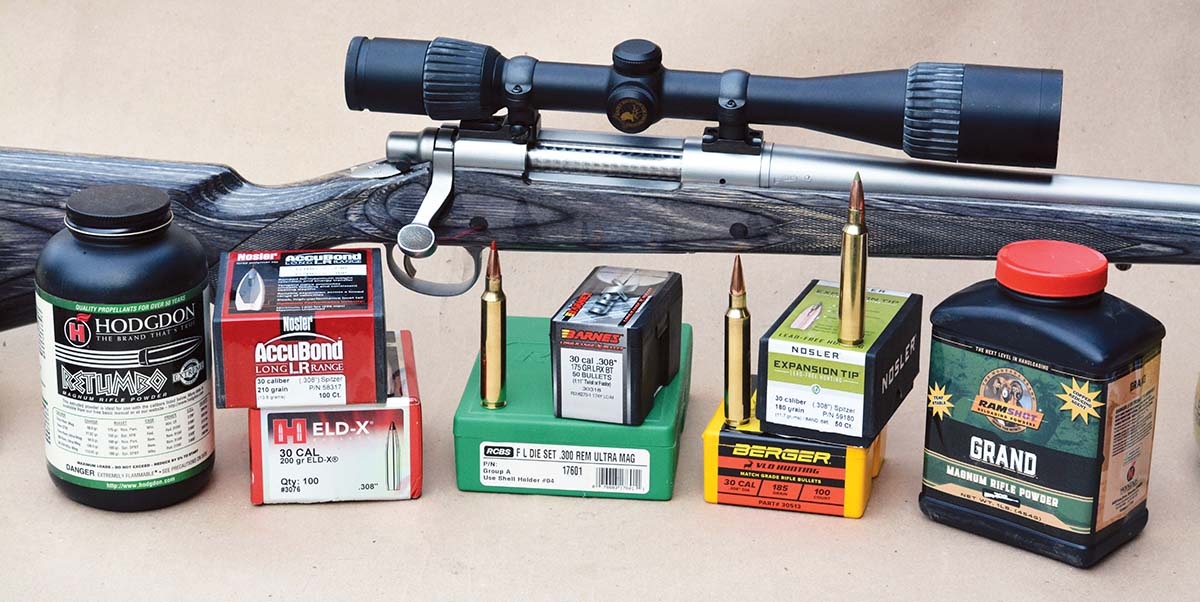
Brian used a Remington Model 700 chambered in 300 Remington Ultra Magnum to develop “Pet Loads” data.
The 300 Remington Ultra Magnum (RUM)was formally introduced in 1999 and is technically based on a new case design that has had tremendous influence within the shooting industry. Ballistics are impressive and generally list a 150-grain bullet at 3,450 feet per second (fps), a 180-grain at 3,250 fps or a 200-grain at 3,032 fps. Thirty-caliber magnums are widely popular in the U.S., especially in the western states where a combination of muscle and flat trajectory are important when hunting elk, moose or large bears, but also offer outstanding long-range finesse for taking antelope, mule deer, sheep, etc. Its performance qualifies it as a top contender for being the most versatile cartridge for hunting all game in North America. In the past 27 years since its introduction, the 300 RUM case has been shortened, necked up and down, and has become the parent case for a host of other commercial cartridges. Clearly, it has played a significant role in modern sporting cartridge development.
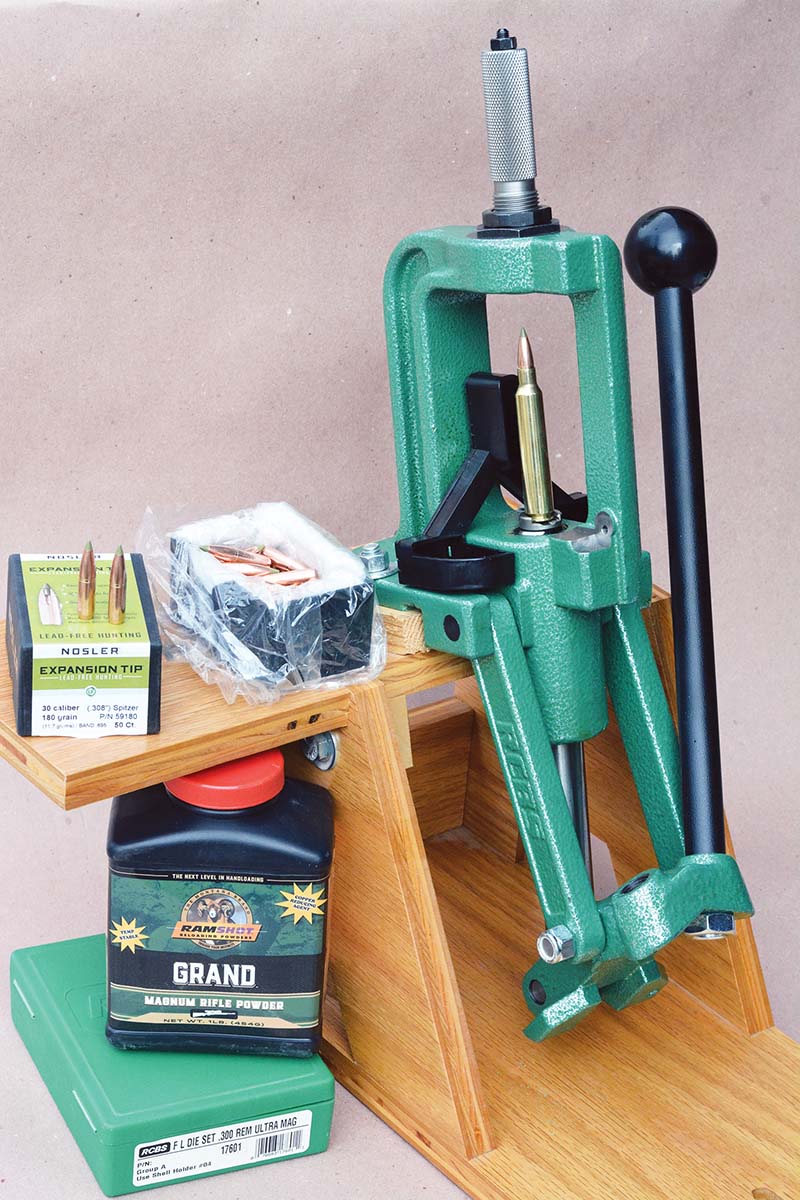
A large press, such as the RCBS Rock Chucker Supreme with a 41⁄4-inch operating window, is an excellent choice for handloading the 300 RUM with its overall length of 3.600 inches.
The best place to begin this story is probably with the 30 Newton that was introduced around 1913, and was a large capacity beltless case that listed a 180-grain bullet at 2,860 fps. Despite being far ahead of its time, it failed commercially. This brings us to a hugely important .30-caliber magnum initially known as Holland’s Super 30, but was soon renamed to 300 Holland & Holland Magnum, which was introduced around 1920. It was the first commercially successful .30-caliber magnum and remains available today. It is based on the belted 375 H&H Magnum case, but necked down for .308-inch bullets. The case is heavily tapered and features a slight 8-degree shoulder, but the overall length was 3.600 inches and required bolt actions to have a long action. Due to the slight shoulder being unable to provide positive headspace control (for both the 375 and 300), the belt was added for that purpose. Western Cartridge began offering loads during the 1920s, but its popularity was limited until 1935 when Ben Comfort won the prestigious Wimbledon Cup Match using a custom-built rifle in 300 H&H. By 1936, Winchester offered the first regular production rifle in their fine Model 70, with early rifles being roll-marked “300 MAGNUM.” This combination became widely popular with hunters and sportsmen as they recognized the advantages of a .30-caliber magnum.
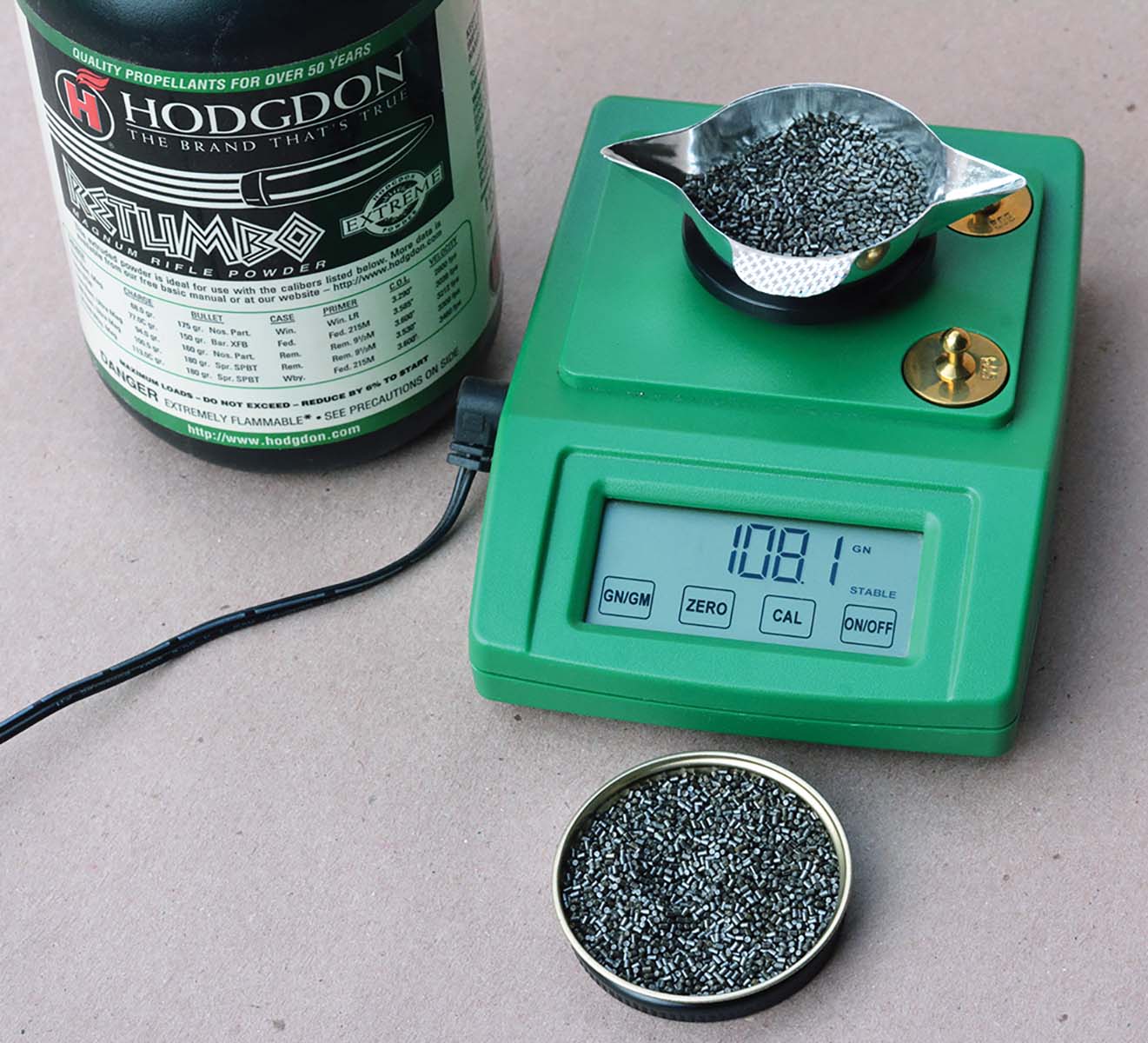
With select loads utilizing up to 108.0 grains of powder, the 300 RUM should only be handloaded with large rifle magnum primers to achieve reliable ignition, with Federal GM215M primers used to develop the accompanying data.
Around 1943, Roy Weatherby started with the 300 H&H case and blew it out to increase powder capacity and power, but the overall length also required the long 3.600-inch length action. He built custom rifles based on Mauser 98 and Winchester Model 70 actions, but in 1957, he designed the Mark V rifle, and the 300 Weatherby became his most popular cartridge for many decades. It became world-famous as an outstanding big-game hunting cartridge.
In 1963, Winchester offered the 300 Winchester Magnum, which was also based on the belted magnum case; however, it was shortened with an overall length of 3.340 inches, which allowed it to function in 30-06 length actions. Due to its shorter length, it became known as a short magnum cartridge (not to be confused with the 300 WSM and 300 RSAUM cartridges that were developed around 37 years later). The 300 Winchester Magnum, as it is affectionately called, has become the most popular .30-caliber magnum and remains in wide use today.
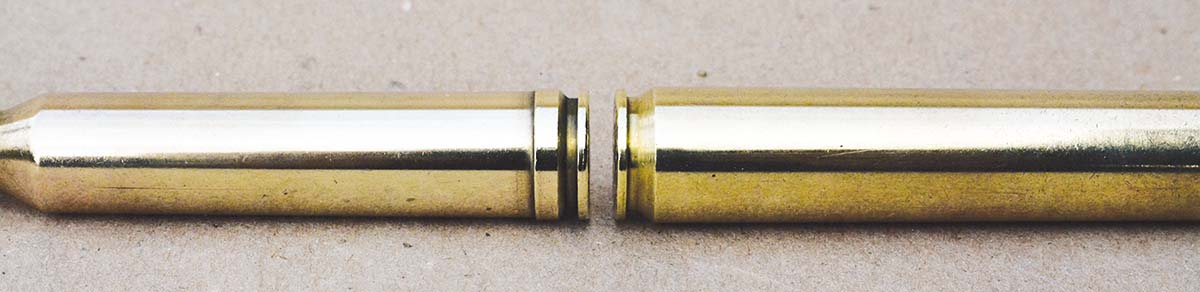
The belted magnum case is on the left, while the 300 RUM is on the right. The outside diameter of the belt is .532 inch, while the rebated rim of the 300 RUM is .534 inch, which allows both to function in the same countersunk bolt faces and simplifies rifle manufacture.
Recognizing the huge popularity and many virtues of the above magnums, Remington decided that it was time to design their own version, but with the goal to offer a truly modern cartridge that was not based on the belted magnum case. Remington took note of the cartridge developmental work of Canadian-based North American Shooting Systems (NASS), which were building cases based loosely on the beltless, large capacity 404 Jeffery case, but strengthened to handle higher pressures and even ordered samples for testing and evaluation. It is noteworthy that Dakota Arms also worked with NASS when developing the 300 Dakota around 1992, but that cartridge has technical differences in the case head and will function in 3.340-inch (30-06 length) actions.
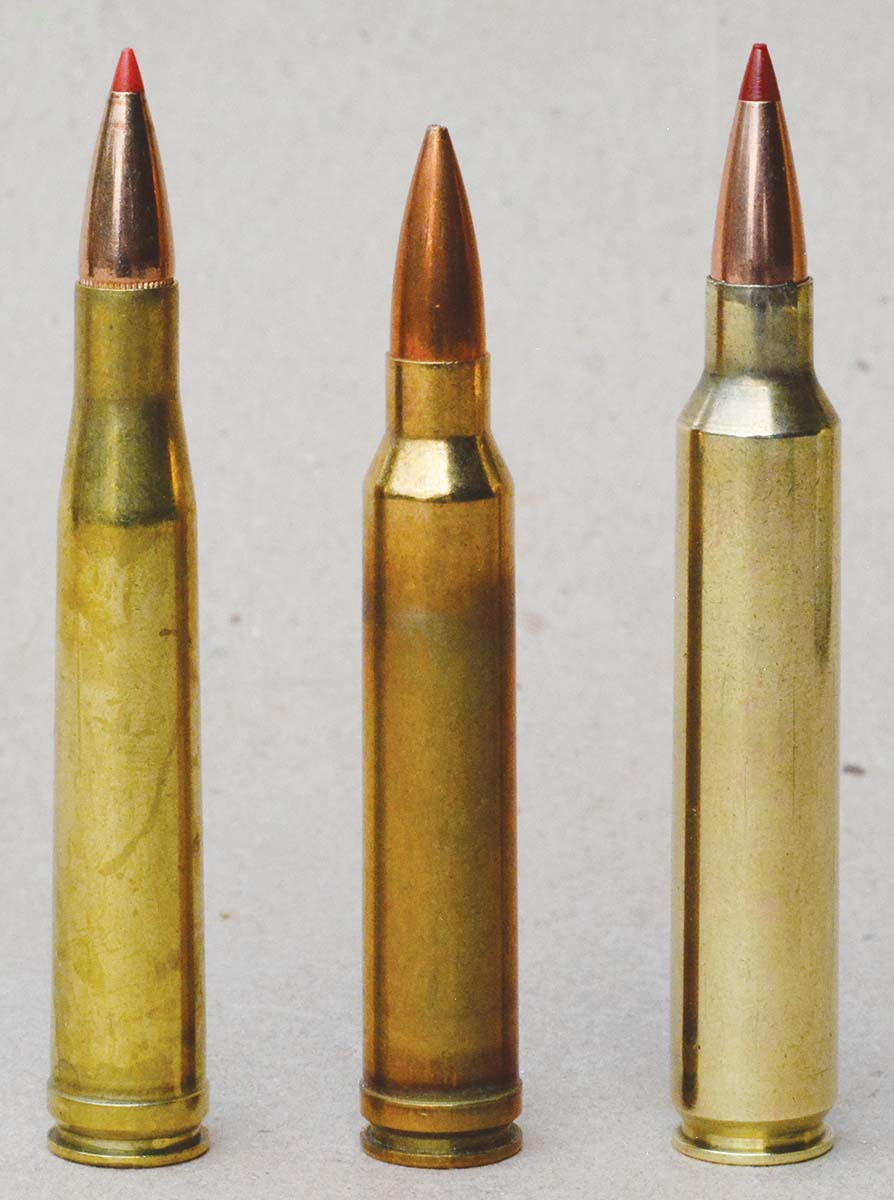
Cartridges shown for comparison: 300 H&H Magnum (left), 300 Winchester Magnum (center) and 300 Remington Ultra Magnum (right) cartridges. Note the longer 3.600-inch lengths of the 300 H&H and 300 RUM, while the 300 Winchester Magnum is designed for shorter action lengths of 3.340 inches.
In spite of the experiments of NASS, Remington did their own designing and engineering work, performed considerable testing, and then tooled up to make cases. The result was a case that measured 2.850 inches, and the cartridge overall length was 3.600 inches, the same as the long action 300 H&H Magnum. The shoulder was 30 degrees, providing positive headspace control and helping with in-the-chamber powder burn efficiency. The 300 RUM has an industry standard (per the SAAMI) maximum average pressure of 65,000 pounds per square inch (psi).
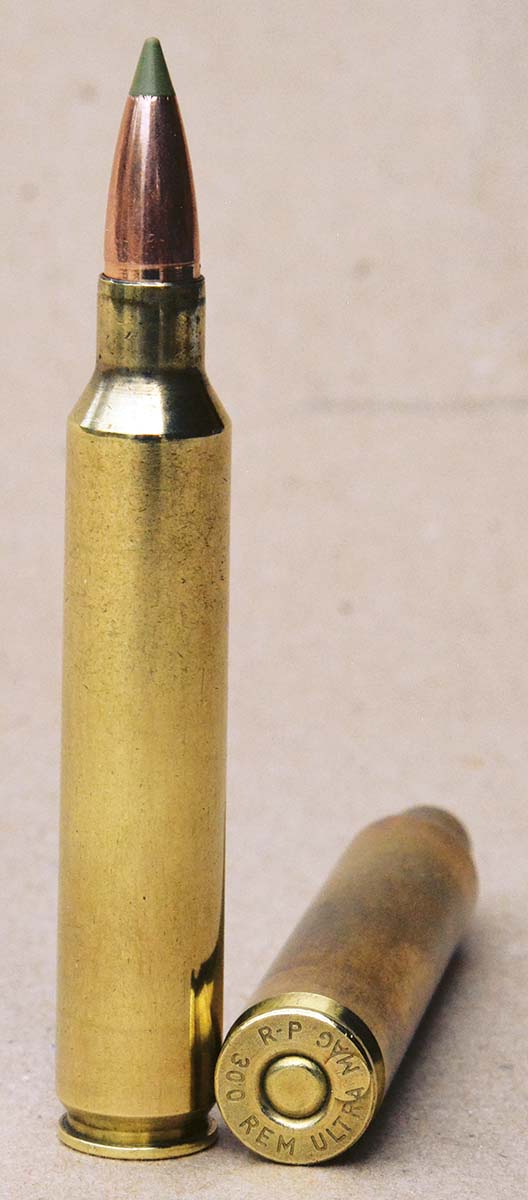
The 300 Remington Ultra Magnum.
One interesting design feature is the rebated rim that measures .534 inch, while the head measures .550 inch. Part of the reason for this design is the Remington Model 700 rifle and its countersunk bolt face, wherein the rim must fit inside to engage the extractor. The belted magnum case measures .532-inch diameter at the belt and rim, or just .002 inch smaller than the RUM’s rim. By designing the rebated rim, Remington could use the same bolt and countersunk bolt specification that they use for the many, many cartridges that are based on the belted magnum case. This effectively saved the manufacturing costs of the Remington rifles and was beneficial to other push-feed rifle manufacturers.
In rough numbers, the 300 RUM offered approximately 20 percent greater powder capacity than the 300 Winchester Magnum and around 13 percent more capacity than the mighty 300 Weatherby Magnum. As indicated, the ballistics of factory loads are impressive.
The 300 RUM was a true game-changing cartridge. In addition to its modern design and large capacity beltless case, future magnum cartridge developments no longer need to be based on the belted magnum case. In other words, for nearly 80 years, commercial magnum cartridges employed the belted case because it was the only one readily available to U.S. shooters and ammunition companies. With modern cartridge designs typically having a shoulder angle between 25 and 35 degrees, the belt served no useful purpose. Handloaders generally headspace cartridges on the shoulder, not the belt. Soon after the 300 RUM’s introduction, many new cartridges began appearing that were based on that case. Examples include the 300 RSAUM; 7mm RSAUM; 7mm RUM; 338 RUM; 375 RUM; 26, 27, 28, 30 and 33 Nosler cartridges and others.
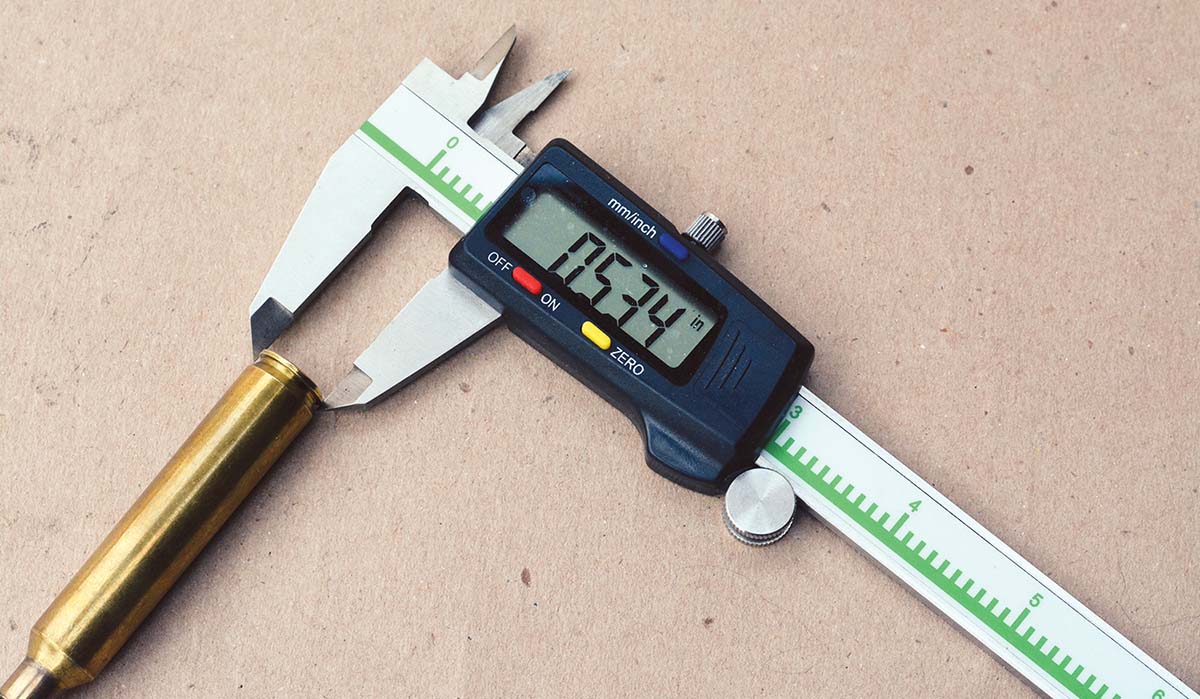
The 300 RUM features a rebated rim that measures .534 inch, while the case head measures .550 inch.
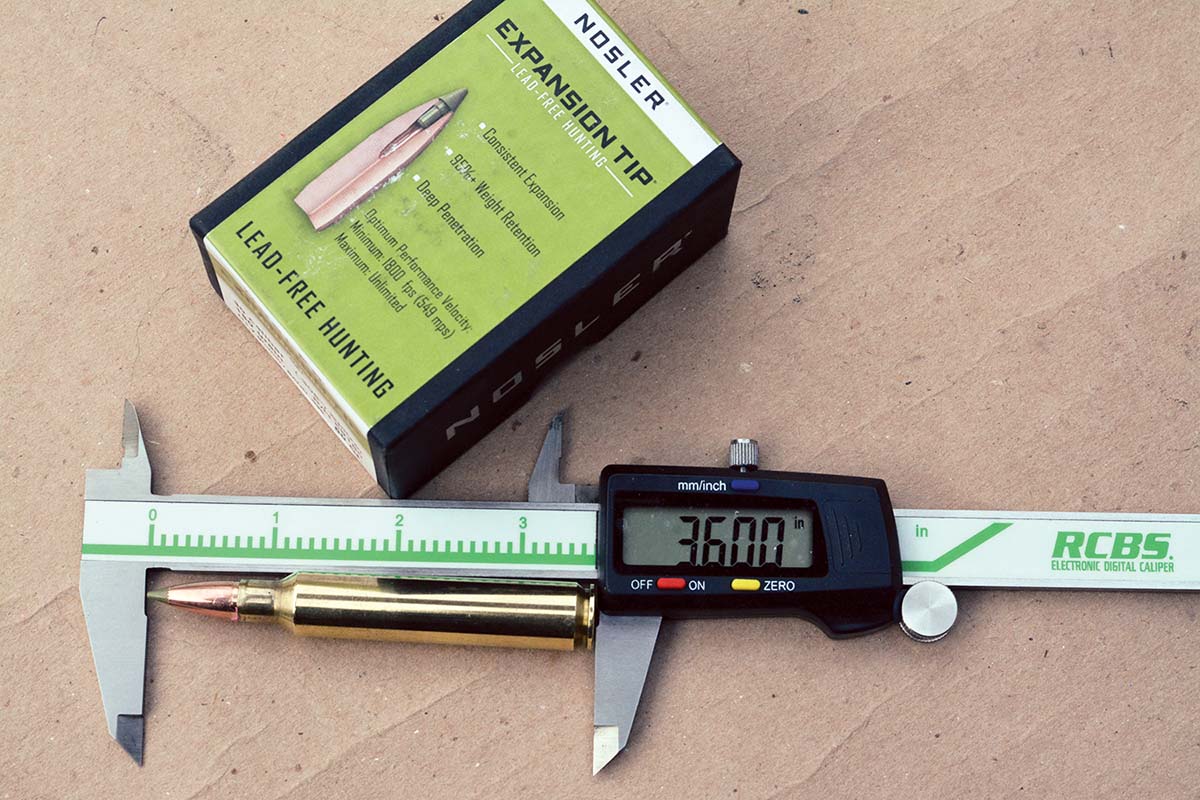
The maximum overall cartridge length is 3.600 inches; however, some rifles will permit slightly longer COLs.
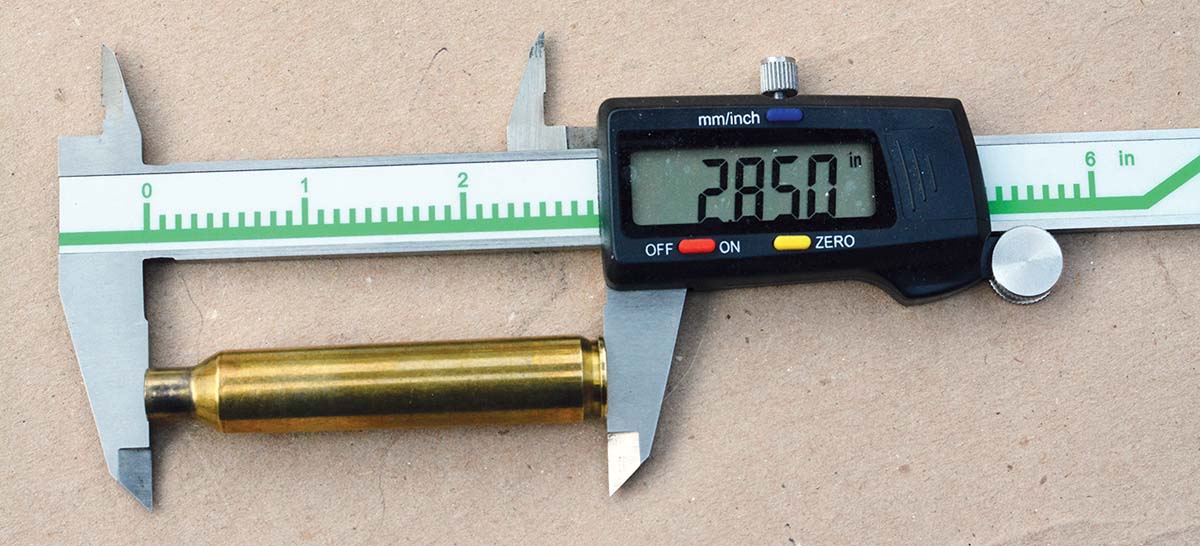
Maximum case length is 2.850 inches.
In referencing actual 300 RUM velocities of Remington factory loads from a Remington Model 700 with a 26-inch barrel, they all virtually clocked around 50 fps less than their listed velocities. Through careful selection of components, handloaders can fully duplicate the ballistics of all factory loads. However, select powder and bullet combinations can easily exceed their performance while staying within the SAAMI (Sporting Arms and Ammunition Manufacturers’ Institute) maximum average pressure limits.
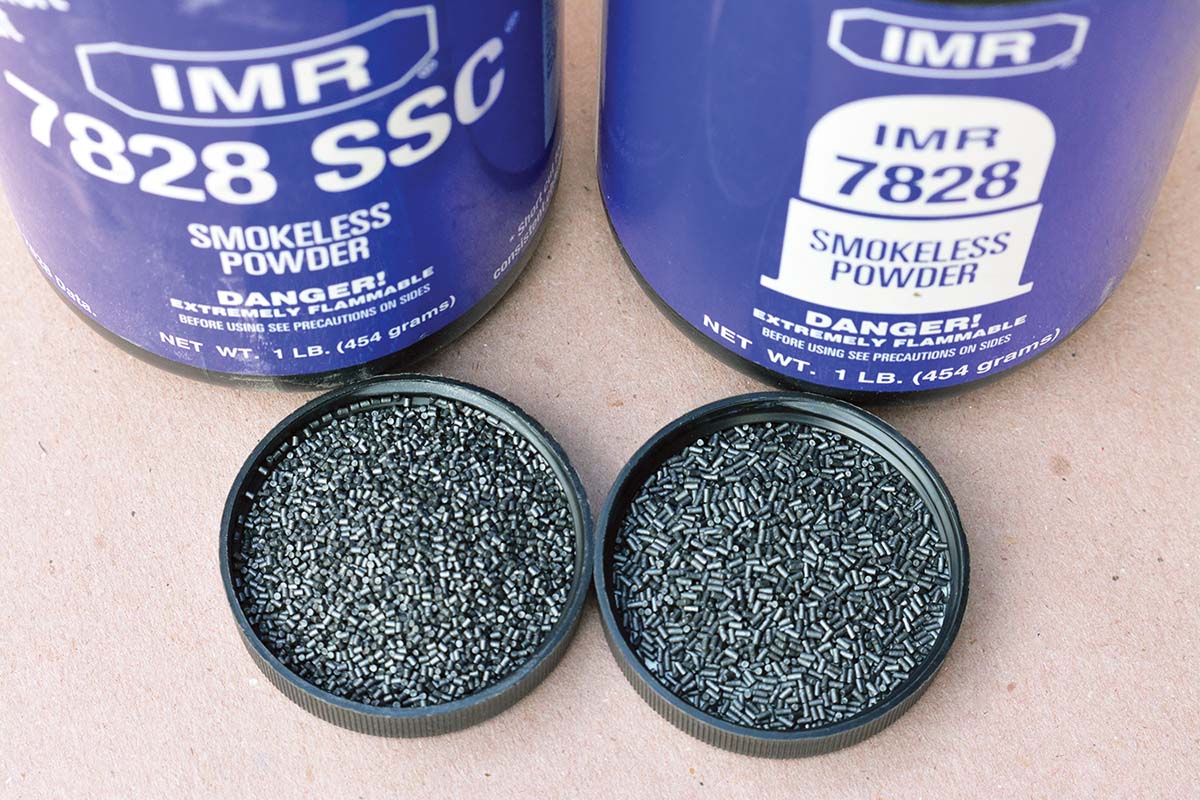
IMR-7828ssc and IMR-7828 share the same burn rate; however, the ssc offers improved metering.
Starting with a large quantity of new Remington 300 RUM cases, which were carefully weight-sorted. The flash holes were deburred, sized, trimmed as needed, the case mouths were deburred and Pet Loads development began. Incidentally, both Hornady and NoslerCustom offer cases as a component to handloaders.
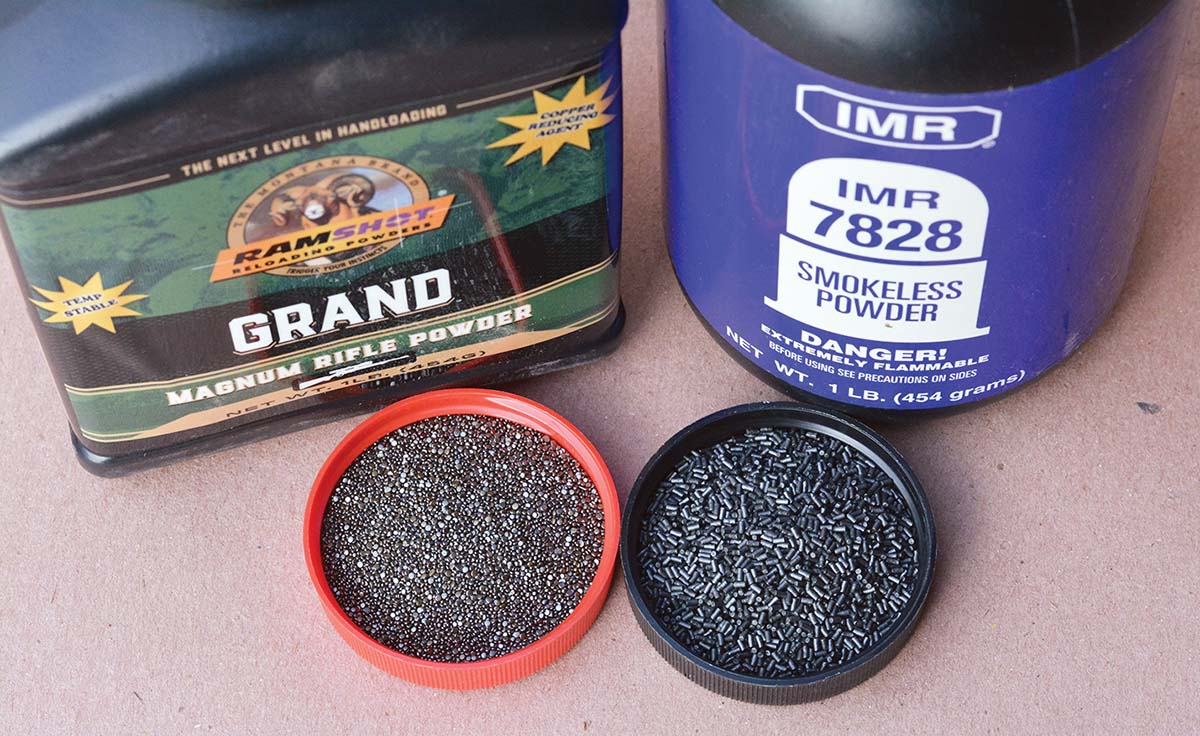
The 300 RUM thrives on slow-burning spherical and extruded powders such as Ramshot Grand and IMR-7828.
With a 3.600-inch cartridge overall length, a reloading press with a large opening will make each step easier, especially when seating bullets. The
RCBS Rock Chucker Supreme press was selected, which is a continuation of the original Rock Chucker that was first introduced in the 1960s and has become widely popular due to its strong O-style cast frame and heavy-duty leverage compound system that reduces the effort required to size large cases. It also offers precision ram alignment to minimize bullet run-out. And with an operating window of 41⁄4 inches, it accommodates the big 300 RUM with ease.

For those who prefer to throw powder charges rather than weighing each charge, spherical (aka Ball) powders are excellent choices, including Accurate Magpro, Ramshot Magnum, Grand and Winchester StaBALL HD.
With many 300 RUM loads containing between 90.0 to 108.0 grains of powder, it is imperative to use large rifle magnum primers to assure reliable ignition. Otherwise, hangfires, erratic pressures, and even squib loads can occur, all of which are potentially dangerous. Not all primers are created equal in terms of energy. I chose the
Federal Gold Medal Match GM215M, as it clearly produces the highest energy and ignition. In previous testing at zero, sub-zero temperatures and temperatures as high as 100-degrees, it is the least temperature sensitive primer that I have tried. As a bonus, it produces low extreme spreads, which is important for top accuracy in long-range matches or in the field.
Naturally, due to its large powder capacity, the 300 RUM thrives on slow-burning powders. Most of the accompanying data fills the case to at least 85 percent of capacity, but most utilized 90 to 105 percent (compressed) and a couple of loads even surpassed the 105 percent figure. As is often the case, loads that utilize around 100 percent capacity tend to give the best accuracy, and generally, bullets will seat easily. (This is mentioned because some charges that are 103 to 110 percent of capacity will require the powder to be trickled into the case to settle the powder enough for the bullet to seat easily and without damage.)
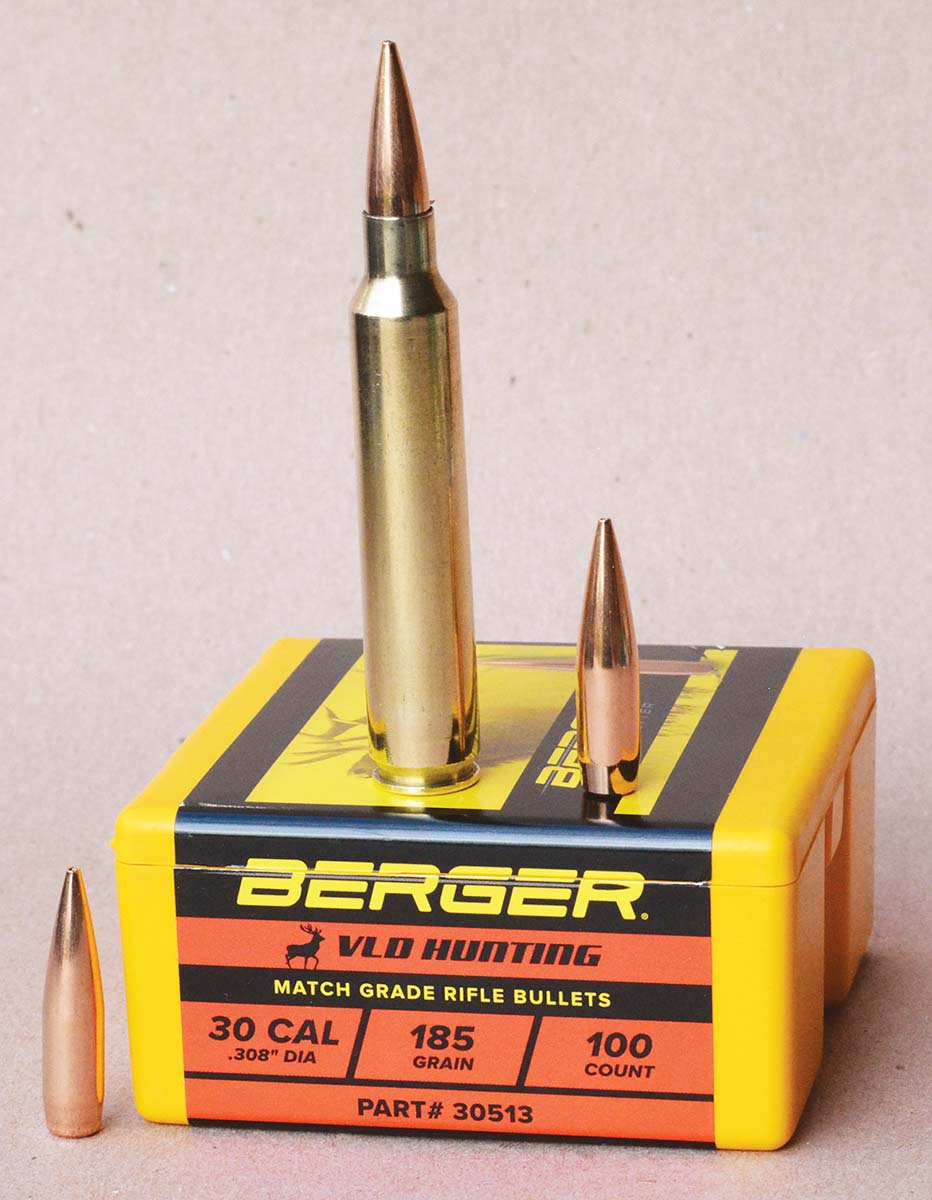
Berger VLD Hunting bullets are popular with hunters.
Many extruded powders were selected, as they have a proven performance record (in terms of accuracy and velocity) and have long been favorites of long-range target shooters. All loads containing extruded powders herein gave respectable performance; however, a few stand-out examples include IMR-7828, IMR-7828ssc, IMR-7977, Hodgdon Retumbo, H-1000, H-4831, H-4831sc, Alliant Reloder 22, 25, 26 and Vihtavuori N170. It should be noted that IMR-7828ssc and Hodgdon H-4831sc will meter from a large-capacity, high-quality powder measure with better consistency than their counterparts IMR-7828 and H-4831. For top accuracy, each charge should be weighed. A simple method is to throw a charge on the scale pan that is a couple of grains below the desired weight and then trickle the remaining grains into the pan. There are several great powder dispensers, such as the
RCBS MatchMaster, that do the work for you by dispensing programmed, weighed powder charges onto the scale and ready to be funneled into the case.
This brings us to spherical or Ball powders that are advancing and offer new levels of performance. However, before we discuss a few standout powders and why, it should be noted that spherical powders should not be used with reduced loads that can cause odd performance, hangfires, etc., and are especially critical in the large RUM case. However, when the correct charge weights are used, they can perform very well.
One notable advantage is that spherical powders generally cost less than extruded powders and considering the large powder consumed with each shot from the 300 RUM that is akin to flushing a toilet, that feature alone makes them attractive. Most spherical powders can be thrown from a quality, large capacity powder measure with respectable consistency, which is always a lure to speed up the loading procedure. Nonetheless, perfectionists may still want to weigh each charge to further decrease extreme spreads and increase accuracy.
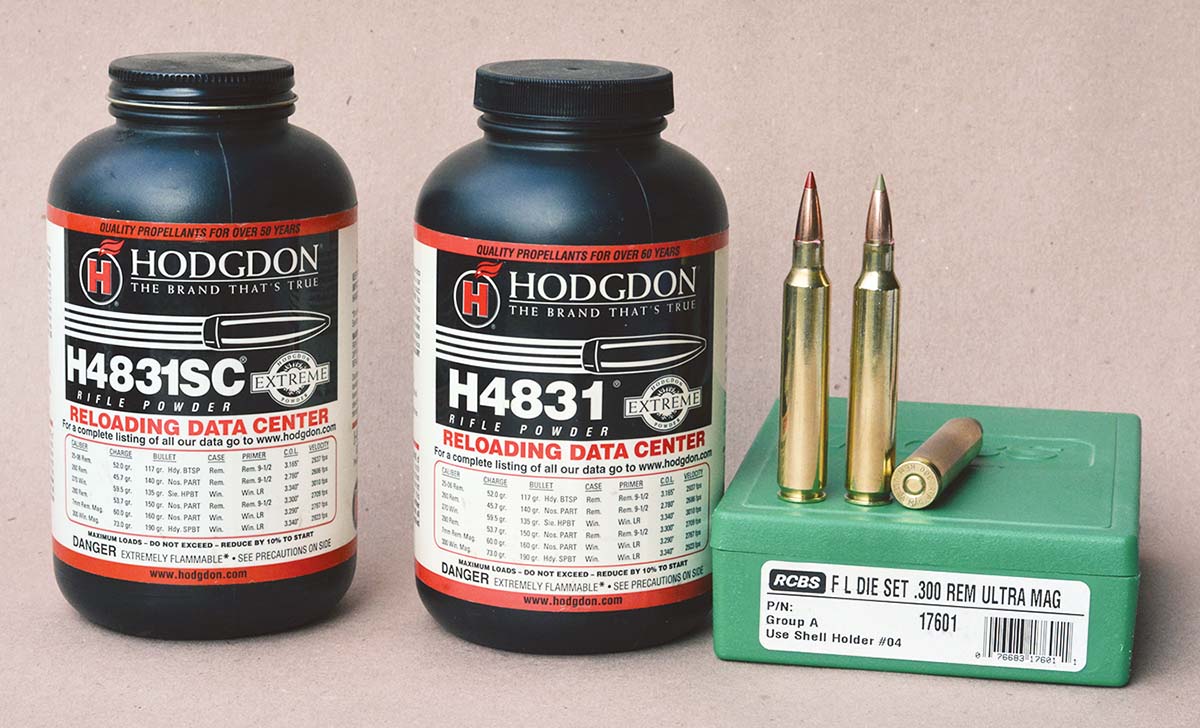
Hodgdon H-4831 and H-4831sc Extreme powders offer outstanding accuracy and boast minimal velocity changes in cold and hot temperatures.
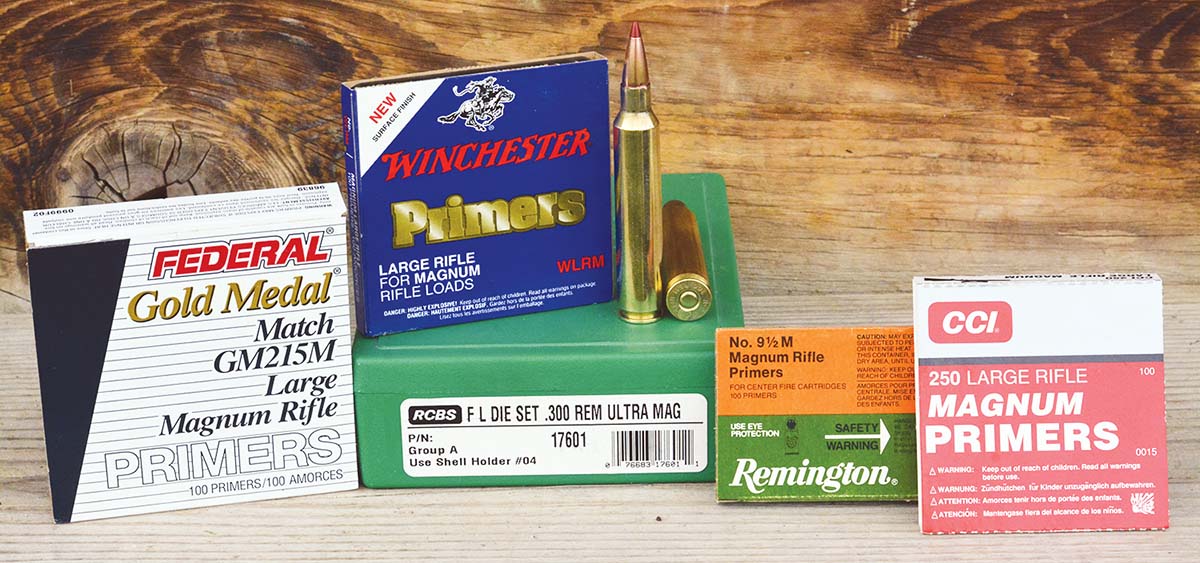
Federal Gold Medal Match GM215M primers offer the lowest extreme spreads and are the least temperature sensitive when compared to other large rifle magnum primers.
The following powders are double-base for added energy and velocity, but as indicated, the double-base formula requires large rifle magnum primers to ensure correct ignition. Ramshot Grand boasts of being temperature insensitive, has a copper reducing agent, and is engineered with a density that fills the case for low extreme spreads and accuracy. Ramshot Magnum is slightly slower burning and produces excellent velocities and shot-to-shot consistency. Magpro is the slowest burning Accurate powder that has given this writer excellent results in many magnum cartridges, including the 300 RUM. Winchester StaBALL HD is relatively new, but boasts of being temperature insensitive – a feature especially appreciated by hunters. Its density is geared towards large capacity magnum cartridges, resulting in low extreme spreads. In addition to being a REACH-compliant formula, as a bonus, it contains copper fouling reducer agents to minimize barrel fouling. Incidentally, top-notch accuracy was observed with StaBALL HD. All of the above certainly explains why the popularity of spherical powders continues to grow.
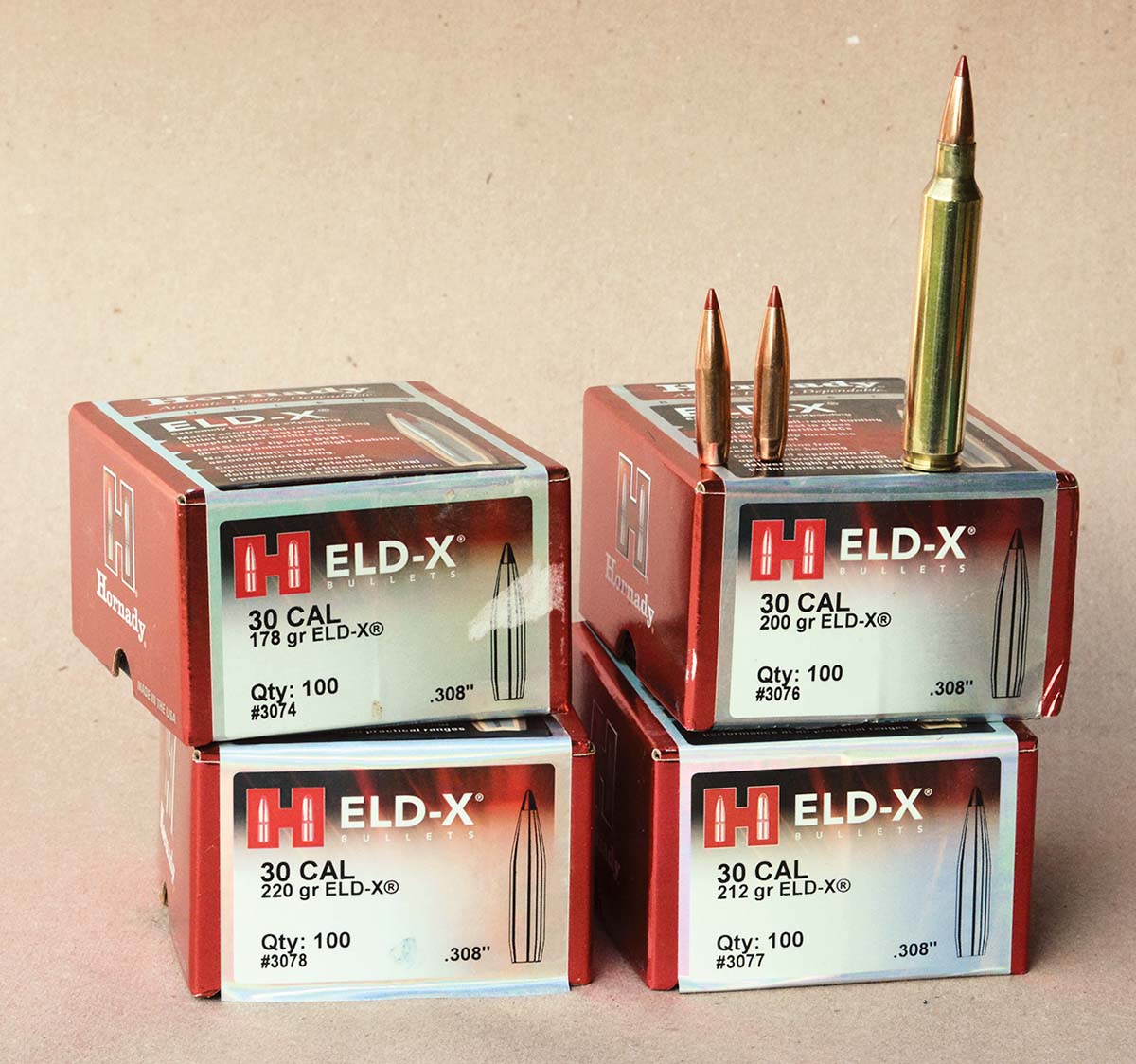
The Hornady ELD-X bullets offer a blend of accuracy, low drag, high BCs and outstanding terminal performance on big game.
The huge selection of .30 caliber bullets plays an important role in the 300 RUM’s remarkable versatility. It can stabilize bullets from 110 to 220 grains (and heavier with faster twist barrels) and include bullets for varmints, deer, larger game or heavyweight match style. My initial tests with two different 110-grain bullets were mediocre, so the 125-grain Nosler Accubond was the lightest bullet used herein. It easily reached 3,700 and almost 3,800 fps (IMR-7828), was accurate, and gives a laser-like trajectory at several hundred yards that is expected to give spectacular results on coyotes and varmints. Several powders pushed Nosler and Hornady 150-grain bullets from 3,400 to 3,575 fps (Retumbo) to easily outrun factory loads. Moving up to 165-grain Nosler and Sierra bullets, several powders reached an impressive 3,350 fps and even 3,450 fps (Retumbo). Various 178- to 185-grain bullets reached 3,300 fps (Retumbo and Magpro) to easily duplicate or exceed factory load velocities. Moving up to 200-grain bullets, such as the Federal Edge TLR, Hornady ELD-X and Nosler Accubond, velocities easily reached 3,000 to 3,100 fps (US-869, IMR-7977, StaBALL HD, Grand) to duplicate or exceed factory load velocities.
Long-range shooters will appreciate the heavy-for-caliber, low drag, high ballistic coefficient (BC) bullets such as the 210-grain Nosler Accubond LR, 210-grain Sierra Tipped GameKing, 212-grain and 220-grain Hornady ELD-X. Several sources list good results with heavier match style low drag, high BC bullets; however, the standard 1:10 barrel twist may not give great stabilization at ultra-long ranges.
The 300 RUM was developed primarily as an all-purpose, highly versatile hunting cartridge suitable for all North American big game and African plains game. It is modern in every respect and a truly great cartridge. By carefully selecting components, handloaders can improve accuracy and overall performance.


.jpg)
.jpg)
.jpg)