The 284 Winchester was introduced in 1963, and according to my count, eleven wildcats formed by simply necking up or necking down its case with no other change have since been created. Previously discussed in this column are the 6mm-284, the 25-284, the 35-284 and the 411-284. The latter cartridge was developed by Chris Moen of Havre, Montana, who uses it in a custom rifle on a 1910 Mexican Mauser action with a barrel made by McGowen Precision Barrels of Kalispel, Montana. An avid hunter, Chris favors 300- and 400-grain bullets from Northern Precision. The most successful of this wild bunch is the 6.5-284, the name of which was changed to 6.5-284 Norma in 2001 and accepted by SAAMI (Sporting Arms and Ammunition Manufacturers’ Institute) in 2019.
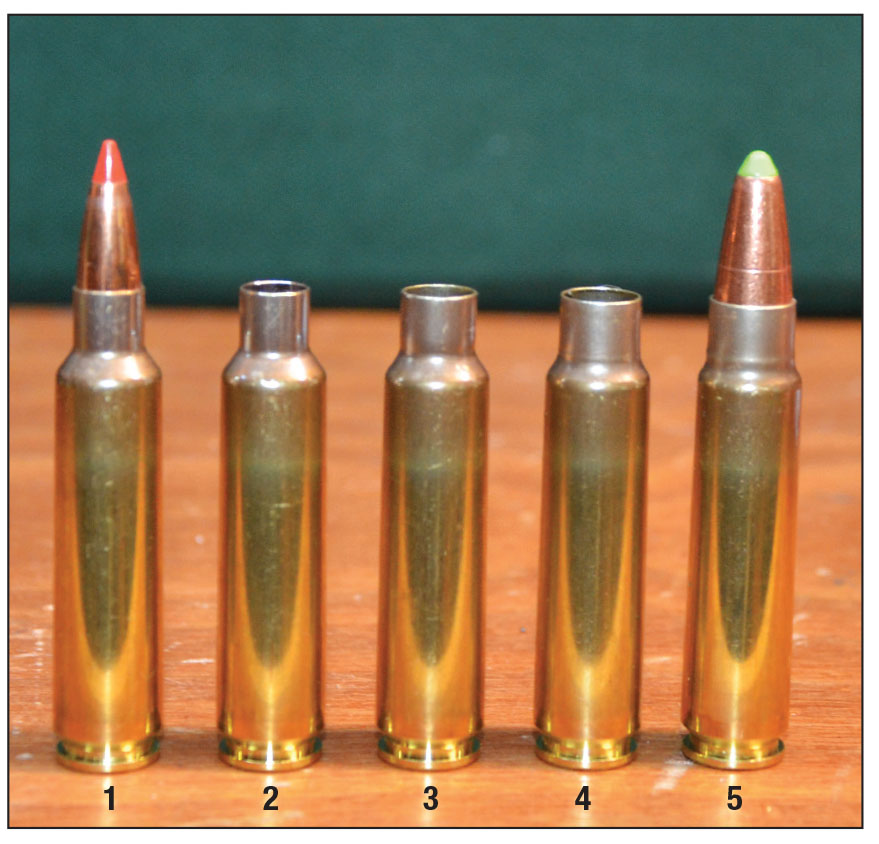
Transforming Lapua 284 Winchester cases into 338-284 cases: (1) 284 Winchester cartridge, (2) case neck expanded to .30 caliber, (3) case neck expanded to .33 caliber, (4) case neck expanded to .35 caliber and (5) case neck expanded for .366-inch bullets and Lapua 220-grain Naturalis bullet seated with a RCBS 9.3-284 seating die.
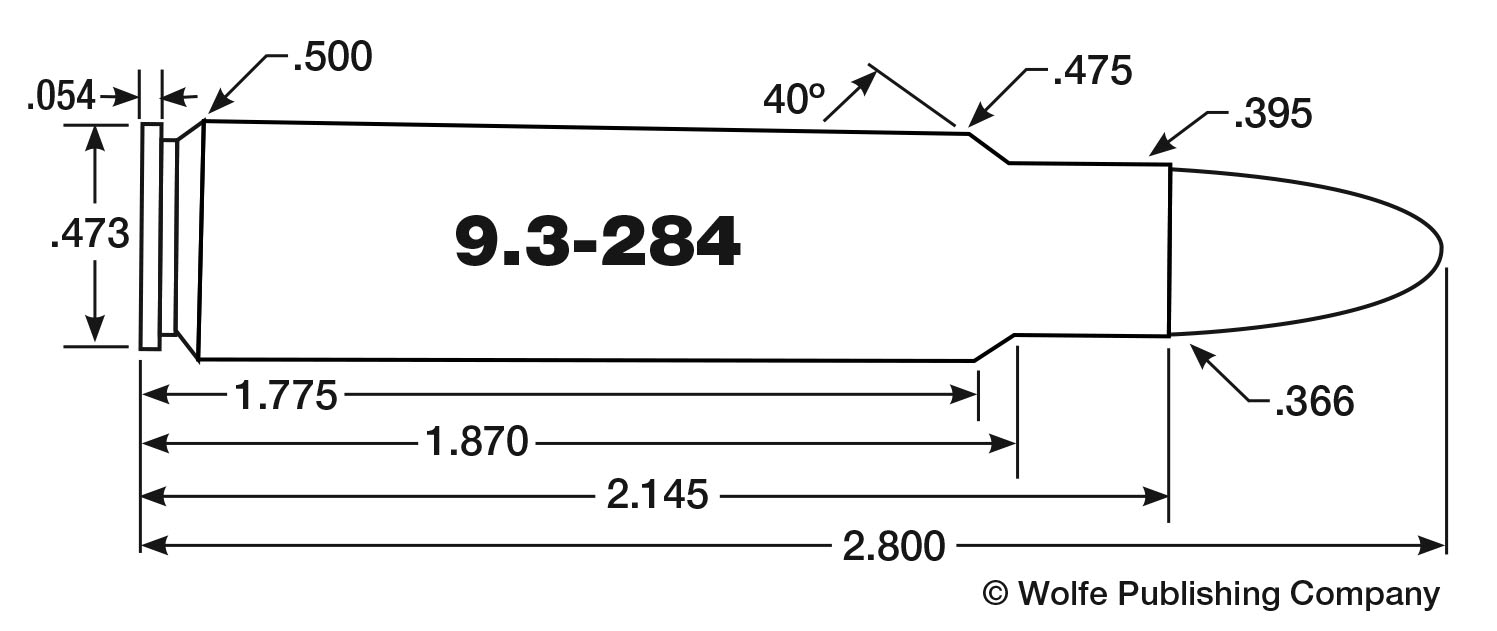
The star of this column is the 9.3-284, which is accurately described as a short-action version of the 9.3x62mm Mauser, the latter developed around 1905 by German gunsmith Otto Bock. I first used the Mauser cartridge while hunting moose in Finland with a friend who worked at Sako Ltd. When asked about my preferred rifle caliber, I chose the 9.3x62mm Mauser because I had never had the opportunity to try it on game.
Lapua of Finland had only recently introduced its all-copper, plastic-tipped
Naturalis bullet, and the Sako ammunition I used was loaded with the 220-grain version. Sako had not had the time required to make new boxes for that load, so printing on the box of ammunition I was issued indicated the 250-grain Powerhead bullet. At any rate, while zeroing the rifle, I found it to be extremely accurate, and that, along with its effectiveness on two bull moose during a week of hunting, made me decide to permanently add it to my big-game rifle battery. I still have it. I also brought home boxes of Naturalis bullets in 220- and 250-grain weights.
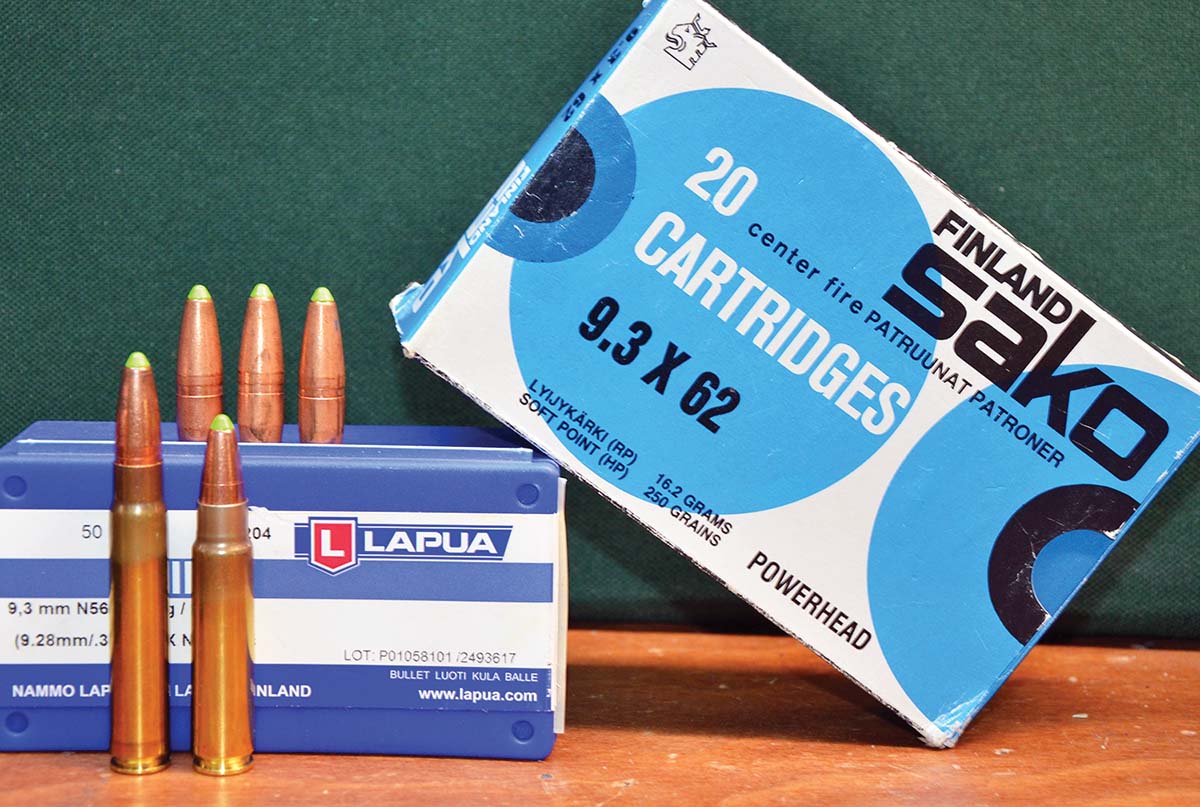
While hunting moose in Finland with a friend who worked at Sako many years ago, Layne bagged a couple of bull moose with a rifle chambered for the 9.3x62mm Mauser and Sako ammunition loaded with the Lapua Naturalis 220-grain all-copper bullet, which had only recently been introduced by Lapua. Boxes for the new load were still several weeks away.
Returning to the 9.3-284, many years ago, I obtained a special
RCBS die along with a collection of tapered expanders for it and used three of them for opening up the necks of 284 Winchester cases for 0.366-inch bullets. A .22-caliber to .30-caliber expander was first, and it was followed by a .33-caliber expander. Case necks then went through a .35-caliber expander and a tapered expander in the RCBS full-length sizing die, making them ready to receive bullets measuring .336-inch in diameter. Case neck tension was sufficient to secure bullets in place.
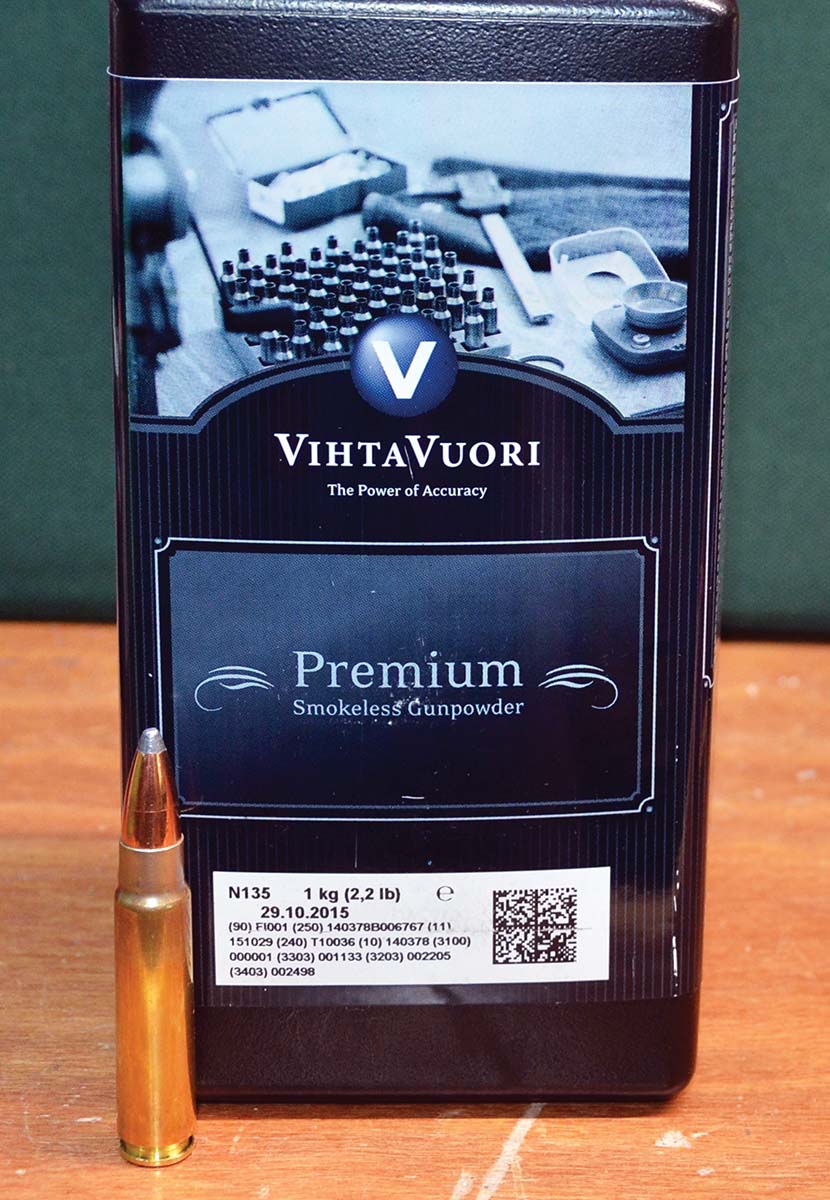
Vihtavuori N135 is Layne’s preferred propellant for loading all bullets weighing from 220 grains to 286 grains in the 9.3-284 and the 9.3x62mm Mauser.
For this report, I compared the gross water capacities of Lapua 284 Winchester cases necked up and Lapua 9.3x62mm Mauser cases. Respective averages were 67.9 grains for the 9.3x62mm cases and 67.1 grains for the necked-up 284 Winchester cases. Due to virtually identical capacities, the velocities of the two cartridges would be the same when both are loaded to the same chamber pressure and fired in barrels of the same length. This assumes the two cartridges are fired in rifles with long actions. From a practical point of view, there is no reason to choose the wildcat for a long-action rifle when 9.3x62mm ammunition, unprimed cases and load data for it are readily available from Nosler, Swift, Vihtavuori and other sources.

Excellent choices in bullets for the 9.3-284: (1) loaded round with Swift 250-grain A-Frame, (2) Lapua 220-grain Naturalis, (3) Swift 250- grain A-Frame, (4) Nosler 250-grain Ballistic Tip and (5) Nosler 286-grain Partition. (The Swift 286-grain A-Frame is not shown.)
The 284 Winchester was designed for use in the short actions of the Winchester Model 88 lever action and the Winchester Model 100 autoloading rifles, and wildcats on that case really belong in short-action rifles. Maximum cartridge length is usually 2.800 inches or close to it. Net capacity is what matters, and when 9.3mm bullets of various weights (lengths) are seated in that case, it rapidly loses ground to the 9.3x62mm cartridge with its nominal overall length of 2.900 inches. As an example, when the Lapua 220-grain Naturalis is seated for a cartridge length of 2.800 inches in the 9.3-284 case and 2.900 inches in the 9.3X62mm Mauser case, respective net capacities are 52.4 grains and 57.0 grains. Not enough difference to greatly matter there, but it increases considerably when longer bullets are seated for maximum cartridge lengths in the two cases. As an example, net capacities with the Nosler 250-grain Ballistic Tip are 49.8 grains for the 9.3-284 and 57.0 grains for the 9.3x62mm Mauser.
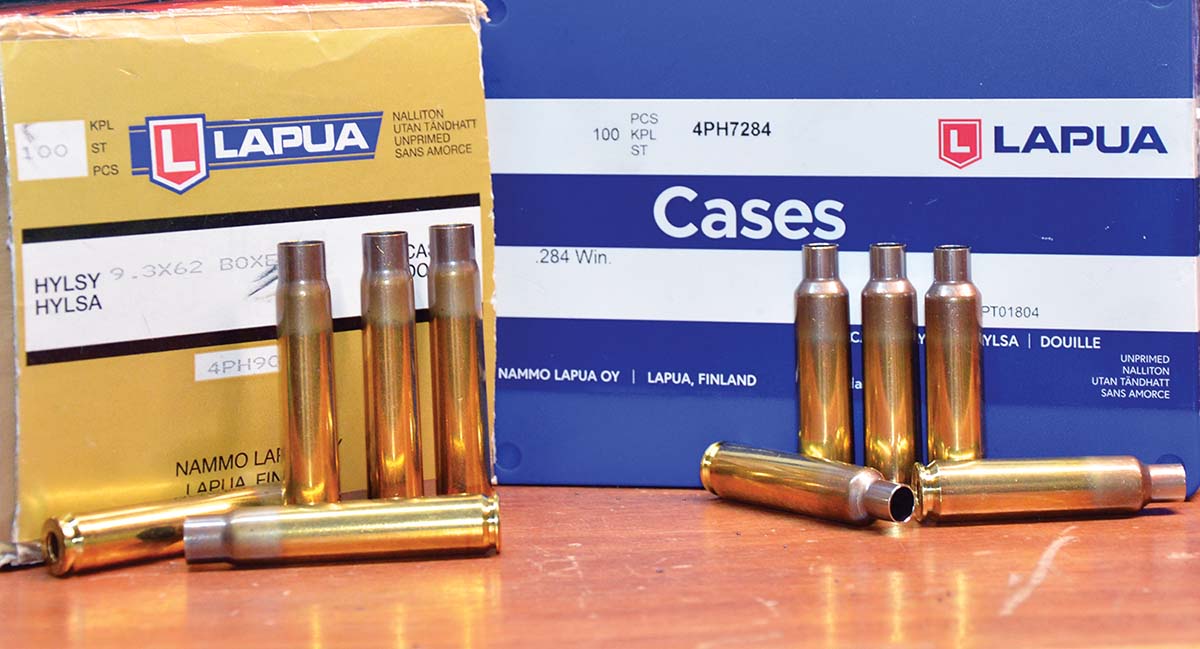
The gross water capacities of Lapua 9.3x62mm cases (left) and Lapua 284 Winchester cases (right) necked up for 9.3mm (0.366-inch) bullets are the same. When the 9.3-284 is loaded to a maximum cartridge length of 2.800 inches for a short action, its net capacity is less than that of the Mauser cartridge.
With that said, from the 22-inch barrel of my rifle on a short Model 700 action, the 9.3-284 is only about 100 feet per second (fps) slower with all bullet weights than the 9.3x62mm Mauser from the 23-inch barrel of my Sako. In my opinion, that makes the short cartridge suitable for cleanly taking any game in North America by hunters who insist on getting within ethical distances prior to sending bullets. For taking moose, elk and interior grizzly, my pick among the various bullets would be the
Swift 250-grain A-Frame at 2,500 fps. The 9.3-284 is by no means a good choice for taking on an Alaskan brown bear in open country, but in the alder thickets of coastal Alaska, it should be quite adequate when loaded with the
Nosler Partition or
Swift A-Frame weighing 286 grains at 2,300 fps.
As a final note of importance, the 9.3-284 reloading die set I have was made many years ago by RCBS, and while that company no longer makes custom dies, Redding Reloading Equipment does. Simply send a chamber reamer drawing or five cases fired in your rifle, and a two-die set for that exciting new 244 Gravity-Defying Super Zapper (or whatever) will eventually head your way. The charge is usually $254, but the exact cost can be verified when the order is placed. A three-die set for a straight-wall cartridge will be higher. The cost is less for the dozens of wildcats that do not require special tooling. The 17 Ackley Bee, 20 PPC, 22/6mm Remington, 243 Catbird, 6mm-06, 25 Gibbs, 6.5 STW, 270 Redding, 7mm Gibbs, 300 Jarrett, 8mm-06, 358 STA and 458x2-inch American are a few examples.


.jpg)