

In Range
The Wisdom of Grennell
column By: Terry Wieland | February, 26
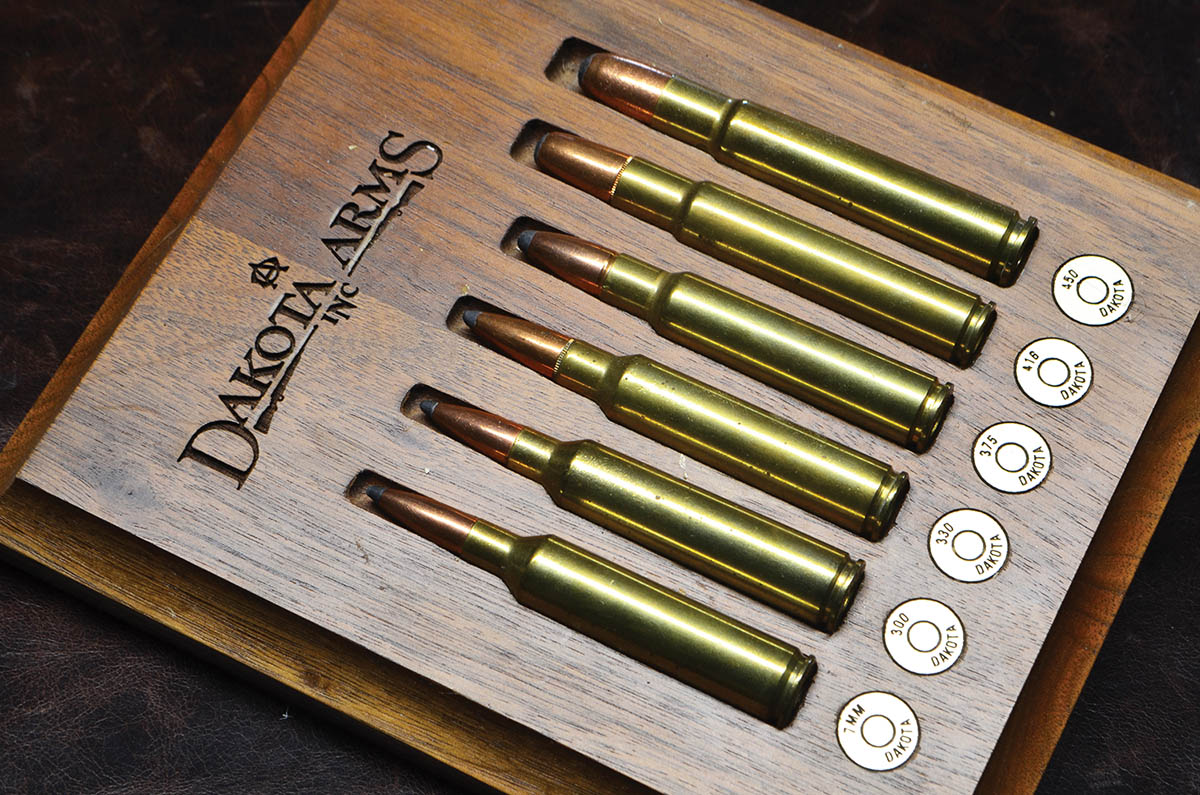
Otherwise, with a 7mm, .300, .330, .375, .416 and .450, the last based on the larger 416 Rigby case, the Dakota line echoed the cartridges from South Gate, California, that had done so much to make Weatherby, Inc., an American gunmaking fixture, synonymous with glitz, glamor and Hollywood stars. The Dakota line anticipated the later “short magnum” craze and, from my limited experience with them, were all excellent cartridges.
Dakota Arms, as a company, was attempting to emulate Roy Weatherby, but doing so with a line of rifles based on the pre-’64 Winchester Model 70 action, updated and appealing to those with taste and discernment. Where Weatherby was California glitz, Dakota was American classic.
Visiting Dakota in 1996, I asked its proprietor, Don Allen, what he hoped to accomplish with a line of cartridges that did little more than duplicate many that already existed.
His answer? “We needed some ink.”
Whether the consequent publicity got the results Don was looking for, I can’t say. He developed cancer a few years later, the company was sold to an investment firm, became embroiled in bankruptcy and, later, a trial for securities fraud, and ultimately became the custom-rifle arm of Remington. When Remington itself went down, Dakota was spun off and is now ParkWest Arms, still in Sturgis.
But back to the Dakota cartridges.
The plan was that rifle owners would buy their ammunition from Dakota Arms, and it would be loaded for them in a corner of the company’s factory. No commercial ammunition company, to the best of my knowledge, ever offered them. When the company disappeared, it left owners of a Dakota chambering with an expensive rifle and no source of ammunition. Some custom handloaders may have produced some, but even the ones I knew way back then are not doing it now.
A good way to quickly check the market is to do a quick search on AmmoSeek.com, and that produced a big, fat zero for every Dakota cartridge. A simple Google search revealed a couple of custom shops offering some Dakota rounds on special order and at very special prices, I might add, but even there, the 300, for example, was simply “unavailable.”
Designing your own line of cartridges, then offering them in a custom rifle, is a lot like making a new car that runs on a special fuel available only from you. It means you have to continue to offer the service ad infinitum, as long as your product is in operation. If you go out of business, your customer is stuck, and the rifle itself is worth a lot less to a prospective buyer than it would be if it was chambered for something like the 30-06 or 375 H&H.
This is not a new problem, by any means.
In the 1980 Gun Digest, handloading editor Dean Grennell found himself in the midst of the worst inflation since Weimar Germany, with the resulting impact on both component supplies and prices. He was reflecting on how he, personally, was somewhat insulated from it because he could load his own and had ample reserves.
Grennell’s example was the 45 Auto Rim (45 AR), famous as the chambering of the Model 1917 revolvers made by Colt and Smith & Wesson. The 45 AR, as the name suggests, is simply the 45 ACP with a rim.
At the time, 45 AR was a standard product but, then as now, subject to periodic shortages because of limited production runs and so on. Grennell commented that he could get up from his typewriter, walk into his shop, and instantly produce 400 rounds of 45 AR “no two exactly alike.” Upon deciding which was best, he could then mass-produce as much as he needed.
Allowing for a little hyperbole, Grennell had summed up the virtues of handloading, especially in cases where proprietary cartridges lived on after their designers had gone to their reward and the production of rifles was a distant memory.
Of course, this does not apply only to rifles. In the case of handguns, the problems are made worse by the fact that it is never easy, and generally not even possible, to rebarrel or rechamber a revolver or semiautomatic to a cartridge that is more readily available. What you buy is what you’ve got, and if ammunition cannot be found, well, tough luck.
Grennell offered a list of new cartridges that came along in 1980 that included the 375 Winchester, the 9mm and the 45 Winchester Magnums. The first resembled the old 38-55 but was not quite the same and disappeared from the Model 94 chamberings pretty quickly; ten years later, it was gone. The two Winchester magnums were intended for the Wildey handgun. Good luck finding any of the above.
Anyone who bought one of those 94s, or a Wildey, is pretty much limited to handloading for them, if and when any brass can even be found.
As someone who owns, loads and shoots a 7x61 Sharpe & Hart, a 280 Ross and a 256 Winchester Magnum, I am not one to preach that anyone should avoid buying a rifle with an obscure chambering, only that you should be aware of what you’re getting into and lay in loading dies and a supply of brass at the same time.
I should add that with the plethora of custom handloading operations, producers of obscure brass, and even some runs of loaded ammunition from larger companies, you may well find either ammunition or the wherewithal. Chances are, however, ammunition that falls into the above categories is likely to be hideously expensive. Again, handloading may be the only affordable answer.
Since the Dakota cartridges limped onto the scene, new cartridges from many different outfits have blossomed like dandelions in spring. To take .30-caliber big-game rounds as just one example, and this is only a partial list, we have the 300 HAM’R (Wilson Combat), 300 PRC (Hornady), 30 Nosler, 30 Remington AR, 30 T/C (Thompson/Center), 308 Marlin Express, 7.62x40 WT (Wilson Tactical), 300 Ruger Compact Magnum, 300 Remington Short Action Ultra Mag, 300 WSM (Winchester), 300 Blaser and 300 Norma Magnum (Norma).
How many of these were, or are, standard loadings, widely offered and available the way the 30-06 has been for 120 years? Few? None? Keep in mind, these are only the ones that have come along since 1995. Throw in everything that came before and it becomes truly mind-boggling.
How many will be available ten, or even five, years from now? Even fewer, I suspect, and in the meantime, still more fevered creations will be thrust upon us. Considering the price of some of today’s popular high-quality rifles, it seems reasonable to pay close attention to the chambering and the future availability of ammunition before signing the check.
Slowly but surely, some of the Weatherby cartridges, notably the .257, .270 and .300, managed to become American standards, with different companies offering ammunition at various times. The Dakota cartridges might have done likewise, had circumstances not conspired against them, but personally, I doubt it. For a cartridge to gain the kind of traction we saw with the 6.5 Creedmoor, the planets would be required to align in just the right way at just the right time.
For all the others, far into the future? Prepare to handload.