The term “Golden Age” is much overused today. Collector folks and historians are continually referring to the golden age of everything from bedpans to art. They are always dealing with the past. However, the Golden Age is never here and now. It is gone, and most of us missed it.
Merriam-Webster lists the term “Golden Age” as first appearing in the English language in 1555. Its meaning is given as “a period of great happiness, prosperity and achievement.” To folks reading these words today (and tens of millions more), their first thought will be of our country. More citizens are enjoying happiness, prosperity and the fruits of all our achievements than at any time in recorded history. Unfortunately, there is also an unhappy, uneducated, vocal minority possessing college diplomas who disagree with us. They are working 24/7 to tear down all that has been built up in the last four hundred years and replace it with a medieval, pagan dictatorship. We must be vigilant.
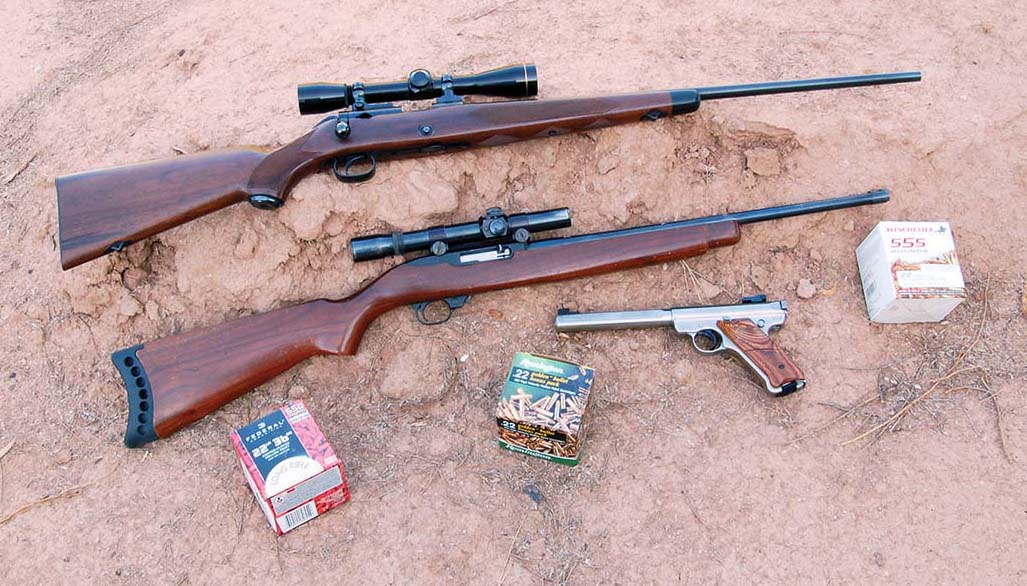
Guns used in testing current ammunition (top to bottom): Japanese-made Winchester M52, Ruger 10/22 and Ruger Mark II Target.
On second thought, particularly for shooters, the definition describes the 21st century perfectly. It’s the Golden Age of the 22 Long Rifle (LR). It is doubtful any other cartridge (including military) has been accorded more development time and money since its inception in the 1880s. Little of this is noticeable. A 22 LR cartridge made today looks like one made a hundred years ago, except for the brass rather than copper case. Bullet lube has changed many times until it doesn’t flake off in cold weather and is no longer greasy, which picks up pocket lint or any small objects found in kids’ pockets.
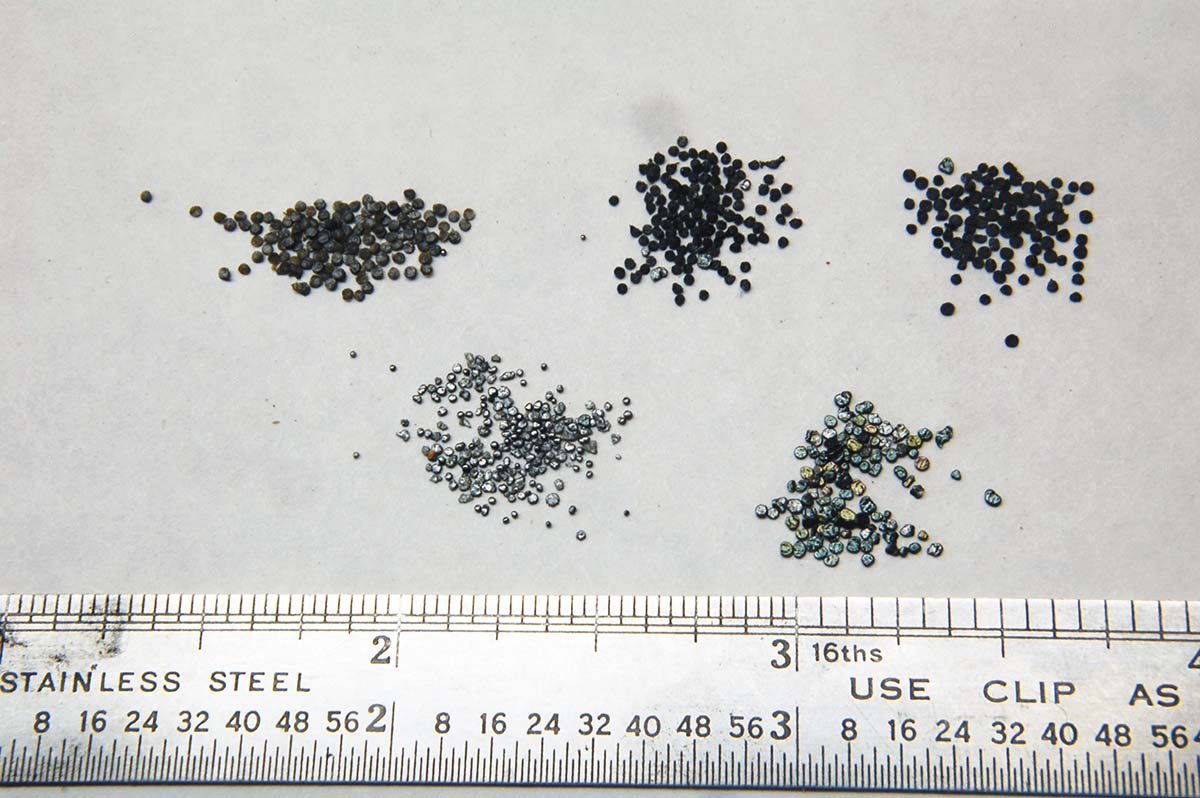
Powder in 22 LRs varies greatly in size of grains and color.
Going back to the dictionary definition, the “period of great happiness” perfectly describes the effect of the 22 LR. Many of our fondest memories are of stalking small game with an old single-shot 22 LR. Today, a rifle or handgun and a few boxes of ammunition provide nearly a day’s entertainment. Kids seem to have the most fun, with girls liking targets that ring or spin when hit. Boys favor something that flies apart, disappears, or blows up anything they can break or destroy.
Of course, the 22 LR brings a lot of new shooters into the fold today through concealed carry. Folks who would never otherwise have owned a gun find shooting to be fun. They soon discover the 22 LR with its low noise, light recoil and numerous shooting games in which to participate.
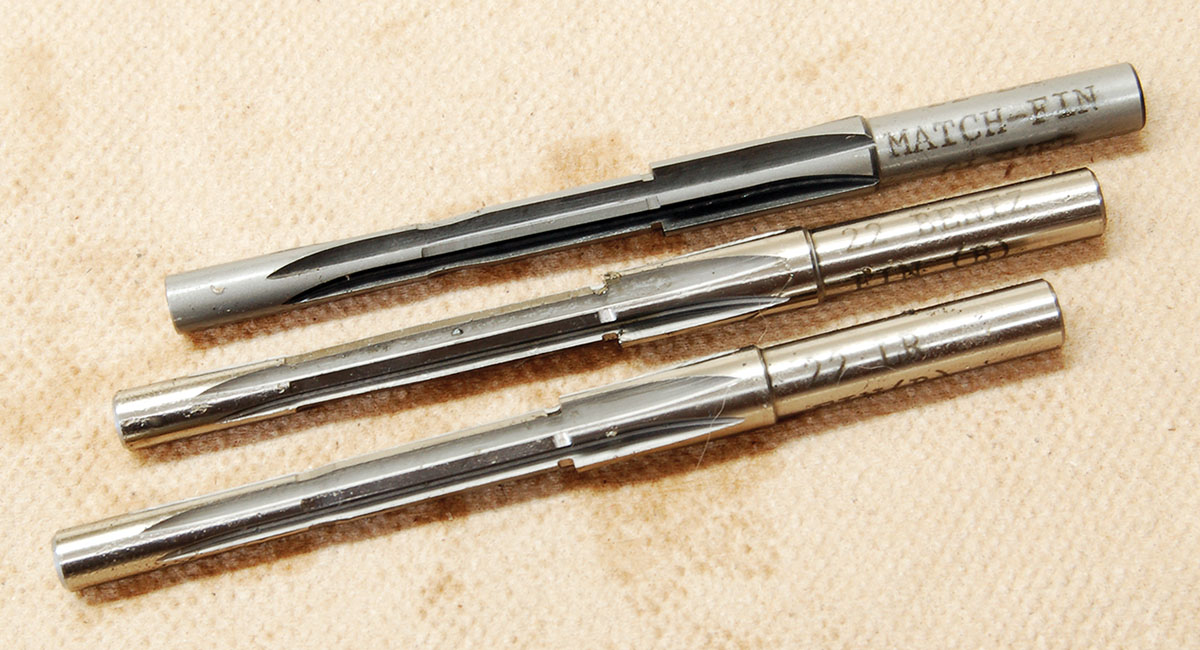
Reamers to cut the three common chambers in today’s 22 LRs (top to bottom): Match, Bentz and SAAMI.
The “prosperity” part of the golden age may be harder to see, but inflation and the ammunition shortage are subsiding because their reason for being has been removed. All the price increases caused by the former pestilence will probably not be permanent. When buying ammunition for this column, four boxes (200 rounds) of
Norma TAC-22 were purchased at a local hardware store for a few cents more than a combo meal at a popular burger joint. Not cheap, but at least affordable.
The final word in the Golden Age definition – achievement – fits perfectly with the 22 LR. The achievement of greater average accuracy, cleaner burning powder, increased reliability and bullet uniformity has been noticeable over the last twenty-five years. I do not, for example, remember the last failure to fire. Misfires were not uncommon in the 1950s and 1960s.
All of this brings us to the question: What 22 LR ammunition is available today? The answer is that no one knows. A few years back, ammunition makers stopped printing paper catalogs. Standard references shooters had used for years suddenly disappeared. Cartridges and ballistic figures are only available online. When a loading is dropped, it disappears from the website forever, but ammunition lasts a long time. Also, guys basically hate websites because they are becoming theatrical productions that must be endured to get to the information wanted. Many folks won’t waste the time.
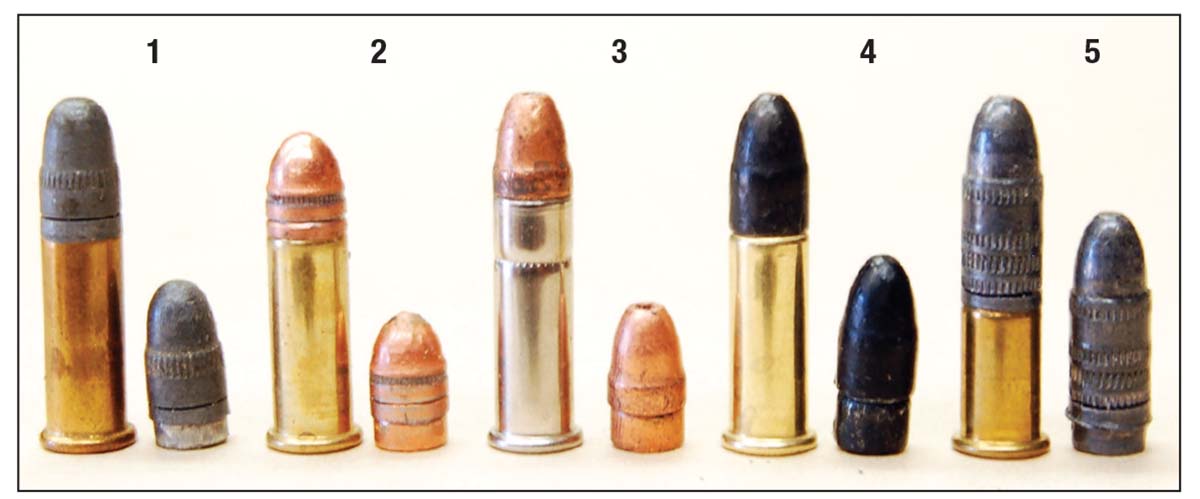
Today’s 22 LR bullets: (1) Federal 40-grain bullet, (2) CCI 32-grain bullet, (3) Stinger 32-grain bullet, (4) CCI Suppressor 45-grain bullet and (5) Aguila 60-grain bullet.
Over a year was spent searching Phoenix, Arizona, gun shops, sporting goods, big-box and hardware stores for 22 LR ammunition. Pickings were slim until I tried
Bruno Shooters Supply on North Central Avenue. Owner Jason Bruno keeps a large stock of 22 LRs. It was possible to fill in many blanks in my ammunition assortment, especially in standard velocity and imported rounds. That’s important when cartridges are needed for a hunt or a match. It’s not possible to “load up a few.” It is factory loads or nothing. The terms “large selection” and “close by” suddenly take on new meaning.
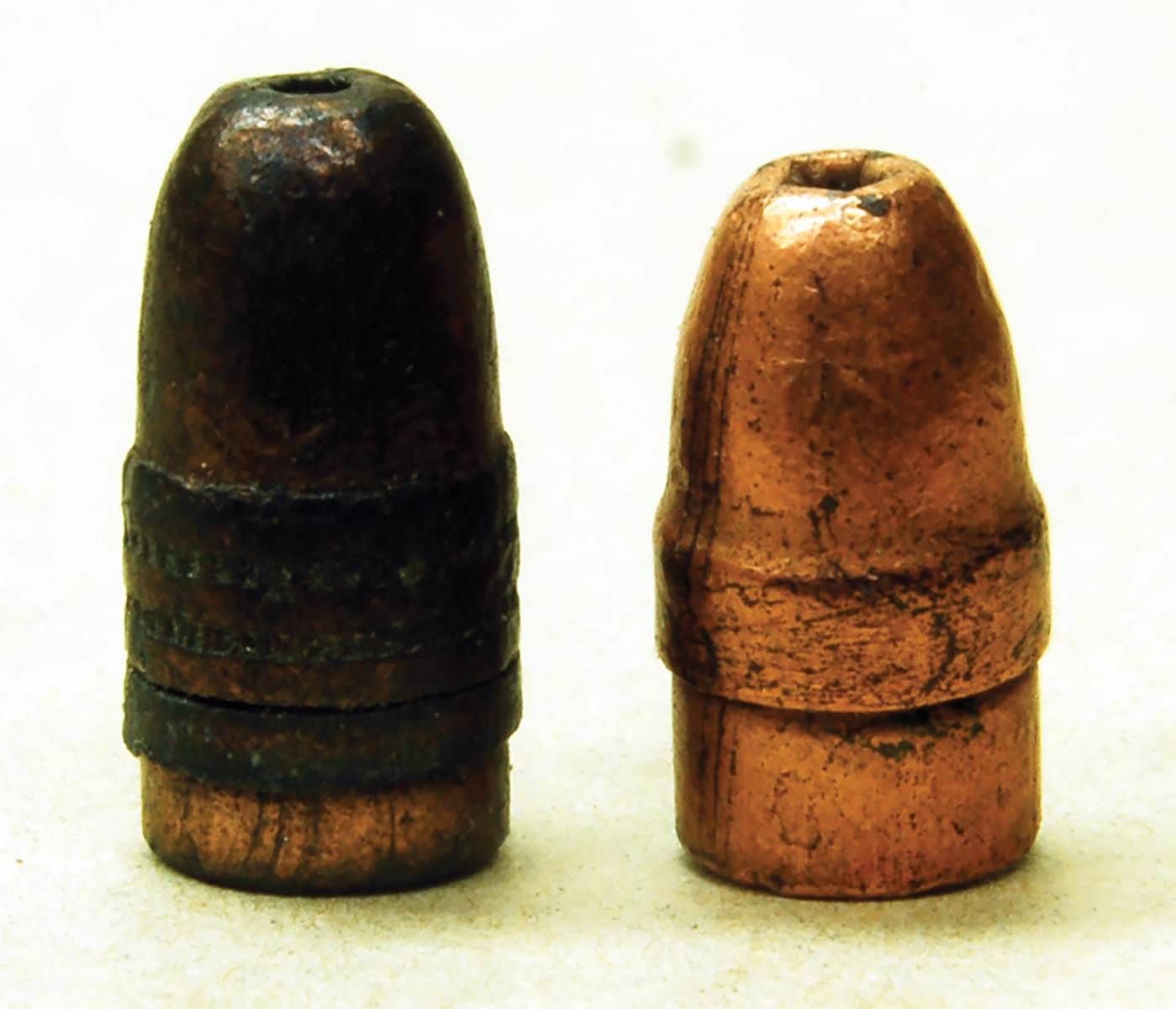
Note the deep crimp grooves in the heel of these 22LR bullets. It is the reason for much inaccuracy and hasn’t changed since the 1880s.
A total of twenty-four 22 LR loadings were fired in three guns: a Japanese-made Winchester M52, a Ruger 10/22 and a Ruger Mark II pistol. The table shows velocity and extreme spread. Group size was not recorded because chamber dimensions are all-important in accuracy. The M52 has some form of match chamber. The 10/22 is to SAAMI (Sporting Arms and Ammunition Manufacturers’ Institute) specifications, sporting dimensions, as is the Ruger Mark II pistol. The published velocity shown is from a 24-inch SAAMI test barrel. These shooting results are terribly important in today’s history of the 22 LR because, after measuring, weighing and disassembling countless cartridges for other projects, as well as making chamber casts and slugging bores, it seems that large variations in group size have far more to do with 22 LR rifles than the ammunition.
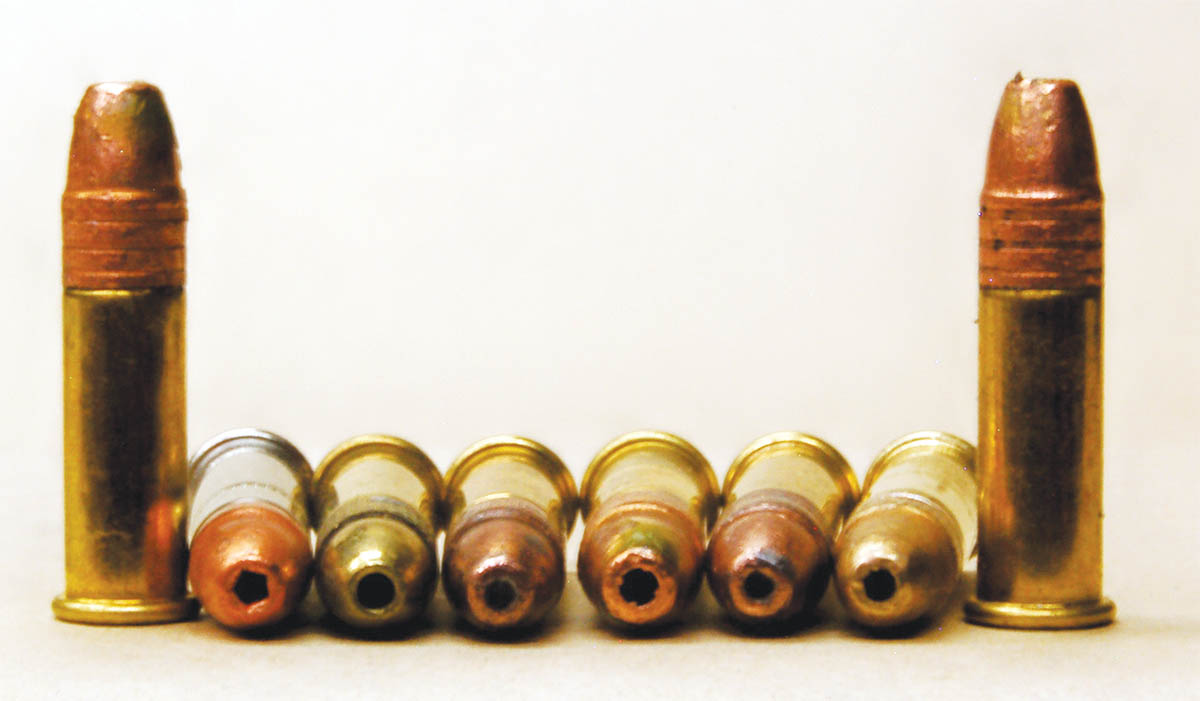
Hollow cavities are quite similar. All behave about the same.
As an example, I have slugged rimfire barrels having individual groove depths of .0015 to .0035 inch. Bore diameter (land-to-land) can vary about as much. Bullet casters would just size the bullet to match the grooves, but that’s not possible here. We can’t measure bullet diameters in factory rounds because many are coated with a hard lube of unknown thickness. This probably explains why target rifles with minimum specification bores and match chambers will group most any 22 LR round well. When it doesn’t, that particular cartridge won’t give good accuracy in any other rifle. Then too, bore dimensions mean buying $20-and-up-per-box, match ammunition will not improve the group size of standard production guns. The subtle improvement in uniformity of the finest target rounds cannot have any effect on rifles that average 3⁄4-inch groups at 50 yards.
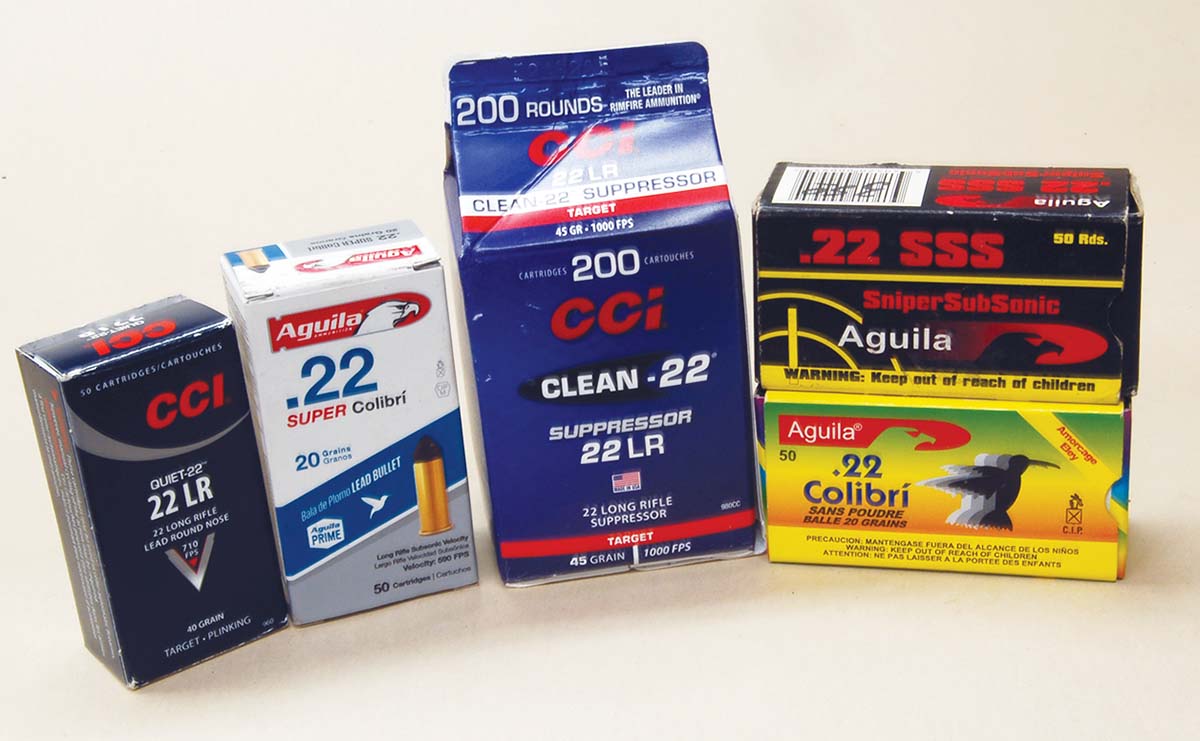
Cartridges, especially for suppressors, are becoming available, but many others under 1,000 feet per second (fps) are also available.
A friend recently spent a day on searching online for 22 LR cartridges. He found 64 different loads listed by U.S. ammunition makers. When foreign rounds and imports were added, the total came to nearly 100. With bullet weights ranging from 20 to 60 grains and velocities of 625 to 1,606 fps, there has to be something for everyone. The table provides an excellent place to start by picking rounds with the lowest extreme velocity spread.
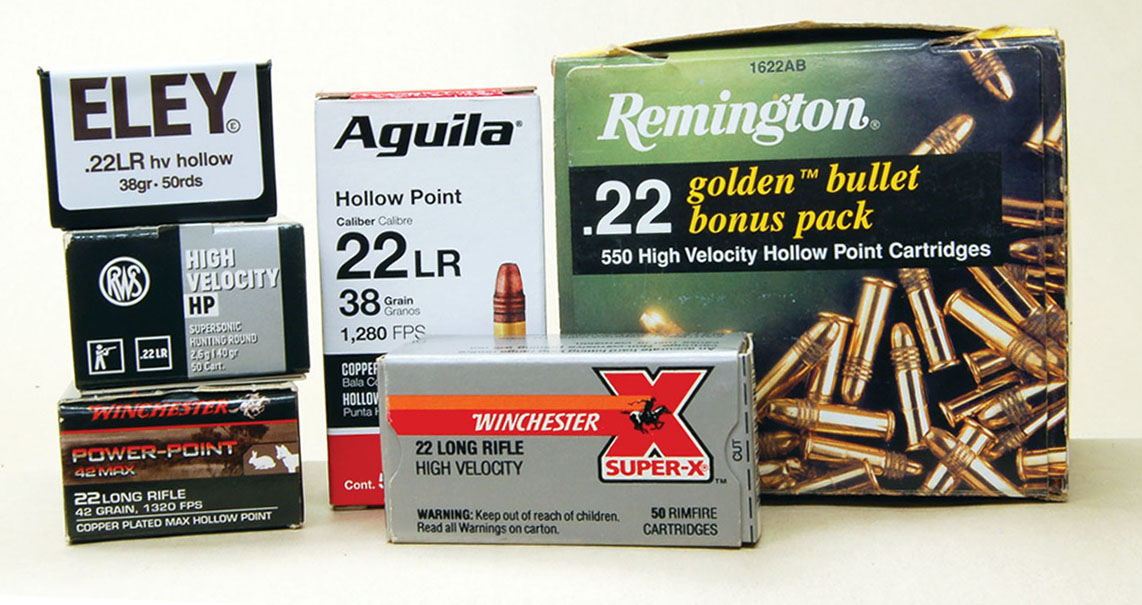
High velocity (1,300-1,350 fps) loads are common, but not all really achieve that speed despite advertising – as seen in the load table.
Now for the future of the 22 LR and Winchester’s 21 Sharp. Accuracy has come as far as possible using a lead, heeled bullet crimped in the case. The 21 Sharp has eliminated all these problems and uses the same case as the 22 LR. The cost at about $20 per 100 is too high, and the accuracy at over one inch at 50 yards is not even adequate, but it’s a start. A hard bullet is needed that can be formed in one operation, and a case alloy that will hold a taper crimp.
The future of the 22 LR looks bright. It will be interesting to see what happens in the next twenty-five years. Shoot more 22 Long Rifles!
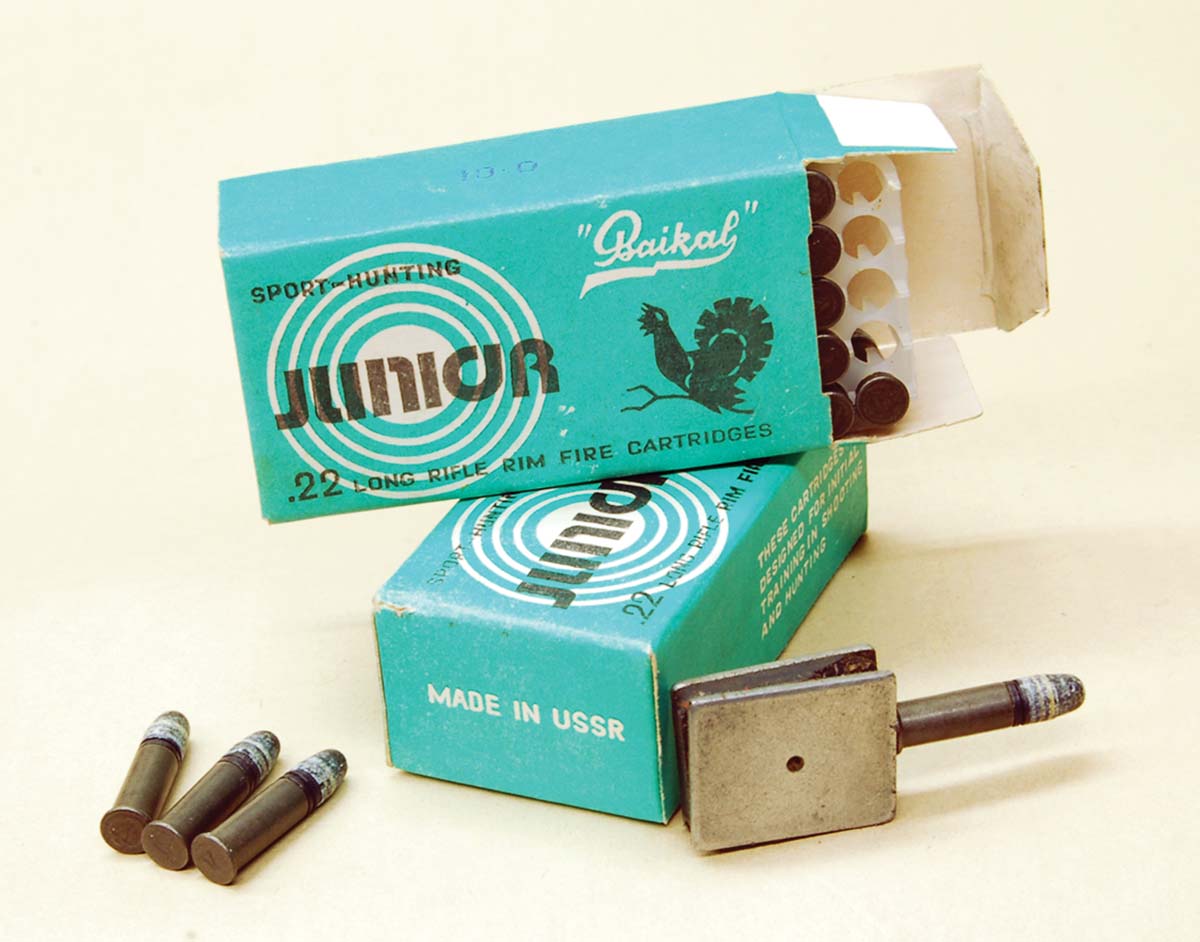
There is no end of odd imports, like this steel-cased ammunition made in Russia.


.jpg)
.jpg)