

Bullets & Brass
Classic Cast Bullet Loads for the 45 ACP, 10mm Bear Protection Loads, Suppressed Loads for a Henry Big Boy X in 357 Magnum
column By: Brian Pearce | February, 26
Classic Cast Bullet Loads for the 45 ACP
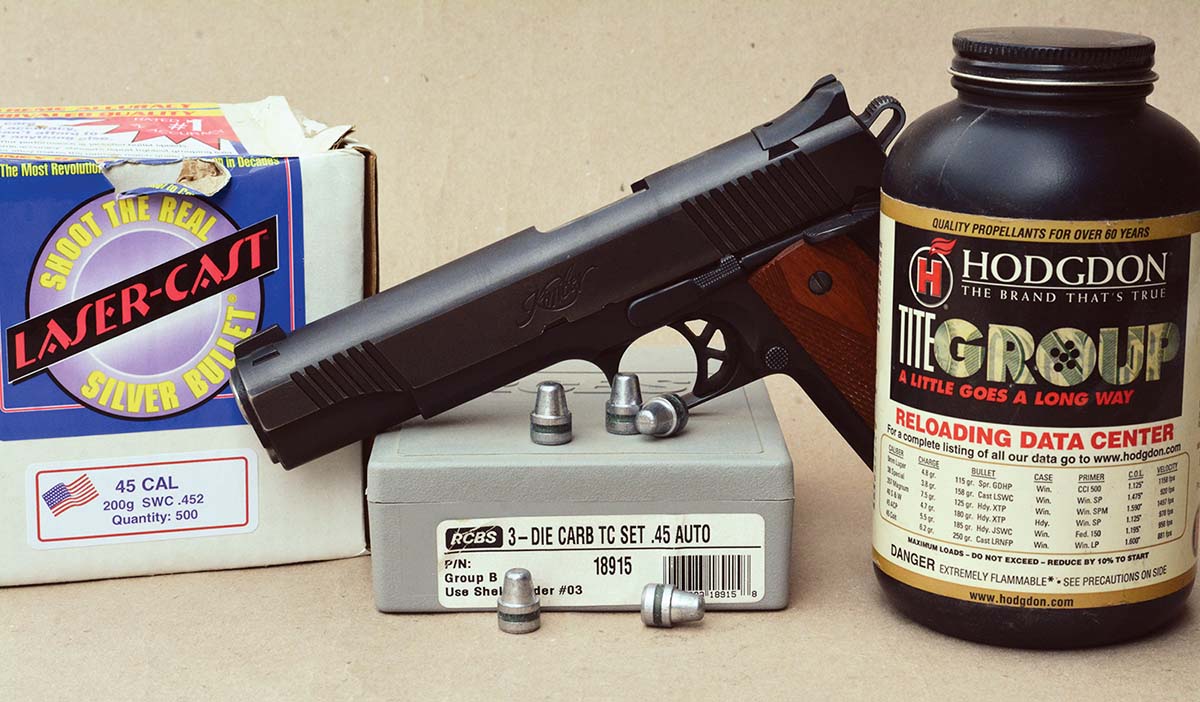
Q: Back in the 1970s and 80s, when I used to shoot a variety of pistol competitions using Colt Model 1911s chambered in 45 ACP, virtually everyone was using bullets cast from the old Hensley & Gibbs mould No. 68 or variations thereof. It was a 200-grain SWC design that fed with outstanding reliability and was very accurate. After I stopped competing, I put away my progressive Dillon press and stopped handloading for that caliber. Today I don’t shoot my 1911s much, but when I do, I generally rely on 230-grain factory-loaded ball loads. The other day, I was at the range with an old shooting buddy, and he handed me some of his 200-grain handloads, and my old gun started shooting better. I decided that I should start handloading for the 45 ACP again.
Many years ago, you wrote an article in Handloader about the virtues of the various 200-grain bullets in the 45 ACP, and you provided much data. I kept that article for years, but now I can’t seem to find it. Part of the problem is that Hercules, or now Alliant powders, that I used back in the day, are nowhere to be found, and dealers tell me they haven’t been available for years. I no longer have my old Hensley & Gibbs mould, so I purchased a quantity of Rim Rock Bullets Standard Hard Cast 200-grain SWC bullets that are slightly different from the old No. 68 mould, but similar enough.
So, my question is: Can you suggest a couple of powders and data that are readily available, give good accuracy and are clean-burning? There are so many new powders that I’m not familiar with. I am looking for 900 feet per second (fps), as that is the velocity that my pistols are regulated. My experience with reloading manuals is that their velocities are from a pressure barrel and are not representative of the velocities from a production handgun. Any guidance will be appreciated.
J.J., via Facebook
A: Yes, the old Hensley No. 68 bullet is a true classic for the 45 ACP. As to powder options, try 5.2 to 5.3 grains of Hodgdon Titegroup powder, 5.8 to 5.9 grains of Accurate No. 2, 7.3 grains of Hodgdon CFE Pistol, 5.3 grains of Winchester 244 or 6.5 grains of Winchester 572 powder. You should find most (if not all) of those powders on dealer’s shelves. They are very good powders for this application. While the above loads were developed with the CCI 300 primer, there will not be a significant velocity difference in standard (non-magnum) large pistol primers from other manufacturers in this application.
10mm Bear Protection Loads
Q: I enjoy Handloader and consider it the most important gun magazine that I subscribe to. I especially like your Pet Loads articles, but wish that you would do more of them on handgun cartridges.
I purchased a Colt Delta Elite 10mm Auto back in the late 1980s, but despite sending it to two different 1911 specialty gunsmiths, I could never fully work out the problems, and I sold it.
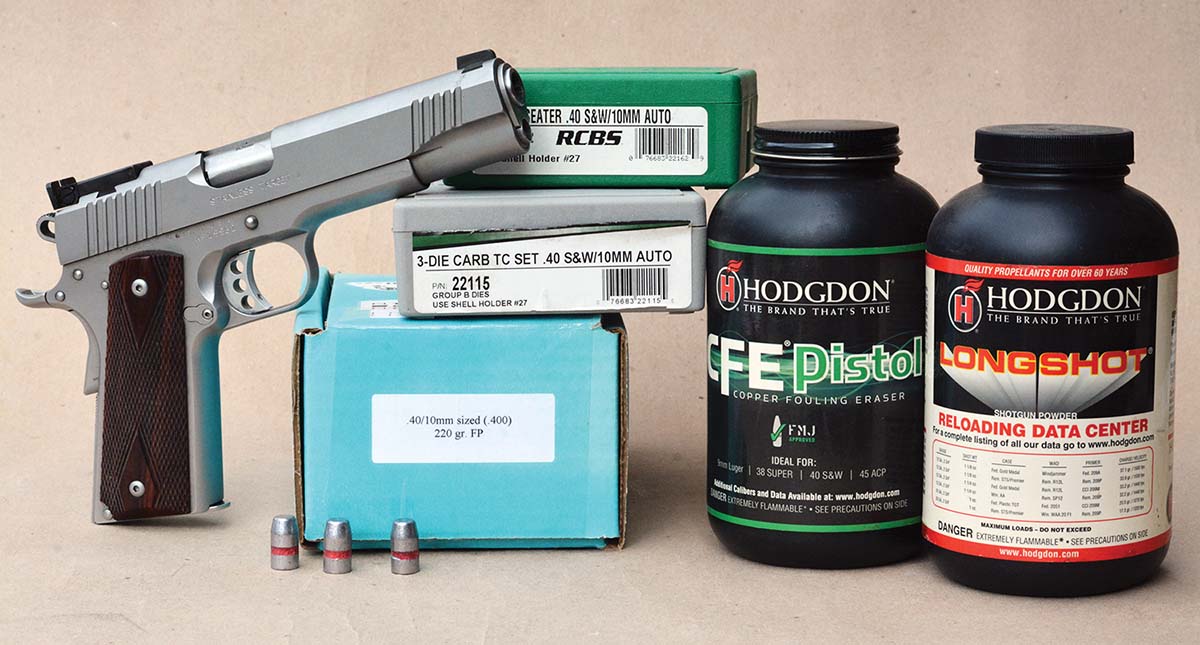
With a resurgence of interest in the 10mm as late, I purchased a Ruger SR1911 Target. I will not carry this gun for personal defense; rather, I will take it in the field when fishing and camping. We have a healthy bear population here in Montana, so my interests are in solid bullets for penetration rather than JHP-style bullets. I was considering a non-expanding 180-grain FMJ bullet, but based on your comments regarding cast bullets, maybe they will be a better choice. Can you recommend a cast bullet supplier and bullet style? Also, suggested data would be great. Most Hodgdon, Accurate and IMR powders are readily available in my area. Thanks in advance for your help.
Barry A., Big Fork MT
A: It is always a bit of a concern when people start asking me about data for the 10mm Auto, and here is why. While SAAMI (Sporting Arms and Ammunition Manufacturers’ Institute) has a specified maximum average pressure of 37,500 pounds per square inch (psi), many production pistols feature a deeply cut feed ramp that can compromise case support. The bottom line is that this can potentially cause the bottom of the case to blow out while pressures are still high and can cause damage to the gun and the shooter. This explains why there is such a huge difference in supersonic loads from various ammunition companies.
I have not worked with the Ruger SR1911 chambered in 10mm, so I am unsure how well the chamber is supported on the underside. For these reasons, I am going to be on the conservative side in offering load data.
You do not specify what weight of cast bullets you want to use. So, I will offer loads for the 180-grain Oregon Trail and the 220-grain TC Rim Rock Bullet. For the 180-grain bullet, try 8.3 grains of Hodgdon Longshot for around 1,250 fps. Seat the bullet to an overall cartridge length of 1.250 inches and apply the taper crimp as a separate step. The crimp diameter at the casemouth should measure (using blade calipers) .421 inch. Changing to the 220-grain bullet, try 5.9 grains of Hodgdon CFE Pistol powder for around 1,000 fps. The overall cartridge length should measure 1.250 to 1.260 inches. The above loads were developed in Starline cases that often give less pressure and higher velocities than some other case brands. Due to their strength, they are less prone to rupture as discussed above. The above loads were developed with CCI 300 standard large pistol primers and are well within the SAAMI maximum average pressure guidelines.
Regarding your request for more pet loads articles on handgun cartridges, I agree; however, it seems there are many, many more new rifle cartridges or popular older rifle cartridges that need updating than there are current handgun cartridges. However, I will be revisiting and updating several important handgun cartridges. Thanks for the request.
Suppressed Loads for a Henry Big Boy X in 357 Magnum
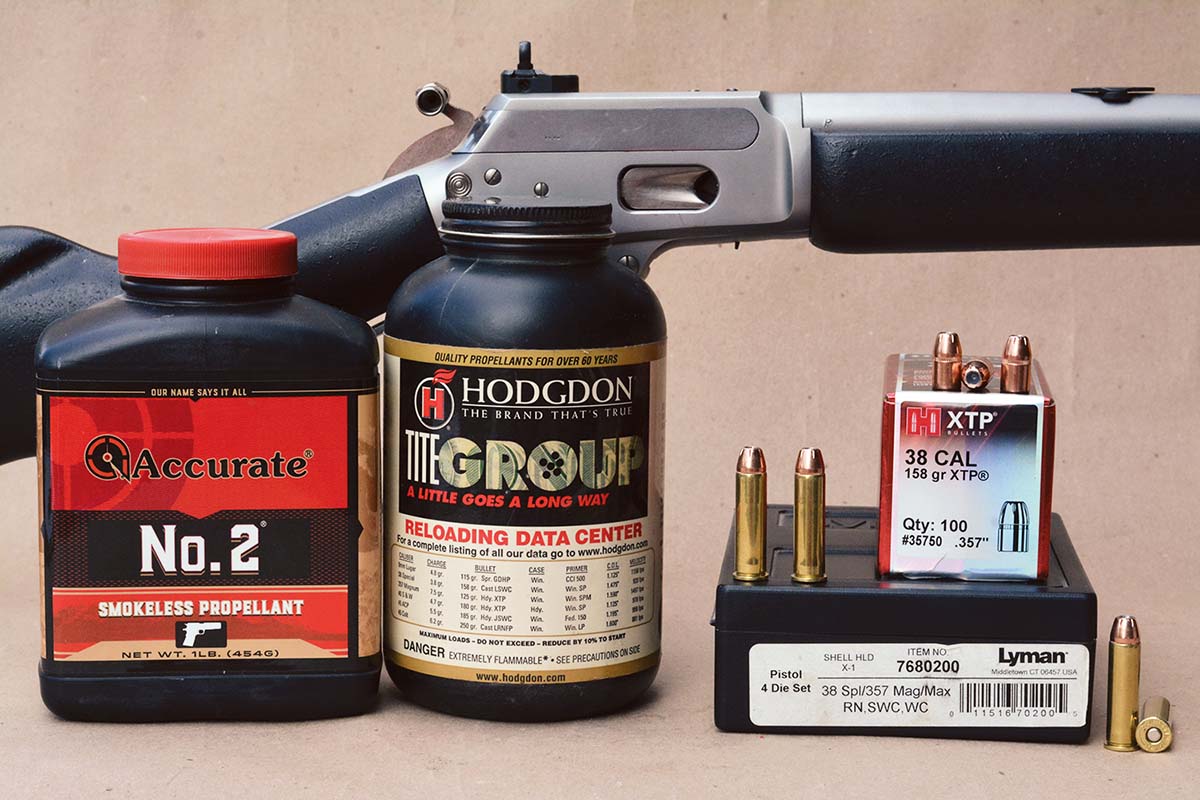
Q: I recently acquired a Henry Big Boy X-Model chambered in 357 Magnum. I have applied to purchase a suppressor and hope to be cleared to buy one soon. None of my handloading manuals lists data specifically for 357 rifles with subsonic loads. I have no idea where to begin or where to find data. Reading online has been concerning, as it sounds like there is a strong likelihood of sticking a bullet in the bore. Any suggestions that you can offer will be appreciated.
Carlos F., via Facebook
A: Due to their low resistance within the barrel, cast bullet loads are ideal for 357 Magnum rifles at subsonic velocities; however, the problem is that some suppressors can be damaged due to lead particles and bullet lube fouling at the muzzle. You should check with the suppressor manufacturer and follow their recommendations. For this reason, I’m going to suggest using JHP-style bullets. The following loads should be used exactly as listed. In other words, do not reduce powder charges.
Using the 158-grain Hornady XTP-HP bullet, try 5.3 grains of Accurate No. 2 powder, or 5.0 grains of Hodgdon Titegroup for 1,012 fps and 1,024 fps respectively from a Ruger Model 1894 with 16.17 inch barrel. Cases were Starline capped with CCI 500 small pistol (standard) primers. Extreme spreads were very low with each load.
With the realization that the above loads are also likely to be fired in revolvers, the Accurate No. 2 load was tried in a Ruger New Model Blackhawk with a 6½-inch barrel and a Smith & Wesson Model 627 with a 4-inch barrel. Velocities were 954 and 939 fps, respectively. Changing to the Titegroup load, velocities were 968 fps and 948 fps, respectively. Neither powder is position sensitive, so there is really no concern of sticking a bullet in the bore of either rifle or revolver (at least with ordinary barrel lengths).