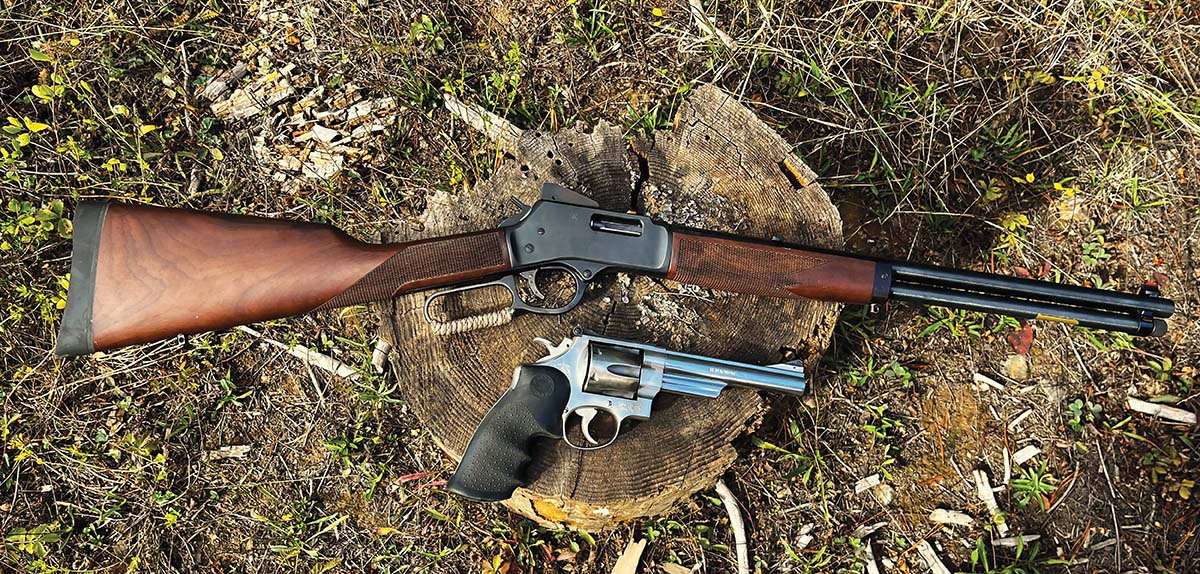
Patrick’s friend Dennis Thompson, owner of the two 41 Magnum test firearms, wanted to find a single load to hunt white-tailed deer and black bears with that shot equally well in both his Smith & Wesson Model 657 revolver and Henry Big Boy Classic Steel lever rifle.
The 41 Remington Magnum remains a sort of red-headed stepchild in the magnum revolver world. It is certainly an able cartridge, though it has been largely overshadowed by the older 44 Remington Magnum. Remington developed it in 1964, eight years after the 44 Magnum’s introduction, and it was intended for hunting and law enforcement applications. Hand-gunning icons such as Elmer Keith, Bill Jordan and Skeeter Skelton are names that crop up in association with this cartridge. A round that falls squarely between the 357 and 44 Magnums. It was also conceived to address the perceived shortcomings of those rounds. These are lesser terminal ballistics of the former (especially before quality jacketed bullets became available) and excessive recoil of the latter (particularly in relation to police work).
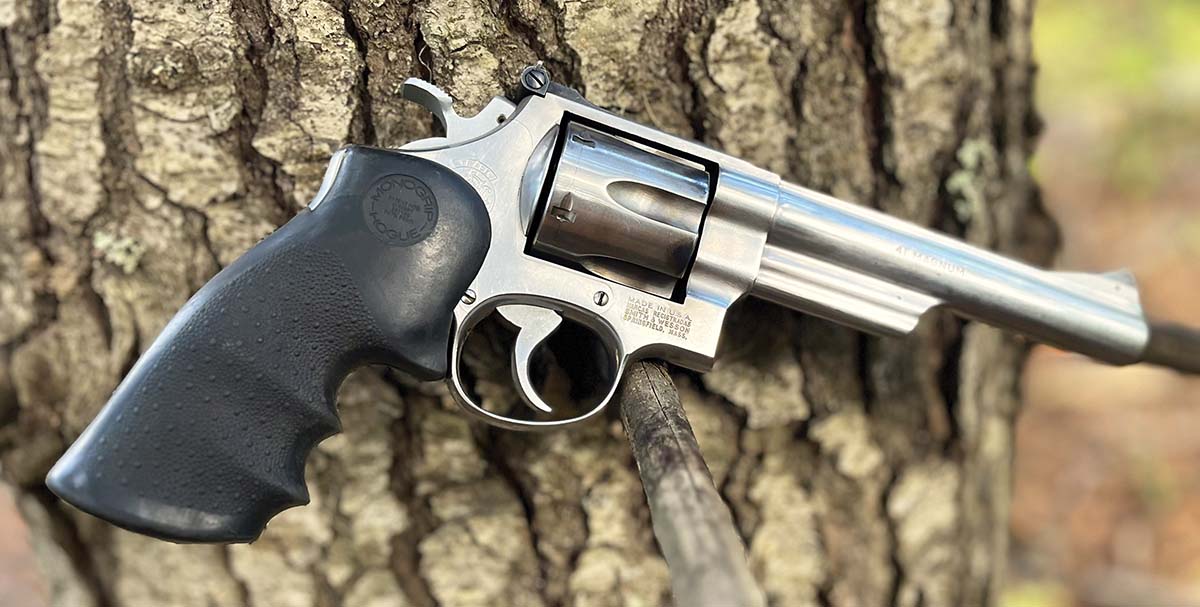
The handgun portion of the 41 Remington Magnum test was conducted with a stainless-steel Smith & Wesson Model 657 revolver with a Hogue Monogrip rubber grip.
Remington, heavily influenced by the public’s newfound fascination with magnum handguns spawned by the 44 Magnum, initially released a load consisting of a 210-grain bullet pushed to around 1,500 feet per second (fps). A lighter police load was also introduced using a 210-grain lead semiwadcutter sent at 1,150 fps, which was still deemed as overpowered by most law enforcement agencies. Smith & Wesson’s Model 58, conceived for law enforcement use, was also largely rejected by that community.
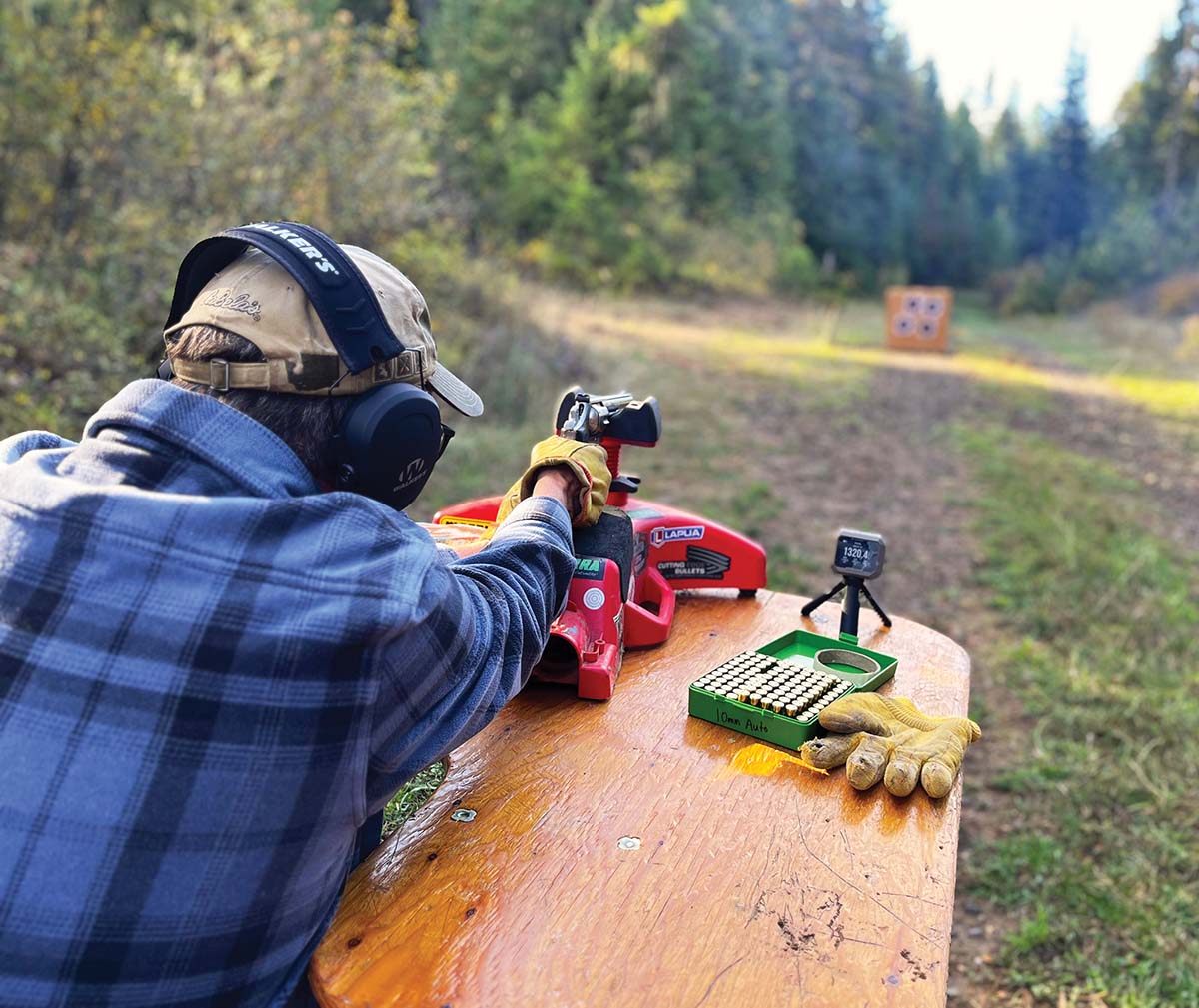
Dennis Thompson did all the shooting from a solid bench rest while Patrick compiled data.
Ultimately, Smith & Wesson produced the Model 57, which included a stronger locking mechanism to deal with the 41 Magnum’s greater thrust. Magnum Research’s Desert Eagle label produced a Mark VII semiautomatic handgun in 41 Magnum, and Ruger’s Blackhawk single-action revolver was also chambered in the cartridge. In lever rifles, Marlin produced four variants of its Model 1894, and Henry Repeating Arms offers their Big Boy with a brass frame and Big Boy Classic Steel. That allows carrying both a revolver and a lever rifle while hunting, which is exactly the gist of this article.
Despite generating significantly more energy than the 357 Magnum and slightly less recoil than the 44 Magnum, the 41 Magnum never really caught on with the shooting public to the degree of the 357 or 44 Magnums. Fans of the 41 Magnum will allege flatter trajectories, but running 210-grain, 41 Remington Magnum and 240-grain, 44 Remington Magnum loads through a ballistic calculator (both sent at 1,400 fps), I find that doesn’t exactly square. They are pretty darn close, actually. Any perceivable trajectory advantage is going to the 44 by the slimmest margins. However, 41 Magnum bullets can be sent in excess of 1,400 fps, which would undoubtedly help flatten trajectory. The 41 Magnum is also handicapped by a shorter list of heavy bullet weights suited to big game hunting than the 44 Magnum. As it sits, when loaded with a 210 jacketed hollowpoint pushed to 1,400 fps, a 6-inch handgun can generate 1,000 foot pounds (ft-lbs) of kinetic energy, which is 75 to 100 ft-lbs short of the 44 Magnum shooting 240-grain bullets at the same velocity.
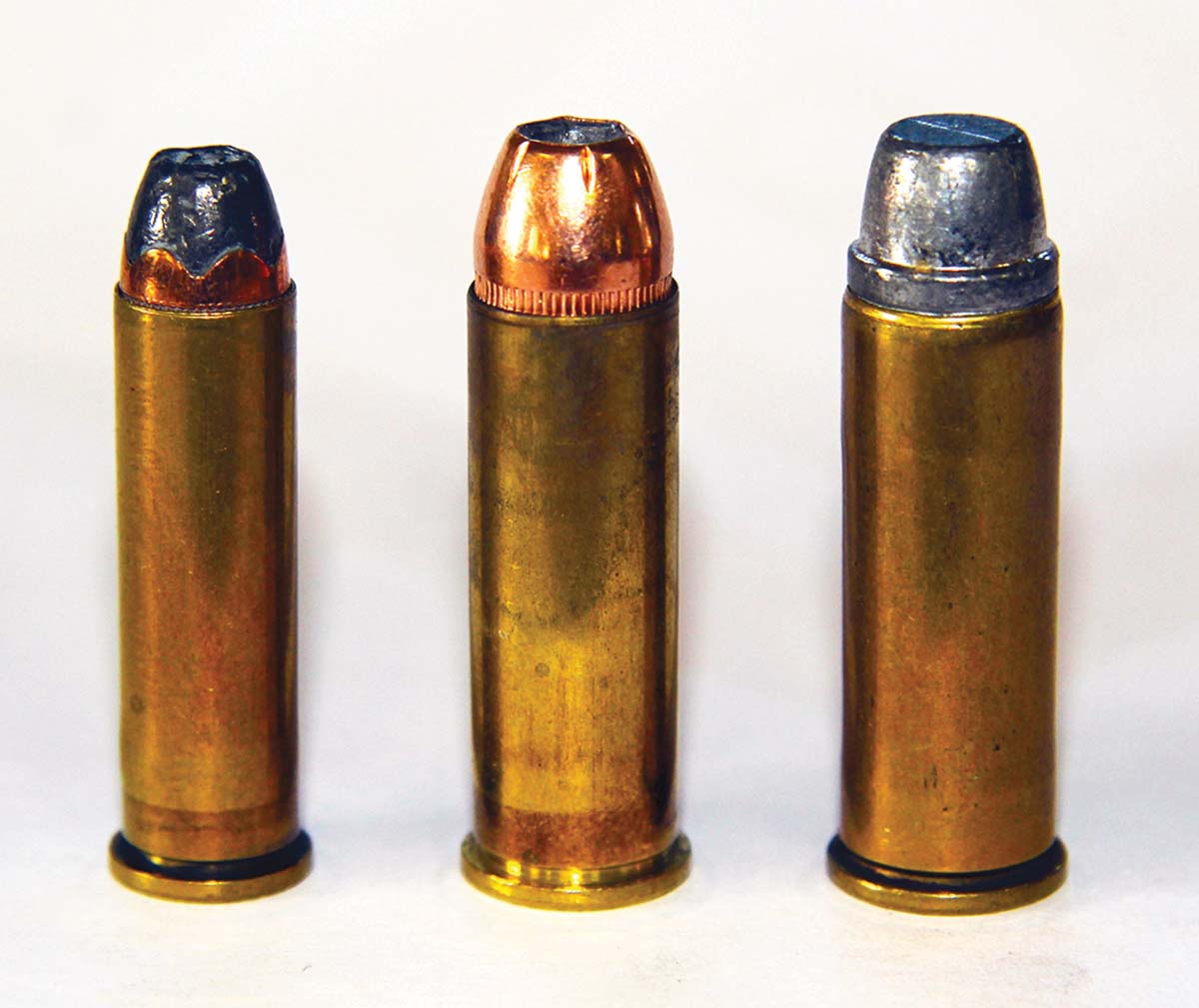
Shown for comparison are the (left to right): 357 Magnum, 41 Remington Magnum and 44 Remington Magnum. Each offers a step up in performance from the previous round.
Despite this, akin to cartridges such as the 280 Remington and 10mm Auto, the 41 Magnum maintains an almost cult-like following with a cadre of fans who will argue the merits of the unappreciated round.
The 41 Magnum has a case length of 1.290 inches, to the 44 Magnum’s 1.285 inches. The 41 Magnum’s rim is .492-inch wide and .060-inch thick. The case head is .435-inch wide and the neck is .434-inch wide. This is contrasted against the 44 Magnum’s .514-inch-wide rim with identical rim thickness, .457-inch-wide base and .456-inch neck. The 41 Magnum uses .410-caliber bullets. Maximum cartridge overall length (COL) is listed as 1.590 inches in the Hornady Handbook of Cartridge Reloading, 11th Edition (though we ran COLs slightly longer without feeding issues), and trim-to length as 1.280 inches. Jacketed bullets from 170 to 210 grains are most common, with some heavier cast-lead options available.
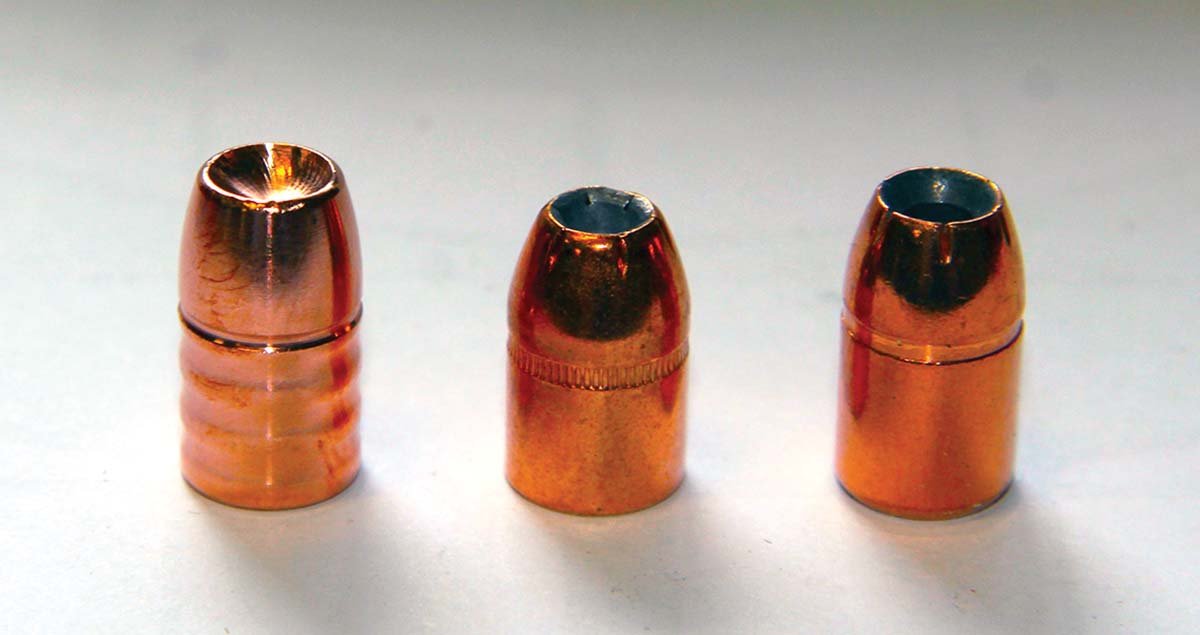
Bullets used while seeking a 41 Magnum revolver/lever-rifle switch load were chosen for hunting white-tailed deer and black bear. They included (left to right): Hammer Bullets’ 200-grain Jack Hammer, Hornady’s 210-grain XTP and Swift Bullets’ 210-grain Heavy Revolver A-Frame.
This project came about because my friend Dennis Thompson, a person I shoot with frequently, recently scored a Henry Big Boy Classic Steel lever rifle to complement his Smith & Wesson Model 657 revolver. Not wanting to develop a load for each firearm and then deal with the hassle of keeping handgun and rifle loads segregated, we set out to develop a load or two that would shoot equally well in both firearms. He also wanted to load bullets suited to still-hunting our north Idaho deep woods whitetails or guarding spring bait sites for black bear. Bullets were chosen accordingly. As a quick aside, the 41 Magnum is legal in straight-walled hunting areas in Ohio, Indiana, southern Michigan and Iowa.
The Smith & Wesson Model 657 is a sturdy revolver. My friend’s model is stainless steel with a Hogue Monogrip rubber grip. Henry’s Big Boy Steel, while based on B.T. Henry’s 1860 rifle, was designed to weigh 1.68 pounds less than the brass-framed Big Boy. Including a 20-inch round barrel with 1:18 rifling twist, the Big Boy Steel hits the scales at about 7 pounds. The frame is matte blued and features an American walnut forearm and an English-style buttstock, complete with quality checkering, front and rear sling studs, and a black rubber recoil pad. This creates a 14-inch length of pull. The rifle feeds from a tubular magazine, holding ten 41 Magnum rounds. The hammer holds a sliding transfer bar safety system, and the forearm a steel cap instead of a carbine-style barrel band. Overall length is 37.5 inches. My friend’s rifle has a Skinner Sights rear peep sight and fiber-optic front bead.
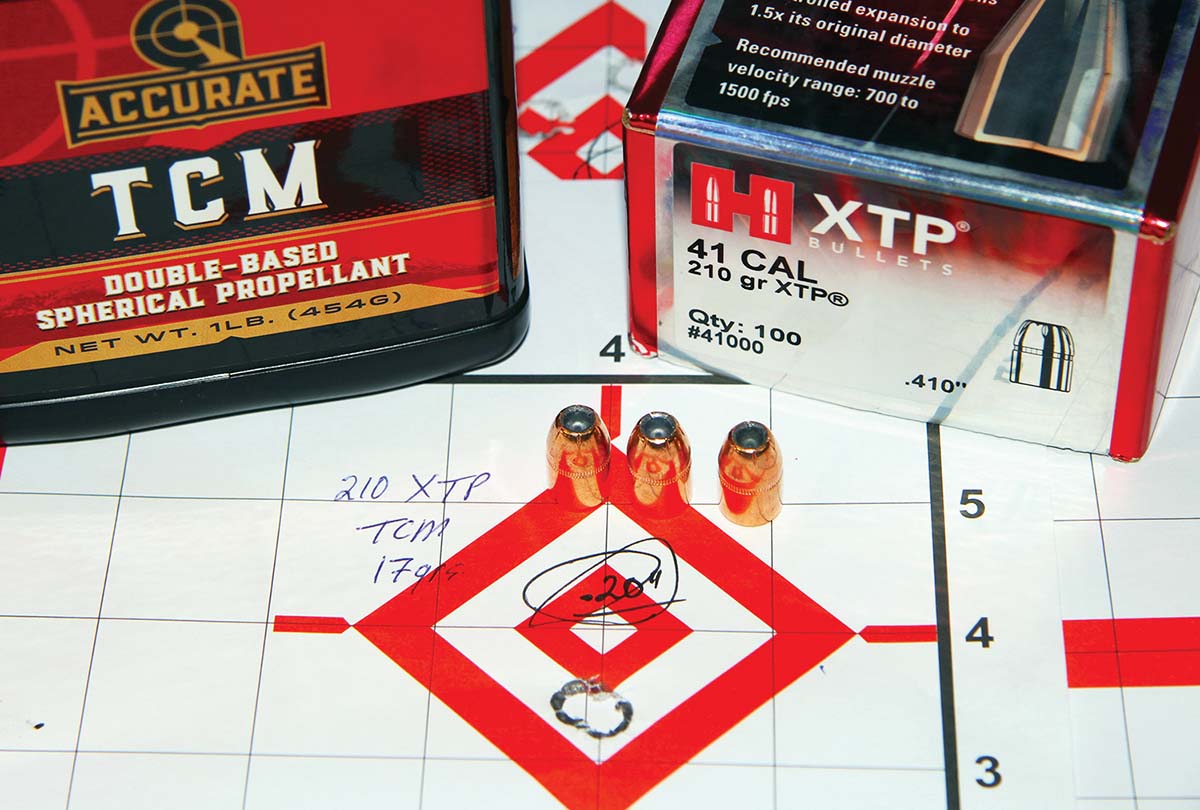
Shooting a combination of Hornady’s 210-grain XTP hollowpoint and 17 grains of Accurate TCM, the Henry Big Boy Classic Steel lever rifle grouped three shots into .20 inch at 75 yards, pushing 1,717 fps from the muzzle.
Bullets chosen for the outlined tasks included
Hammer Bullets’ 200-grain Jack Hammer,
Hornady’s 210 XTP and
Swift’s 210-grain A-Frame. Powders included the usual magnum revolver suspects, or at least those I had on hand.
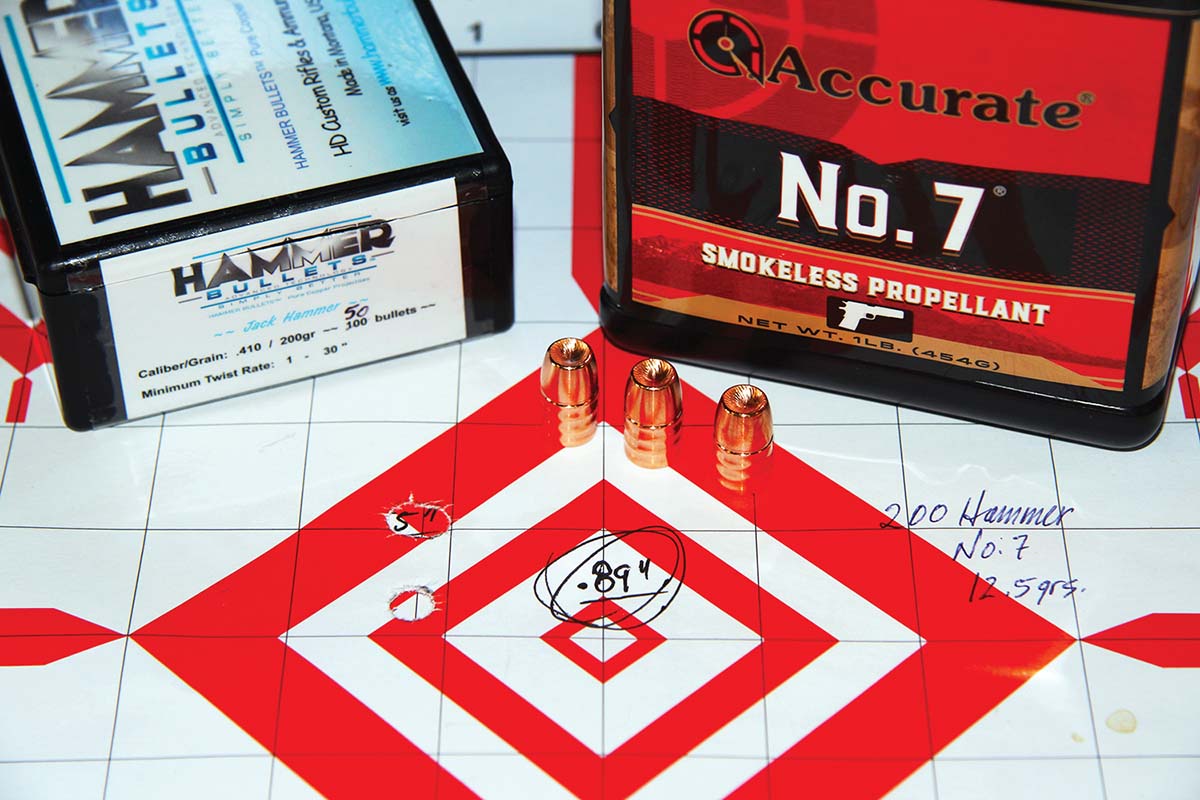
The Henry Big Boy Classic Steel lever rifle shot its best group with Hammer Bullets’ 200-grain Jack Hammer using 12.5 grains of Accurate No. 7. That group measured .89 inch and was sent at a relatively pokey 1,349 fps.
The 200-grain Jack Hammer is a milled monolithic copper bullet with a cupped nose that promotes deep, straight-line penetration, 100 percent eight retention and destructive soft tissue damage. The Jack Hammer provided reliable feeding in the test rifle. Like all 100 percent copper bullets, the Jack Hammer is long for weight, measuring .753-inch nose to base, which is .041 inch longer than the 210-grain Hornady and .023 inch longer than the 210-grain Swift. This can result in severely compressed loads when seated to the provided crimping groove. With its estimated .199 G1 ballistic coefficient (BC), given a modest 1,450 fps muzzle velocity and zeroed at 50 yards, the Jack Hammer drops 3.4 inches and retains 635 ft-lbs of kinetic energy at 100 yards (though it is doubtful shots at that distance will be taken).
The 210-grain XTP from Hornady is hunt-ready, while providing target-grade accuracy. The hollowpoint design was engineered to expand reliably at pistol or lever-rifle velocities while also driving deep. It includes precise serrations to initiate symmetrical expansion. The tapered gilding metal jacket protects the bullet nose and allows the hollowpoint cavity to function properly on impact, the uniform swaged core promoting controlled expansion and in-flight stability. The cannelure provides a consistent crimping point to eliminate distortion and boost accuracy. With a G1 BC of .182, sighted at 50 yards and sent at a modest 1,400 fps, the 210-grain XTP drops 4 inches and retains 610 ft-lbs of kinetic energy at 100 yards.
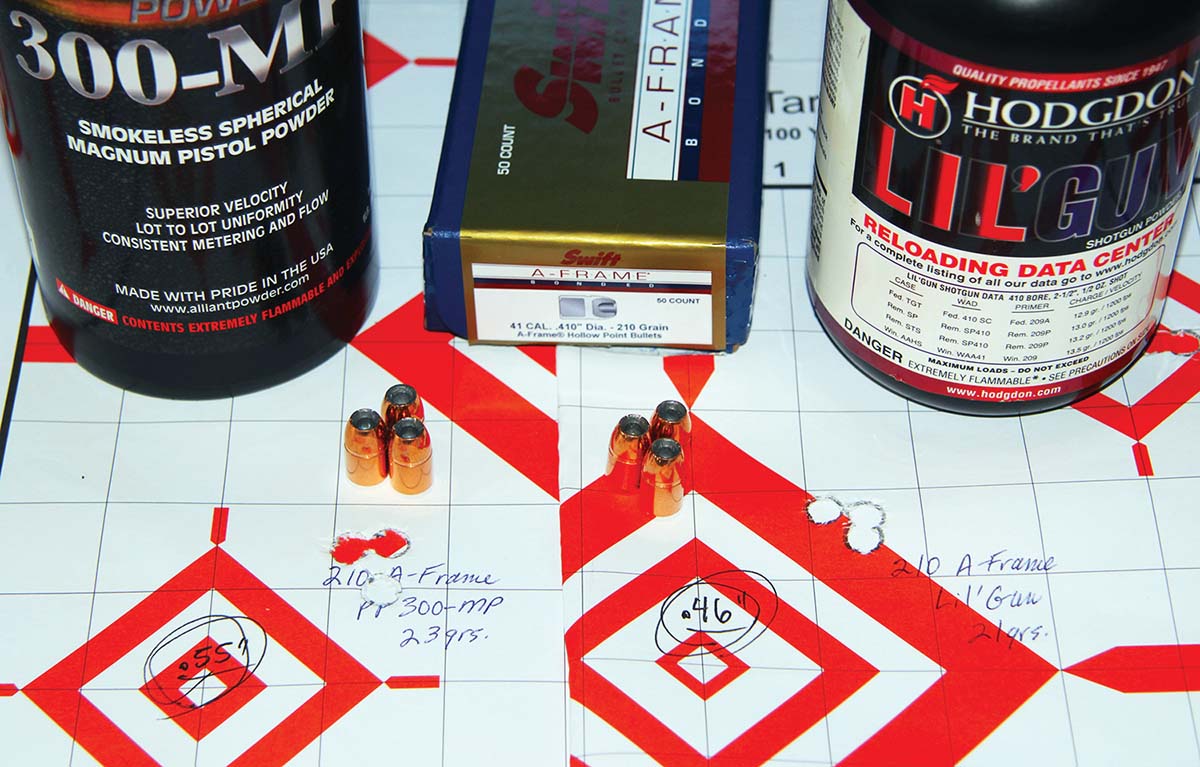
While the revolver did not care for Hodgdon Lil’Gun and Alliant Power Pro 300-MP, the Henry produced great groups with both. Twenty-three grains of 300-MP produced a .55-inch group at 1,871 fps, while 21 grains of Lil’Gun resulted in a .46-inch group at 1,830 fps.
Swift’s Heavy Revolver A-Frame includes a Partition/H-Mantle-style divided jacket with bonded lead hollowpoint nose and base. Swift says these bullets will open at velocities as low as 950 fps, expanding to about 1.65 times their original diameter while retaining around 97 percent of their starting weight. They are also speed-rated to velocities in excess of 3,000 fps, making them essentially indestructible at revolver or carbine velocities. With a .159 G1 BC (which seems pretty conservative) and a modest 1,400 fps muzzle velocity, given the same 50-yard zero, this bullet also drops 4.2 inches and retains 581 ft-lbs of kinetic energy at 100 yards. The cannelure was used to establish seating depth.
Powders for the 41 Magnum are pretty predictable, sitting between number 52 (Accurate No. 7) and 70 (Alliant Power Pro 300-MP) on the relative burn chart. Winchester 296, Accurate No. 11 FS and Hodgdon 110 (not used here) seem about ideal, producing top velocities in all bullet weights. These three are essentially identical in burn rate, while Hodgdon also lists equal measures of each in any given bullet weight.
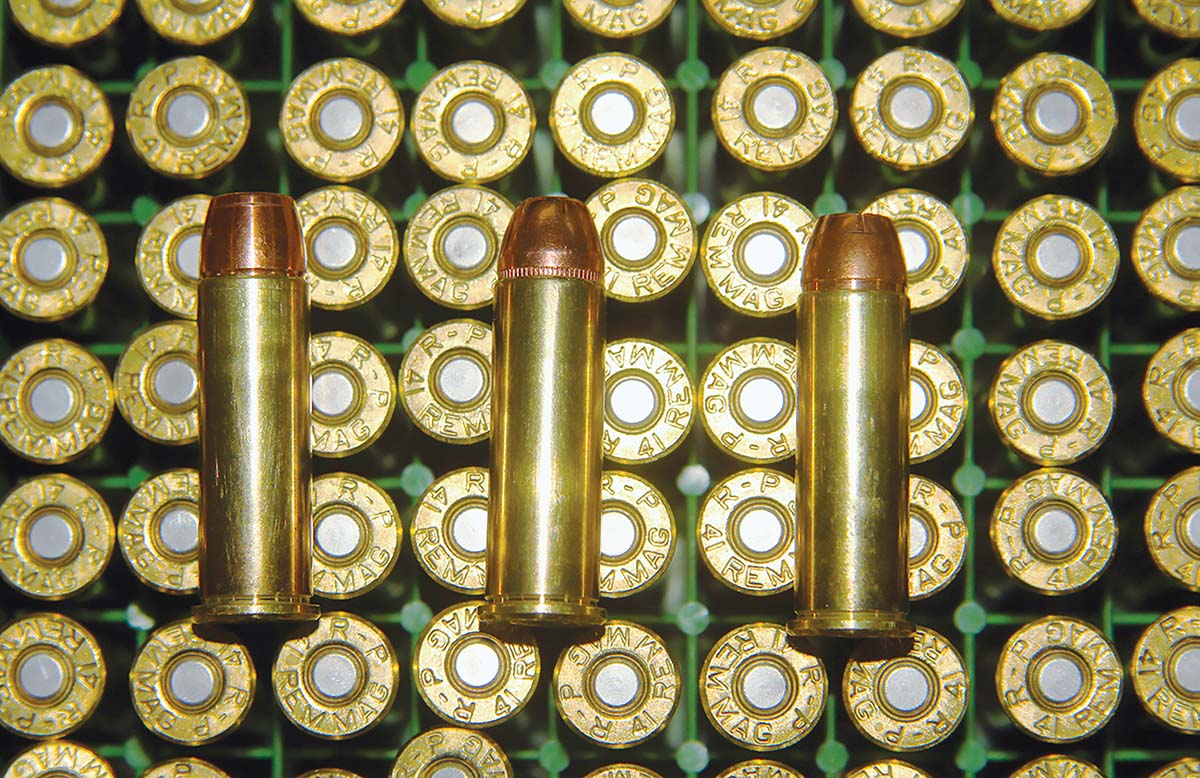
Loaded and ready for testing: (1) Hammer Bullets’ 200-grain Jack Hammer, (2) Hornady 210-grain XTP and (3) Swift Bullets’ 210-grain Heavy Revolver A-Frame.
The 200-grain Jack Hammer was paired with Winchester 296, Ramshot Enforcer and Accurate No. 7. The latter provided the fastest relative burn rate of the series, which also resulted in lower muzzle velocities. Powder charges were reduced 1 to 2 grains beneath recommended like-weight lead-bullet data in deference to the copper bullet’s longer bearing surface and likelihood to compress maximum loads due to their long-for-weight nature. The 210-grain Hornady XTP was set up with Accurate TCM, Accurate No. 11 FS (FS representing an added flash suppressant) and Vihtavuori N110. For the Swift, Accurate No. 9, Hodgdon Lil’Gun and Alliant Power Pro 300-MP (the slowest powder included in this series) were used. That leaves powders like Hodgdon Longshot, Alliant 2400, Accurate 4100, Norma E123 and IMR-4227 as 41 Magnum viable, but absent in this test. Exercise all due caution when approaching listed maximum loads, as most are true to that label.
RCBS carbide dies and fresh
Remington brass were used to assemble all loads. I assumed magnum pistol primers would be involved, but after consulting several loading manuals, CCI No. 300 large pistol primers were deemed appropriate for ignition. Aside from inside and out mouth chamfering, loading was conducted in four steps: sizing, belling, bullet seating over measured powder charges and crimping conducted as a separate and final step.
Dennis did the shooting while I recorded data. My first surprise was how cool both the revolver and lever-rifle shot, allowing us to proceed at a steady pace, opposed to spending more time waiting for firearms to cool than shooting, as is often the case with centerfire bolt rifles. I had also assumed there would be excruciating compromises to ponder when pairing up one or two loads that would give their best in both firearms. Surprisingly, those choices proved amazingly simple. In general, the powders and charges that provided good accuracy in the revolver also shined in the lever rifle. There were exceptions, of course. For instance, the handgun didn’t exactly care for the copper Jack Hammer bullet, while the rifle produced some impressive groups with it. Additionally, the revolver seemed to be allergic to Hodgdon Lil’Gun and Alliant Power Pro 300-MP, while the rifle thrived on those powders.
In the end, three solid loads emerged, one for each bullet, with only a minor compromise involved with the Hornady bullet. The 200-grain Jack Hammer shot about 1.5 minute of angle (MOA) with 12.5 grains of Accurate No. 7 from the handgun, and less than an inch with the same load from the rifle. The only downside here was the relatively pokey 1,293/1,349 fps muzzle velocities (revolver/handgun). The most compatible two-gun load for the Hornady 210-grain XTP involved 17 grains of Accurate TCM, shooting less than 11⁄2 inches from the revolver (a .25-inch smaller group resulted with 16 grains of TCM from the revolver), and less than 1⁄4-MOA from the rifle. Velocities were respectable, clocking 1,372 fps from the muzzle of the revolver and 1,717 fps from the rifle. Finally, shooting the 210-grain A-Frame, 17 grains of Accurate No. 9 grouped into .61-inch from the revolver at 25 yards with an impressive 1,416 fps muzzle velocity, while the rifle sent the same load into .63-inch from 75 yards and at 1,657 fps.
It’s always satisfying when a plan comes together so easily, if you consider shooting 162 magnum rounds easy. Dennis now has a choice of three solid loads using three excellent hunting bullets that will provide top accuracy from both his 41 Remington Magnum Smith & Wesson 567 revolver and Henry Big Boy Classic Steel lever rifle.



.jpg)
.jpg)