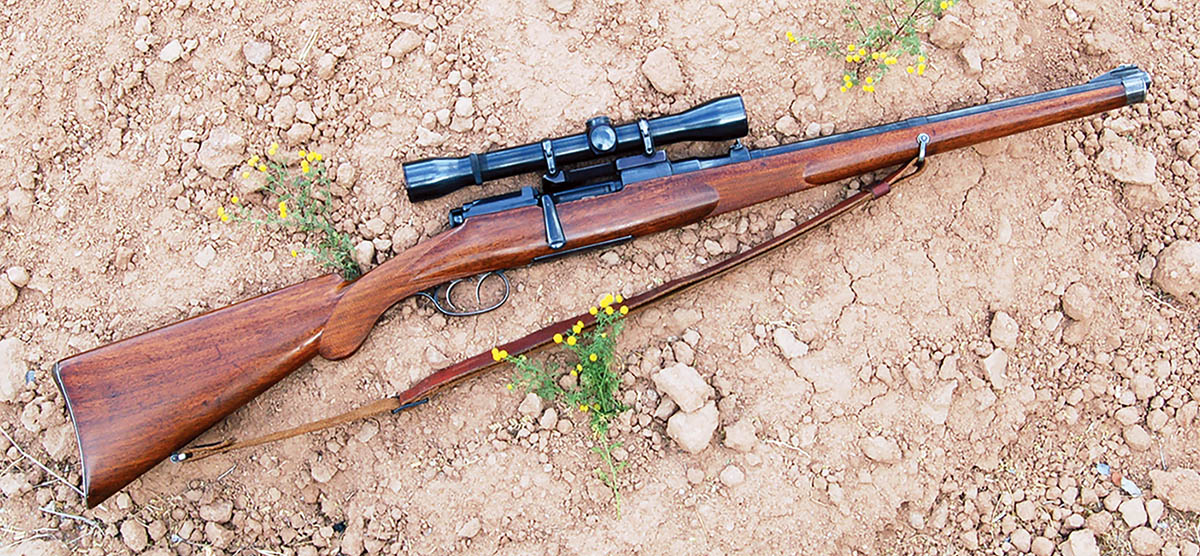
Gil’s M1910 M-S was sold as 9.5x56mm M-S, but had been rebarreled to 7x57mm.
This cartridge will appear as a mystery to most riflefolk unless they are Mannlicher-Schoenauer rifle fans. Yet its muzzle energy is nearly equal to the modern 308 Winchester and only ten percent below the modern 358 Win. There is even disagreement as to the proper name for the round. References show 9.5x56mm Mannlicher-Schöenauer (M-S), 9.5x57 M-S, 9.5x57.5 M-S, 9.5 M, 9.5 Express, 9.5 M-S, 9.5 Mann and probably a few others. An interesting fact is that the chronicles tell us the cartridge is of Austrian origin, and the Austrians had the strange habit of measuring case length beginning at the front of the rim. The rest of the planet considers case length as, well, case length. Thus, the 56mm figure, the actual case length is 57mm for regular folks.
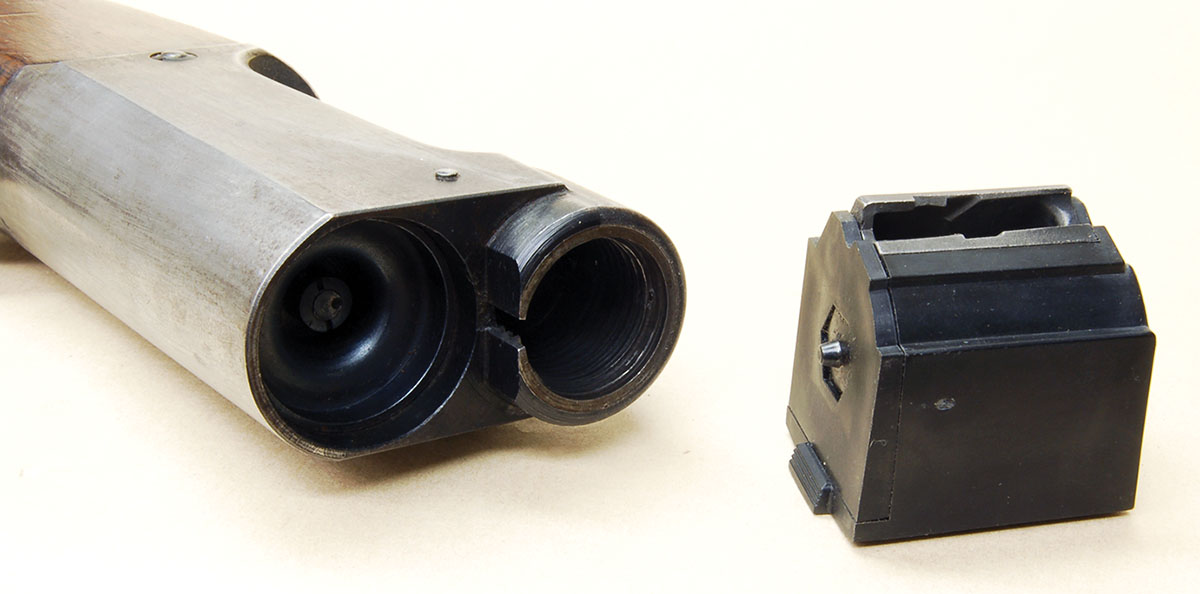
Rotary magazines like the Savage 99 (left) are difficult to disassemble to clean. Ruger 10/22 magazines (right) are easy.
The 9.5x56mm M-S and its rifles
came about, as did many hunting rounds in the early smokeless era, as an outgrowth of work on military arms. The name Mannlicher in the cartridge title refers to Ferdinand von Mannlicher (1848-1904). Born in Germany, he moved to Vienna at age 17 and there enrolled in Vienna Technical University, studying mechanical engineering. Graduation landed him a job with the Austrian Imperial Northern Railway. He was good at his job because he soon held the title of Chief Engineer (mechanical design).Mannlicher’s employment allowed him to travel to the U.S. in 1876 to visit the Centennial Exposition in Philadelphia. There, he became enamored with myriad firearms designs from all parts of the world. Arriving back in Austria, he retired from the railroad
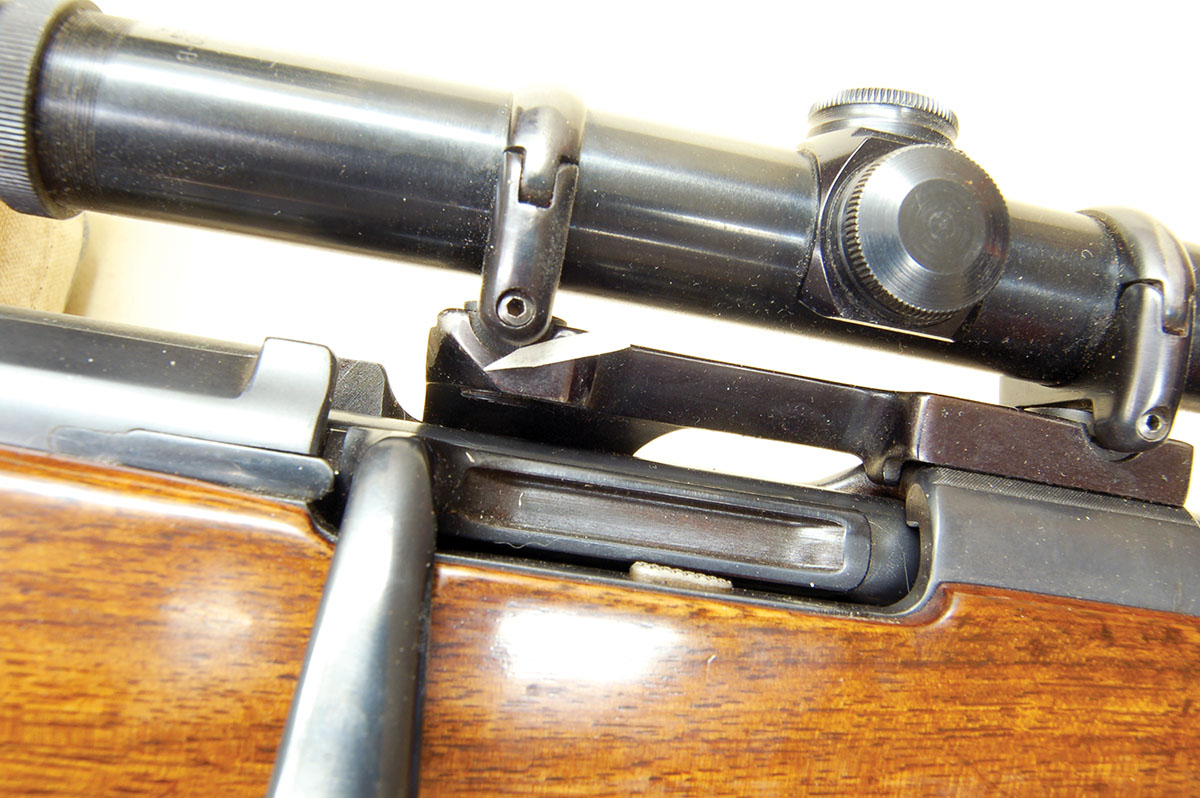
A scope based on a rebarreled Ml910 has the rear ring located ahead of the bridge with the base ground away (arrow) to allow the bolt handle to access the split bridge. It is a special Leupold Adjusto-Mount from the 1950s.
and was immediately hired by gunmaker Steyr, eventually rising to Chief of the Research and Development section. One reference states that Mannlicher invented and had produced in steel and wood, “more firearm designs than any of his contemporaries,” which obviously includes John Browning and the Mauser brothers. That’s quite an accomplishment, which is largely unknown today.
While Mannlicher designed all types of small arms, his infantry rifles were mainly modifications of the split-bridge
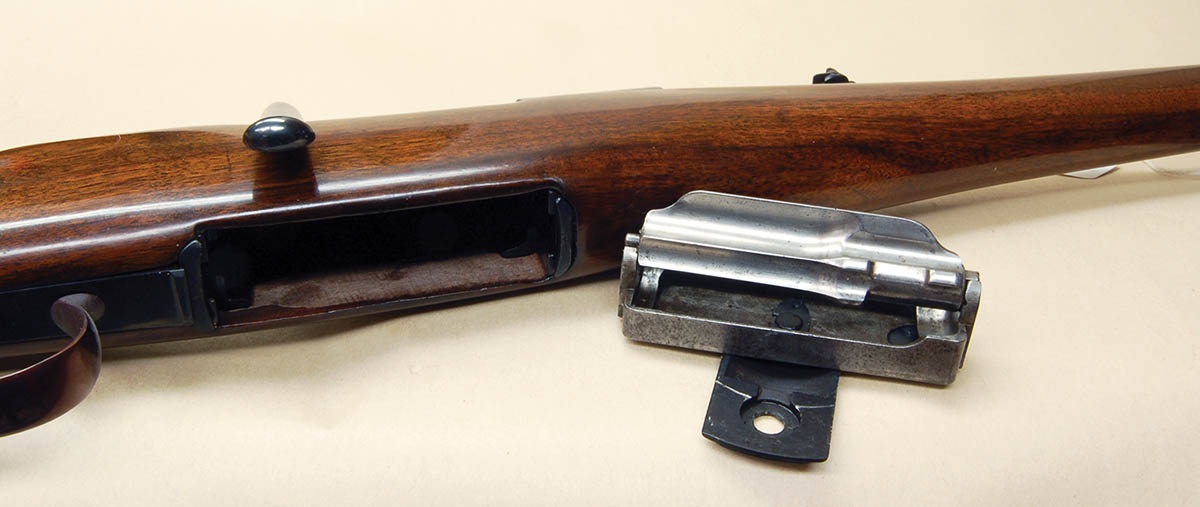
To remove the Schöenauer magazine for cleaning, simply rotate the floorplate 90 degrees and the magazine assembly falls out in the hand.
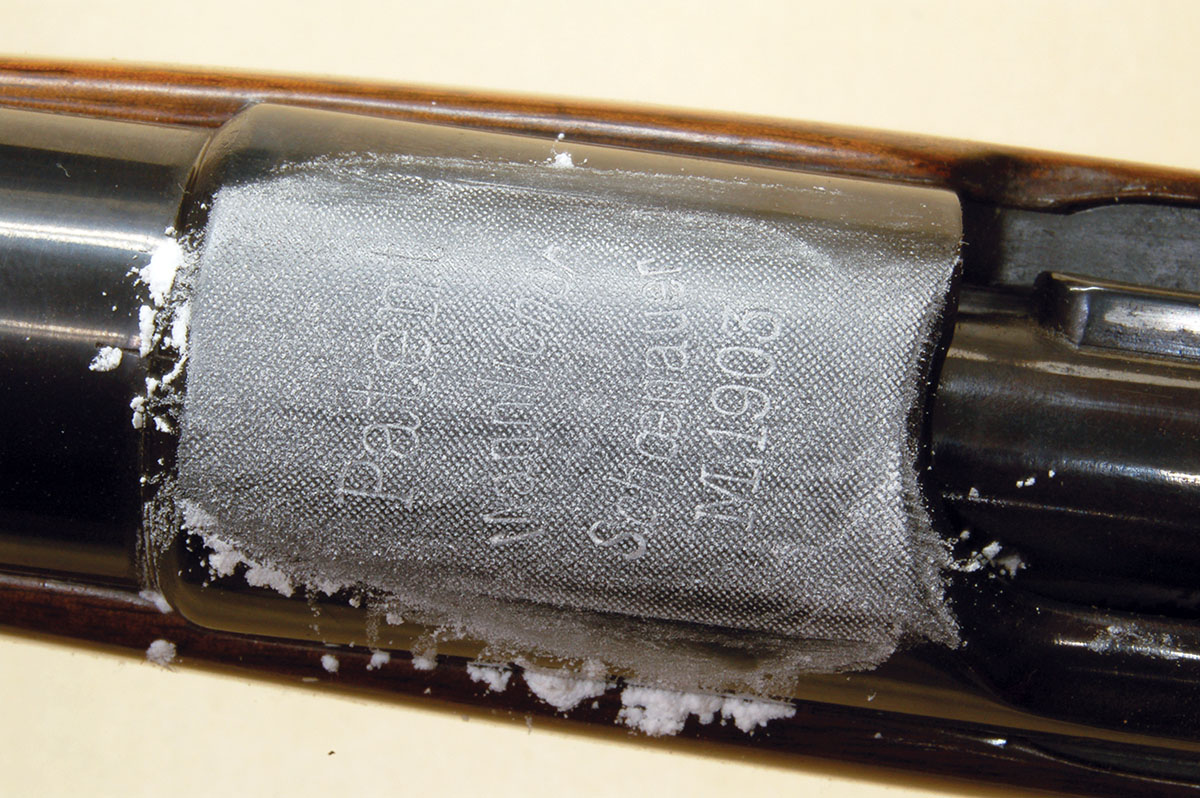
Lightly stamped ‘‘M1903” on receiver ring indicates rifle is chambered for 6.5x54mm M-S. If “M1910,” it would be 9.5x56mm M-S.
German Model 88 action. He also designed the Mannlicher “packet” magazine. This was a sheet steel “clip” that held 5 cartridges. The whole assembly was pushed into the magazine through the ejection port. It fell out of the bottom of the magazine when empty. By 1889, the Steyr company was producing more infantry rifles than any other manufacturer in the world.
In 1886, the Steyr company hired Austrian gunsmith Otto Schöenauer, who had an idea for a rotating magazine. Schöenauer worked with Mannlicher on many projects. One was the Model 87-88 Straight-Pull Repeating Rifle with Revolving Magazine and Clip Loading. It was the fastest-firing and reloading rifle at the time. Although made up in several military forms, no one was interested. Steyr then combined the rotary magazine with Mannlicher’s modified type-88 turn-bolt receiver. Greece then adopted the rifle as the Model 1903 M-S. Cartridge was 6.5x54mm M-S.
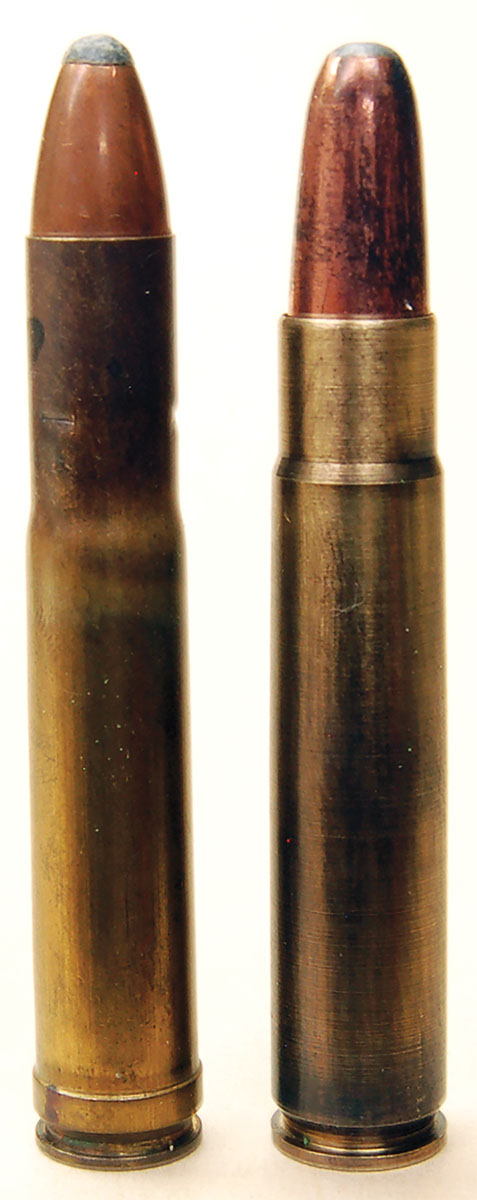
The H&H 400/375 Belted Nitro Express (left) came out just before the 9.5x56mm (right). It went nowhere, but H&H later copied the M-S round, calling it the .375 Rimless Nitro Express. It was loaded for years.
Many countries were then taking advantage of smokeless powder to create military rounds that pushed 6 to 6.5mm bullets to over 2,300 feet per second (fps). Hunters somehow immediately got hold of these rifles and cartridges, then
ran to Africa and
India to shoot anything that walked. Velocity was everything. Some animals dropped to the shot, but others just ran off, never to be seen again. Some, however, ran up to the guy with the rifle and settled the matter then and there. Velocity wasn’t everything.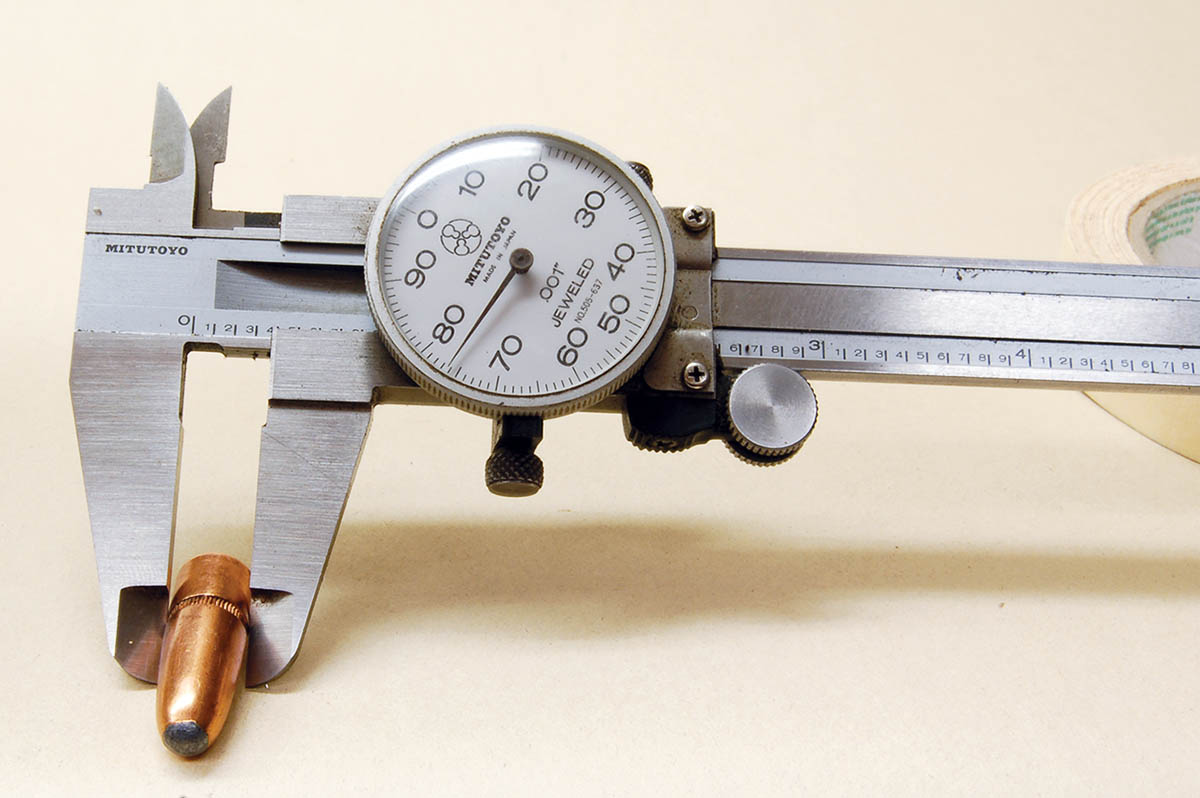
A caliper on a 9.5mm bullet showing .376-inch diameter.
Steyr took advantage of the trend by shortening the barrel of the Greek rifle to about 17.75 inches (450 mm), stocked it to the muzzle so the forend could be quickly grasped anywhere and retained the 6.5x54mm chambering. The little carbine (called the Model 1903) became an instant success, especially in Germany’s African colonies, where British guns and ammunition faced high tariffs.
Steyr then also offered the carbine in 8mm Mannlicher (Model-1908), 9x56mm M-S (Model-1905) and a new round titled 9.5x56mm M-S.
Just where the 9.5mm bullet diameter came from is puzzling. There doesn’t seem to be any in Europe prior to 1900. However, 9.5mm equals .374 inch, and 9.5x56mm M-S bullets are .375-.376 inch, which was seen in American rounds at the time.
The British had only one cartridge using this bullet diameter prior to 1900. This was a black powder round called 380-21⁄4 inch Rigby. Then, in 1905, Holland & Holland released its 400/375 Belted Nitro Express. It was basically a 7.92x57mm case drawn a quarter inch longer and having a belt at its base, similar to today’s belted magnums. The belt was needed because the .375-inch bullet did not leave enough shoulder to maintain headspace. The round was never popular.
This was all washed away in 1910 with the appearance of Steyr’s M-S carbine in 9.5x56mm M-S. Here was a true 7.92x57mm case necked up to
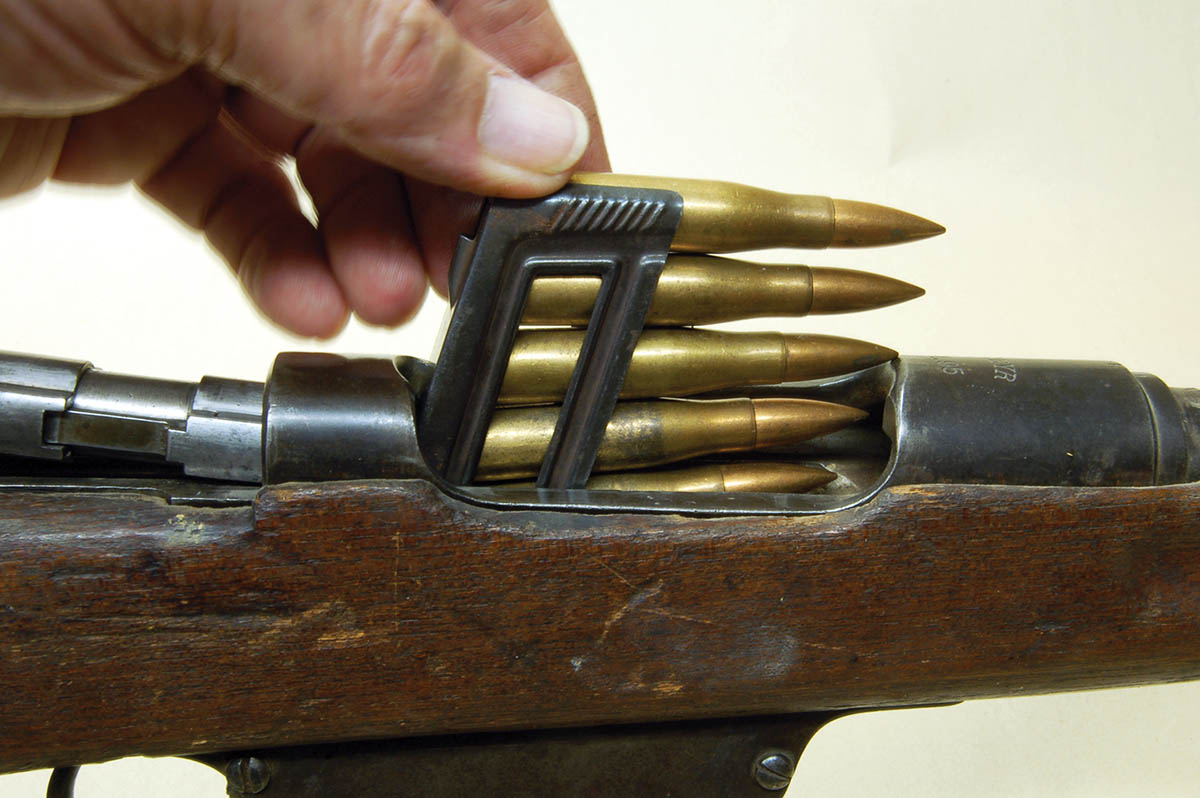
Mannlicher’s “packet” loading system, which helped to make his reputation as one of the world’s great gun designers. It is faster than a Mauser M98 charger, but few shooters have heard of it.
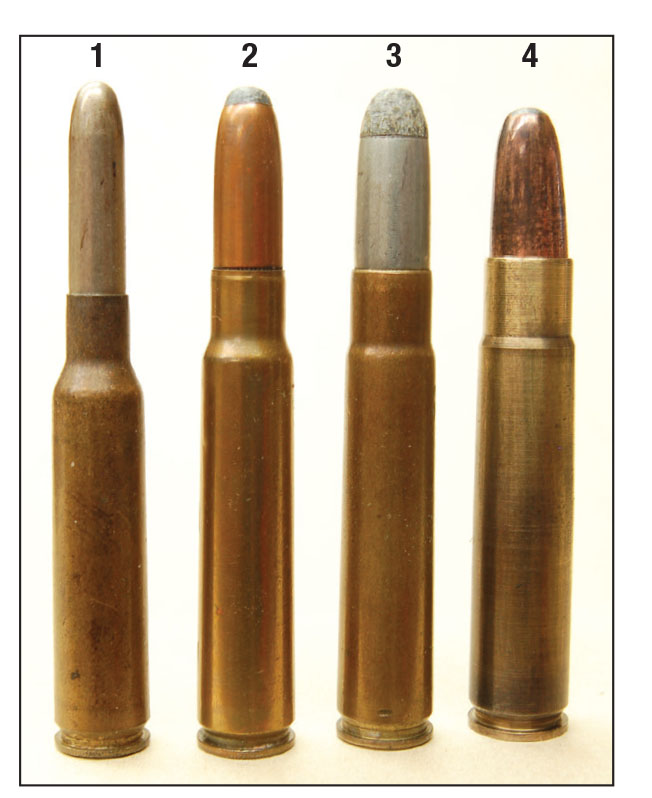
The four Steyr M-S carbine cartridges are: (1) 6.5x54mm, (2) 8mm Mannlicher, (3) 9x57mm and (4) 9.5x56mm.
.375 inch. It had enough shoulder to not need a belt and was the maximum size possible for the Steyr M-S receiver/rotary magazine. It became very popular with African farmers and ranchers.
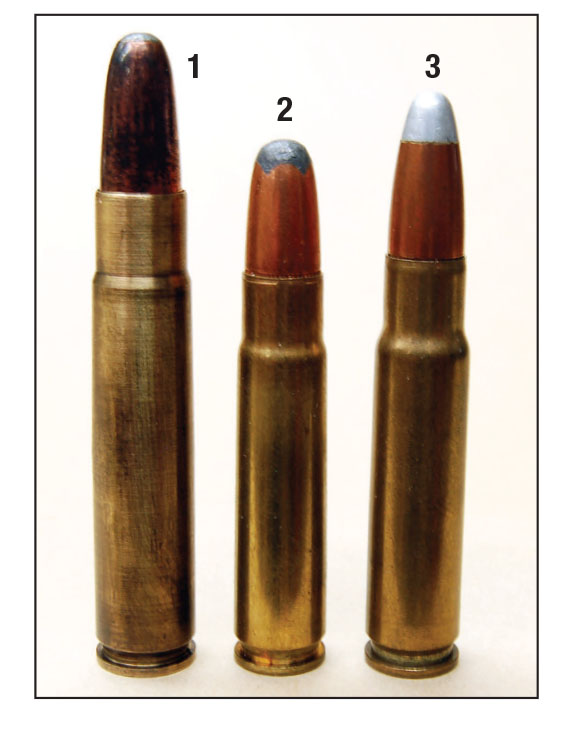
The 9.5x56mm M-S (1) is compared to a lesser-powered 35 Remington (2) and greater powered .358 Winchester (3). The .358 Winchester is loaded to a higher pressure than the 9.5x56mm.
Original ballistics are a bit hard to find. The round was not loaded in North America. Steyr mentions a 272-grain bullet at 2,230 fps from what must have been at least a 600mm (23.6 inch) test barrel. Muzzle energy was over 2,900 foot-pounds. Other sources show 270- and 286-grain bullets at speeds from 2,050 to 2,150 fps, but no barrel length.
A pre-World War II DWM catalog shows a 370-grain softpoint at 2,057 fps from a 600mm barrel. Listed pressure was quite low at 38,000 pounds per square inch (psi) (crusher), probably in deference to the light Steyr M-S carbines. Nevertheless, the cartridge became popular enough that the British adopted it about 1925, renaming it as the 375 Rimless Nitro Express. Kynoch listed it until 1970.
For fifty years, the 9.5x56mm M-S served African farmers and ranchers much the same as the 30-30 Winchester did American farmers and ranchers. It offered light carbines having adequate power for all varmints and game animals one would encounter on their respective continents. The larger two or three
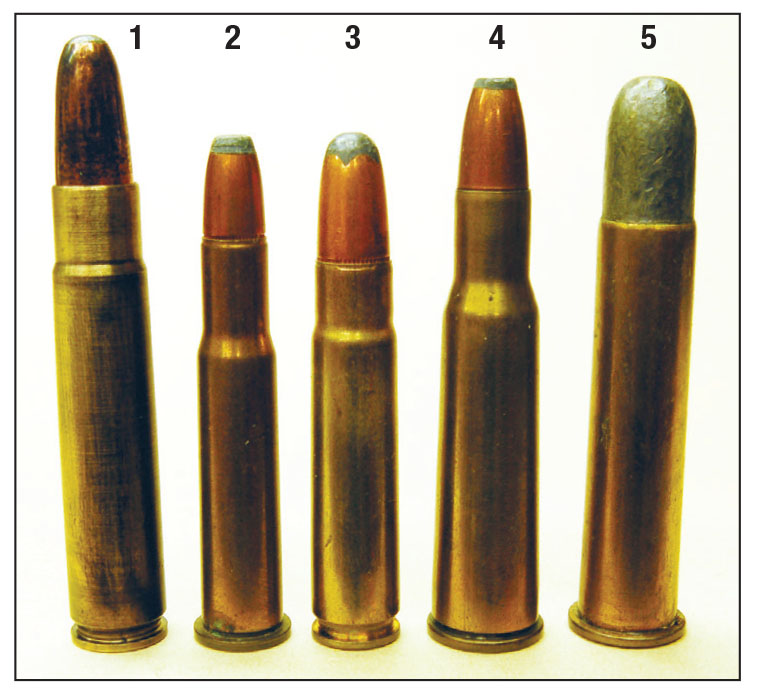
The (1) 9.5x56mm is loaded to relatively low velocity, probably to limit recoil in the light Steyr carbines. It was best for 100- to 150-yard shots from iron-sighted rifles, as were (2) 30-30, (3) 35 Remington, (4) 348 Winchester and (5) 45-70.
species were best left for more powerful rounds, but weren’t always done, much to the detriment of the rifle’s owner.
Factory ammunition has been unavailable for years. Word is that the new Kynoch (Kynamco) was listed a few years back, but I couldn’t confirm that any was ever loaded. A source in South Africa came up, but given the political situation there it is probably gone. Thus, the 9.5x56mm M-S is a handloader’s cartridge.
Proper cases can sometimes be found online or formed from 35 Whelen brass. Bullets are common cup-and-core of .375-inch diameter. Powder and primers are the problem. With the rounds’ popularity mainly in Africa, what very little data that is available uses European and/or Australian powder and primers. None has pressure figures.
While preferring to list load data with which I have personal experience, this is not possible. The M1910 Steyr carbine shown in the photos is mine, but it’s not a 9.5x56mm M-S. It was purchased at a local estate sale with the scope base removed so the “M1910” was visible. A tag read, “9.5x56mm – ammo no longer made.” A few weeks later, it was noticed that the hole in the muzzle looked small. The gun had been rebarreled to 7x57mm. The job was so good that the only way to tell was a lack of proof and inspection marks on the barrel.
One load using American powder, with a pressure figure, was finally found. This uses a 270-grain bullet, 45.0 grains of IMR-3031, for 2,250 fps from a carbine barrel at a pressure of 45,000 pounds per square inch (psi). This is hot compared to the DWM load mentioned earlier. Starting at 40 grains IMR-3031 and working up to a velocity of 2,050 to 2,100 fps should equal early factory loads in the carbine. A 235-grain bullet ahead of 42.0 grains of IMR-3031 supposedly gives less recoil and 2,150 fps, but no pressure is listed.
It must be said that the 6.5-pound Steyr carbines have a reputation as beautifully balanced, dynamic things, but only with factory iron sights. Hang a two-pound scope and steel mount on them like my M1910, and they become just another 8.5-pound rifle. Perhaps that is why they never became popular in America. We have to have scopes.


.jpg)