

Propellant Profiles
Hodgdon CFE BLK
column By: Rob Behr | August, 26
What raised AA-1680 and the later rebranded A-1680, after Accurate Arms was acquired by Western Powders, to the level of a profitable burn rate was the meteoric growth of the AR-15 market. As interest in the AR-15 grew, so did the market for innovative small cartridges specifically designed for use within that platform’s limited 2.260-inch magazine length. Of these cartridges, the 300 Blackout is a true standout, only surpassed in popularity by the 223 Remington/5.56 NATO. While A-1680 is too fast to be a good choice in the 5.56 NATO, it is the perfect powder for the Blackout and a real contender in many of the newer cartridges expressly designed for the AR-15.
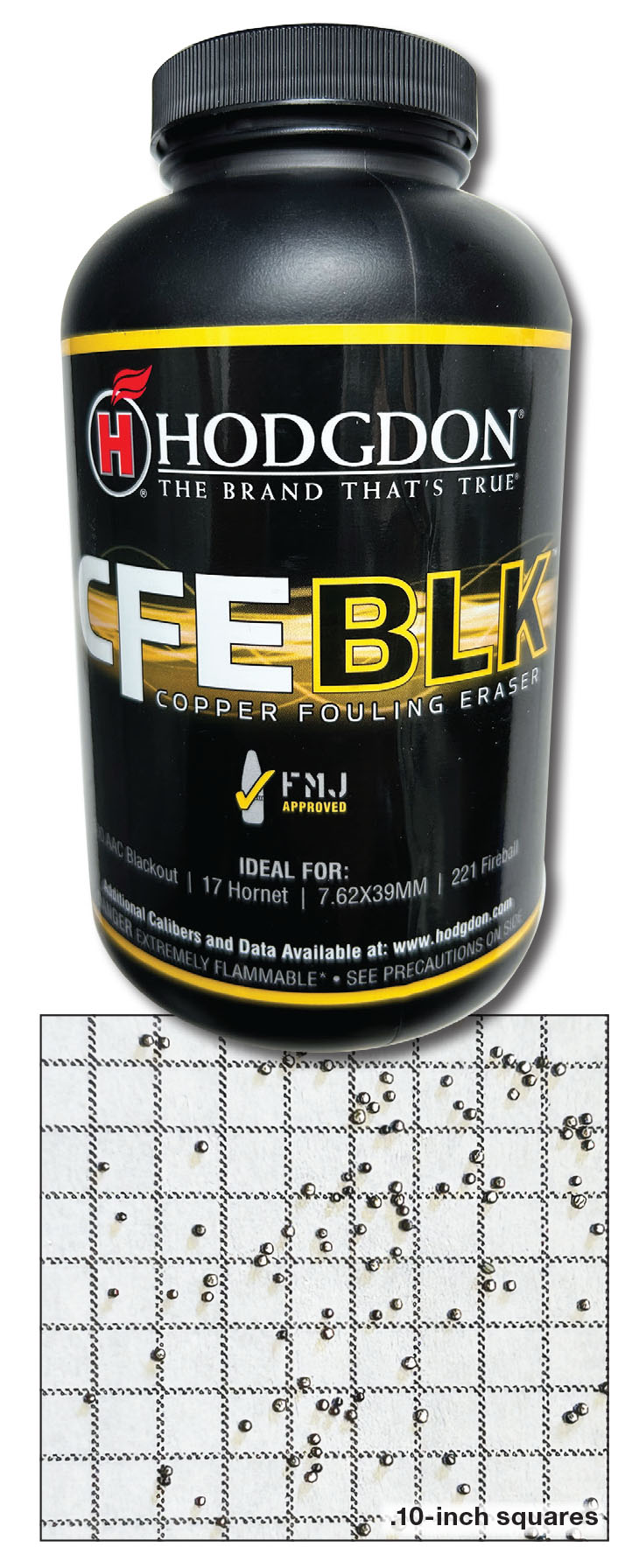
Never one to miss a market trend, Hodgdon announced in 2016 that it would be introducing a new propellant called CFE BLK, a powder intended to compete directly with A-1680. Even the name, BLK, hints at the powder’s most compatible cartridge as SAAMI officially lists BLK as an appropriate abbreviation for the 300 Blackout. Because I was with Western Powders at the time and had easy access to A-1680, I had never tried using CFE BLK until I was asked to test the powder for this column. I have to admit I came away impressed.
Physical Characteristics
In a powder hopper, this double-base powder is a dark slate grey, with some grains that reflect light. It is a very small-grained, spherical powder measuring about .017-inches in diameter. Part of what makes CFE BLK such a useful propellant in small cartridges is its ability to pack densely into small capacity cases. Not surprisingly, its bulk density is very high at .980g/cc. Its place of manufacture is listed as the USA, making Saint Mark’s powder in Crawfordville, Florida, the likely manufacturer.
Temperature Stability Testing
I was blown away by how well CFE BLK handled temperature extremes. Those frozen rounds averaged 1,889 feet per second (fps) with a standard deviation (SD) of 16 fps. The hot rounds averaged 1,903 fps with a SD of 21 fps. Those are impressive numbers. With a tested extreme range of 142 degrees Fahrenheit (F), the velocity only shifted by 14 fps. This is extraordinary performance from a small grained fast burning rifle powder. I expected quite a bit more than a mere .74 percent increase. The cartridges tested at an ambient temperature of 70° F nestled nicely in the middle, producing an average of 1,893 fps.
Comparing A-1680 to CFE BLK
When propellants are shipped, they are listed under broadly defined Original Equipment Manufacturer (OEM) designation. Once they arrive, they are tested against known samples of powder that represent both the desired burn rate and appropriate pressure levels. Back before Hodgdon owned Western Powders, Saint Marks Powder would have shipped both of these propellants in bulk under the OEM designation WC-680. The ballistics labs at both locations would have then tested the bulk powder to make sure it produced the anticipated pressure and velocity levels in order for the bulk powder to be marketed as a canister grade product.
I expected A-1680 and CFE BLK to have a very similar burn rate. To test this, I loaded 20.5 grains of A-1680, the same charge weight I had used with the 150-grain bullet test loads using CFE BLK. The A-1680 loads produced an average velocity of 1,970 fps with a SD of 13.4. This represented a velocity shift of 77 fps, an increase of a little more than 4 percent. AA-1680 is notably faster-burning than CFE BLK, at least in the 300 Blackout.
Fouling Cleanup
I had noted the CFE designation of a couple of Hodgdon products and knew it referred to some type of copper mitigation chemical that had been added to the powder molecule. I did not know what the acronym stood for, but I do now. It stands for Copper Fouling Eraser. There, now we all know.
I went to Hodgdon’s Safety Data Sheets (SDS) to see what chemical (technically called a surfactant in the industry) had been added as a surface coating. The answer, according to the SDS sheet, was Tin Dioxide, a surfactant that has been used as an anti-coppering agent in smokeless propellants since DuPont patented the process somewhere between 1910 and 1920.
The process works by creating an amalgam of copper and tin formed by the heat and pressure produced by firing a cartridge. The resulting amalgam is more brittle than copper alone and tends to break free of the barrel steel more readily. It was a pretty good idea in 1920, and it remains so today.
The barrel of the 300 Blackout I chose to test for fouling buildup was made by Proof Research and was manufactured quite well. In retrospect, a less smooth barrel might have been a better test bed. I cleaned the barrel thoroughly after I was done shooting and only found small amounts of copper fouling. The carbon fouling was more than I expected, but I shot quite a few subsonic rounds through the rifle because they are a lot of fun. With almost no copper fouling and easily removed carbon fouling, the barrel was clean again with the 13th patch. Overall, I thought the powder cleaned up very nicely.
Data
Hodgdon’s online data lists 19 cartridges running from the 22 Hornet to the 458 SOCOM. Ten of them were not on the market in 1987 when Accurate Arms introduced the original AA-1680. It took a while, but Winchester 680 finally found its place in the market. Hodgdon, to their credit, seems to have perfected it.
.jpg)