

From the Hip
Cimarron 1872 Open Top Navy 44 Special
column By: Brian Pearce | August, 26
Beginning in 1959, Aldo Uberti began offering replica firearms, mostly reproductions from the U.S. Frontier era, which at that time were uncommon, and he took a huge risk by investing in tooling and manufacturing. His intuition proved correct, as shooters wanted affordable reproductions of historic antique arms, manufactured from modern steel, and that could be fired with modern smokeless powder loads (cap-and-ball revolvers and muzzle loaders being exceptions). The countless models that have been offered over the past 67 years are impressive, and sales continue to grow steadily.
Uberti offers many reproductions of cartridge revolvers from the late 19th century, such as the ever-popular Colt Single Action Army, various Smith & Wesson top-breaks such as the Schofield, the Remington Models 1875 and 1890 and others. A rather unique cartridge sixgun replica is the Colt Model 1871-72 Open Top (aka Opentop) that should not be confused with the Colt conversion guns that were made from cap-and-ball guns beginning around 1868.
Just a brief discussion regarding the events prior to the Colt conversion guns and the Model 1871-72 Open Top
seems appropriate. Rollin White (formerly employed by Samuel Colt until 1854) developed a series of patents that included bored-through chambers on a revolver cylinder that would
accommodate metallic cartridges (which he claimed began development as early as 1839). While his patent was not fully developed and awkward at best, he held the rights to it. White soon (1855) made an agreement with Smith & Wesson to use his bored-through cylinder patent exclusively and received 25 cents per revolver manufactured with this feature.
The White patent was set to expire on December 11, 1869; however, he filed for an extension, stating that he was not fairly compensated for his patent, but his request was denied. He next appealed to Congress in 1870. In short, Congress granted a rehearing, but President Ulysses Grant vetoed it based on White’s litigation on the same subject during the Civil War, which was “an inconvenience and embarrassment” to the Union.
Prior to the patent expiring, in 1867, White and Smith & Wesson offered to sell the patent rights to Colt for 1.1 million dollars (between 26 and 30 million in today’s money). Colt’s Manufacturing declined the offer, as it was far more economically
feasible to just wait a year or two for the patent to expire. Nonetheless, Colt was not well prepared to manufacture revolvers with bored-through chambers and began making cartridge conversion guns from cap-and-ball revolvers.
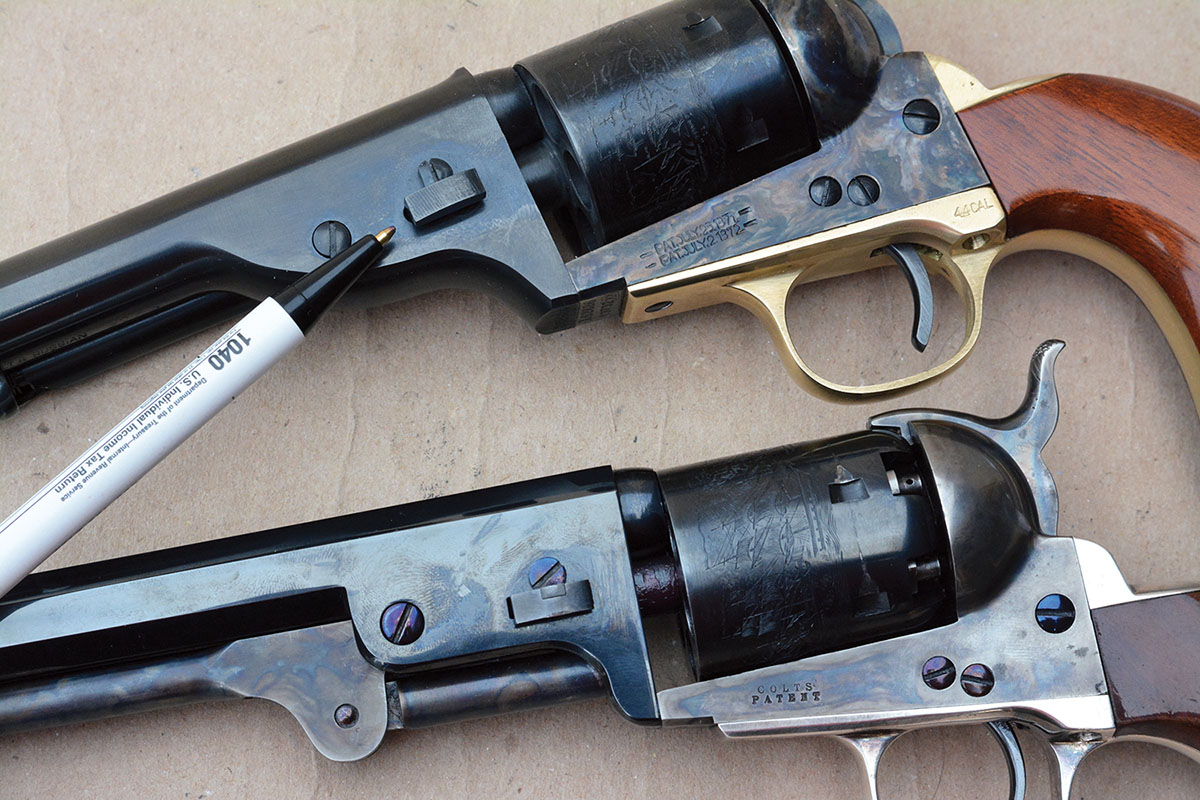
This brings us to the 1871-72 Open Top revolvers that were produced prior to the development of the Colt Single Action Army,
with its solid top frame, and were not conversion guns. Rather, they were based on 1871 and 1872 patents (thus the Model 1871-72 designation) and were designed primarily by William Mason and Charles Brinckerhoff Richards. They were primarily chambered in 44 Henry Rimfire and were submitted to the U.S. Army for testing and possible adoption in 1872, but the Army wanted a stronger gun and a more powerful cartridge.
Mason immediately began working on the new “strap” (top-strap) pistol that would become the Colt Single Action Army chambered in 45 Colt that was submitted to the government in 1872, which was quickly adopted by the military and the rest is history.
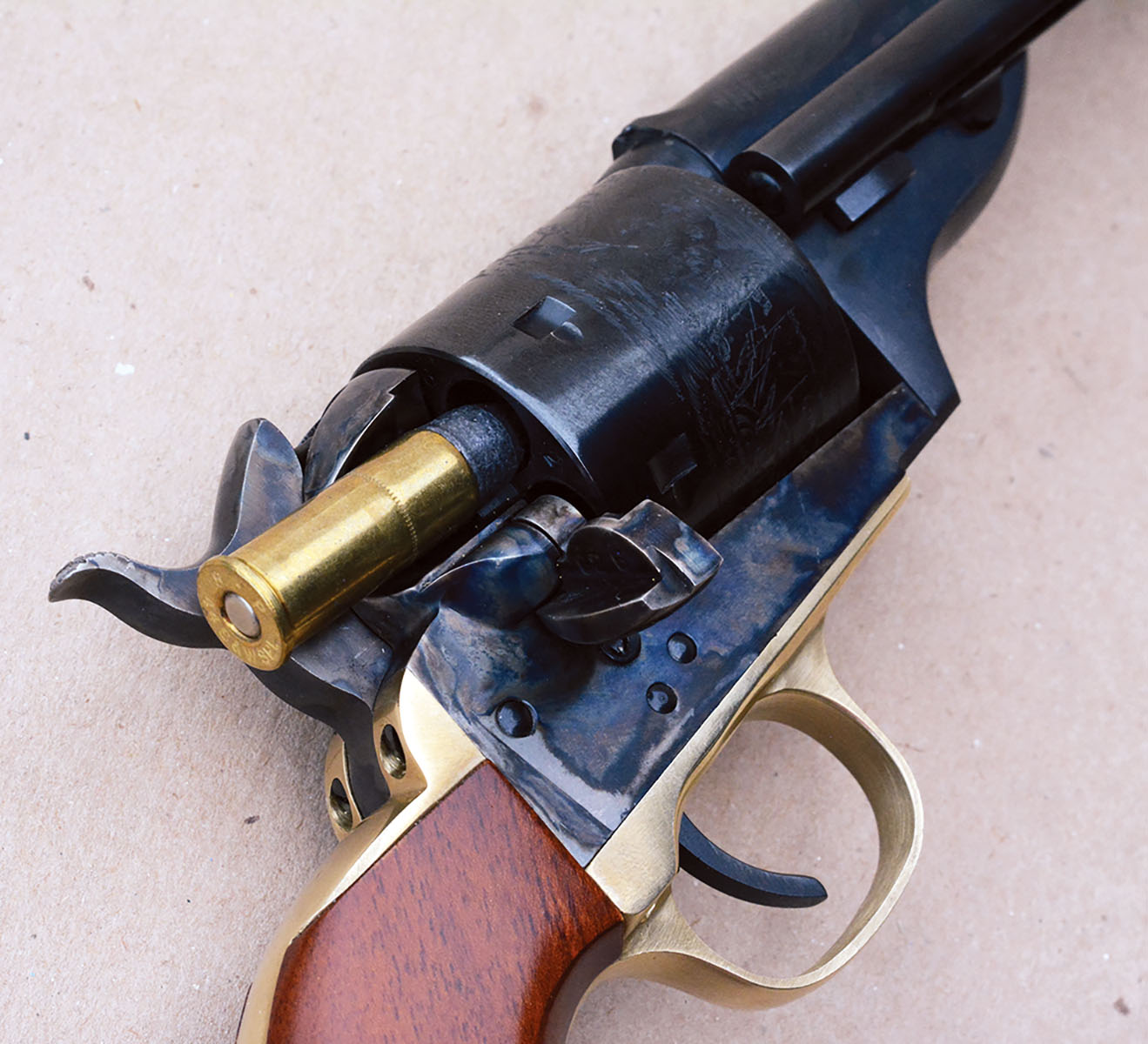
Regardless of the turbulent history, the White patent number 12648 for “Improvement in Repeating Firearms” played a huge role in modern revolver development.
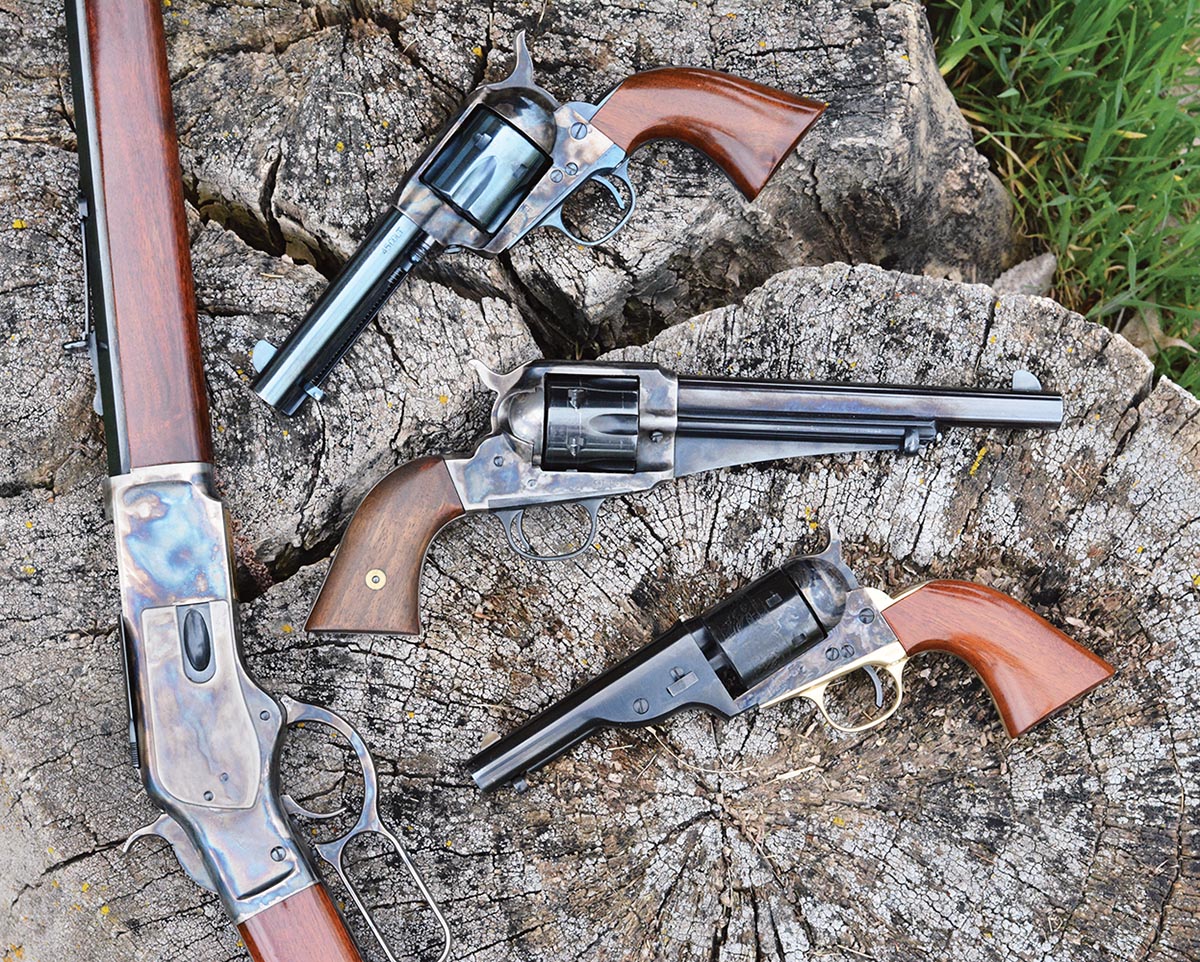
Although the Colt Model 1871-72 was only produced for a very short period, they are a significant part of history. Today, originals command significant premiums among Colt collectors, and being chambered for obsolete cartridges, they are not for modern shooters. For those who enjoy shooting period guns, the Uberti is a great option.
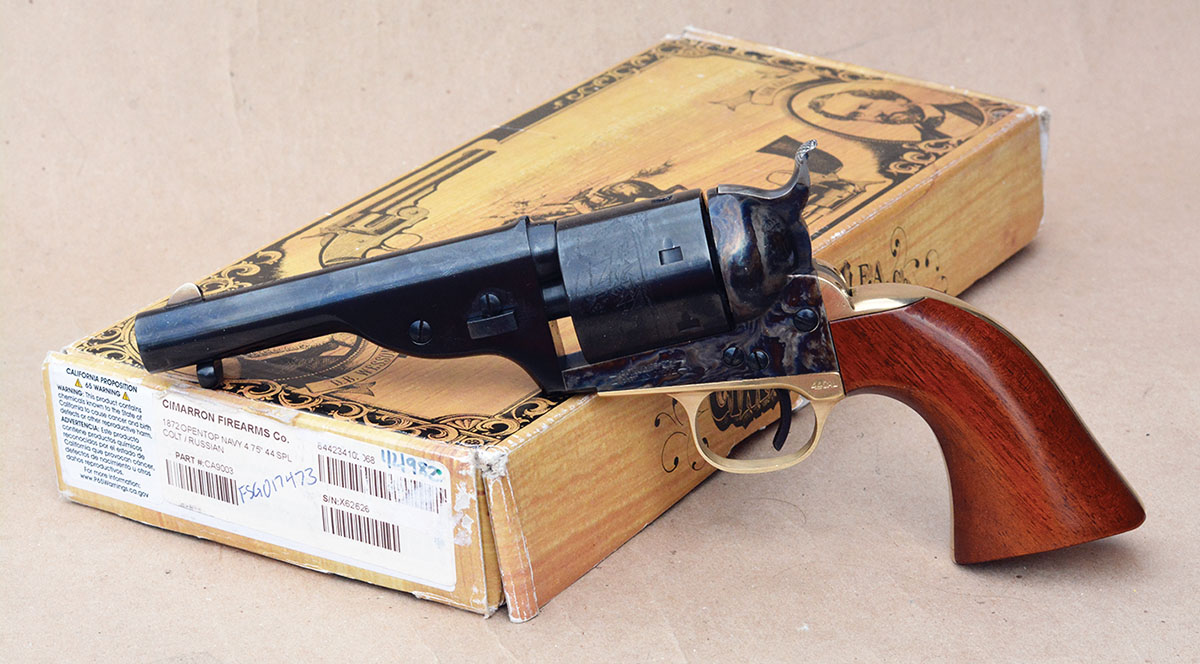
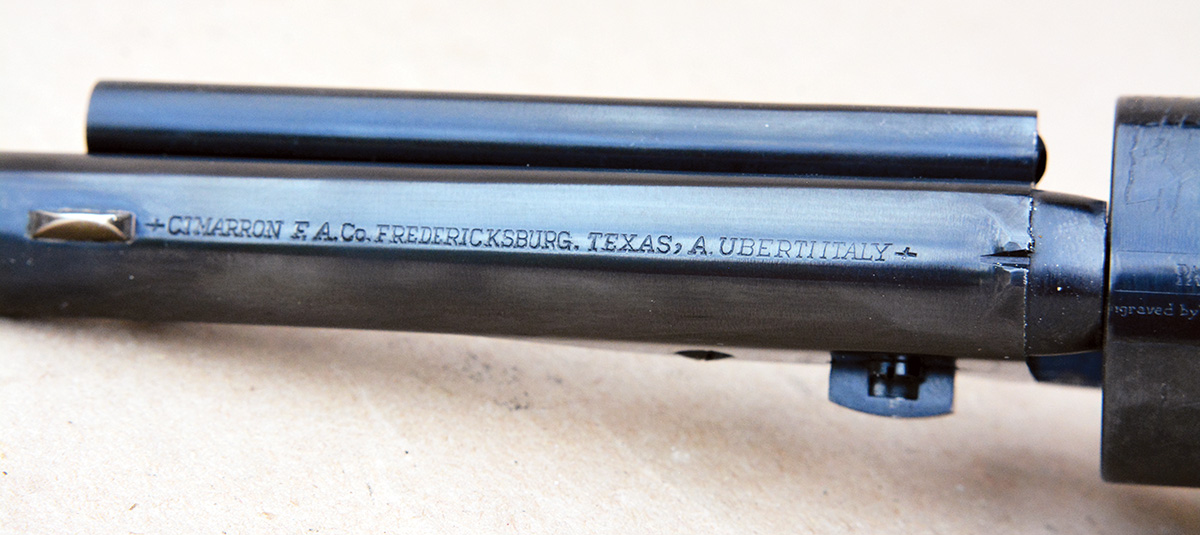
For today’s purposes, a Cimarron Firearms imported Model 1872 Open Top Navy chambered in 44 Special, 44 Colt and 44 Russian (and is so marked under the barrel) was selected for review. While most original Model 1871-72s feature longer barrels
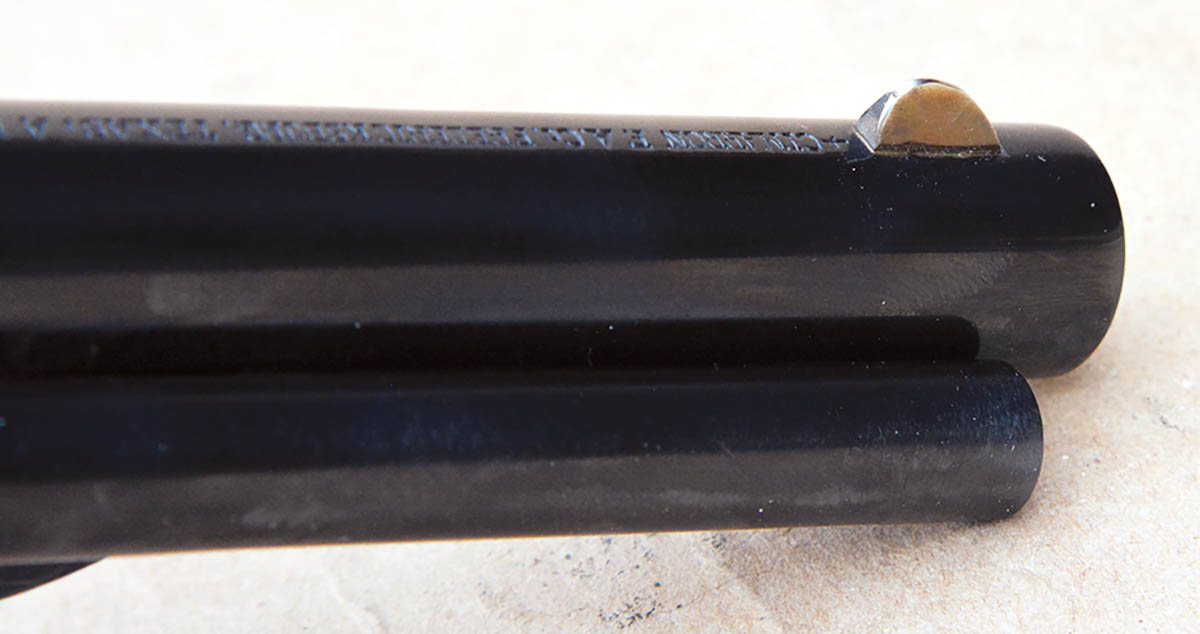
that were preferred during that era, this shooter favors the handiness of the 43⁄4-inch length and purchased a sample accordingly. Other features include a SAA-style back strap and trigger guard made from brass, one-piece walnut stocks, a rear of barrel sight (milled as part of the barrel) and a blade front. The frame and hammer are simulated case colored, while the barrel and ejector tube are blue finish. The cylinder is non-fluted and has period roll-mark ship images similar to original guns.
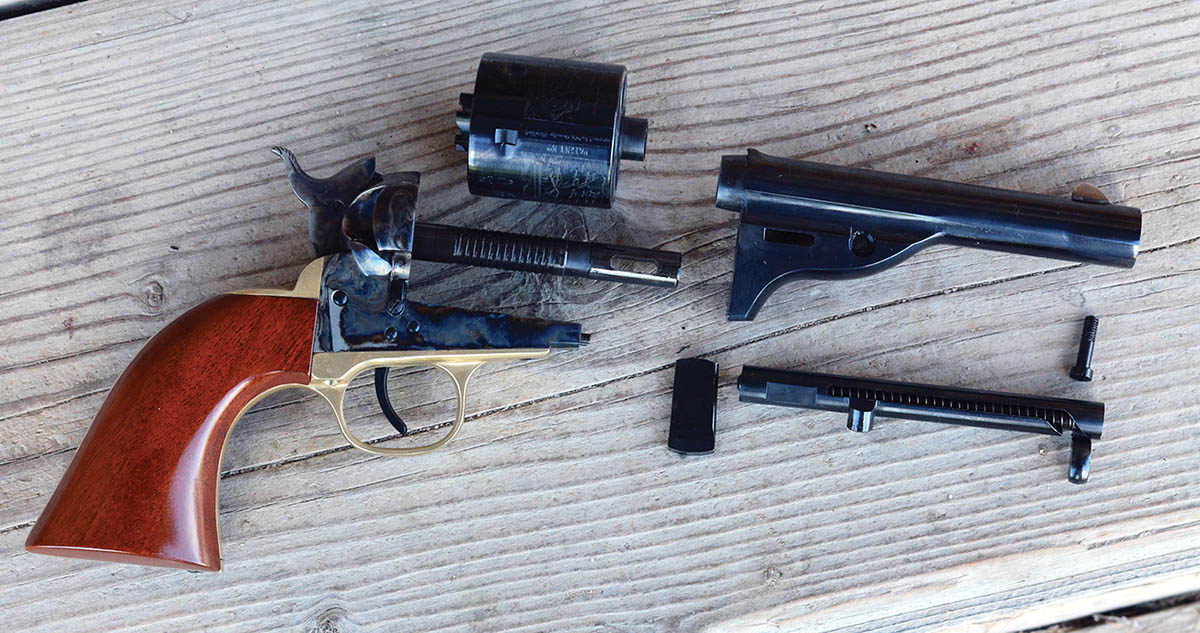
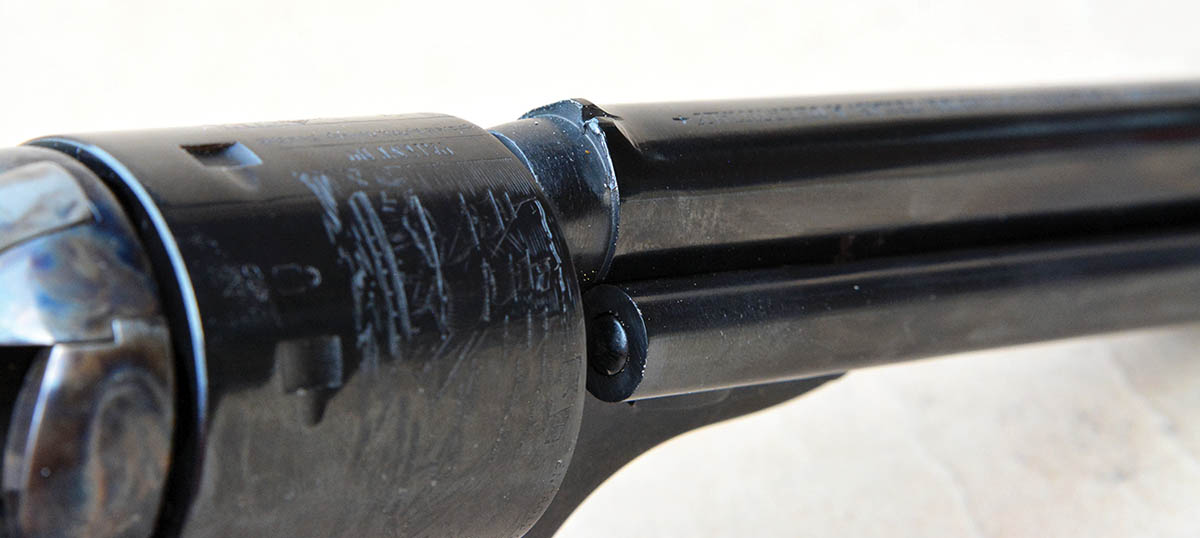
The hammer spur is high and resembles the profile found on many cap-and-ball percussion Colt sixguns, such as the famous 1851 Navy and others, while the ejector tube housing is round. Being a transition model between the cap-and-ball and conversion guns and the Single Action Army, it still features the barrel wedge assembly that secures the barrel to the frame. By removing the wedge, the barrel and cylinder can be
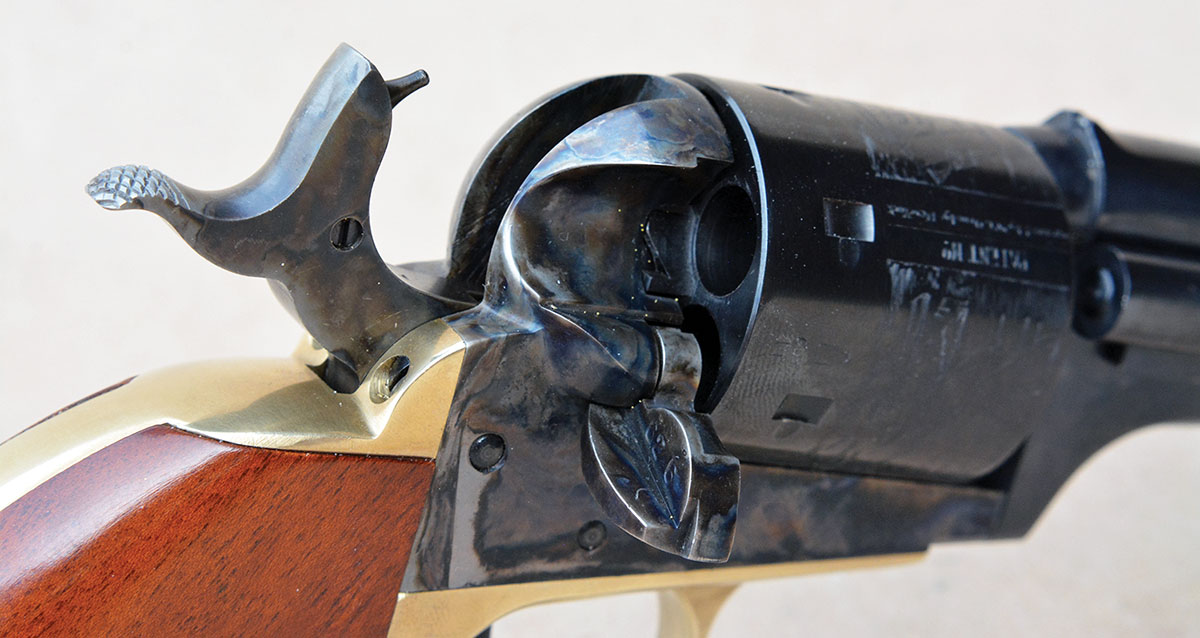
removed for cleaning. When reassembling, the wedge should not be installed tightly, just snug; binding can occur.
Loading and unloading is almost identical to the familiar Colt Single Action Army, as it has the familiar half-cock hammer position to unlock the cylinder for rotation to load and unload through the loading gate. When the hammer is fully cocked, the gun is ready to fire.
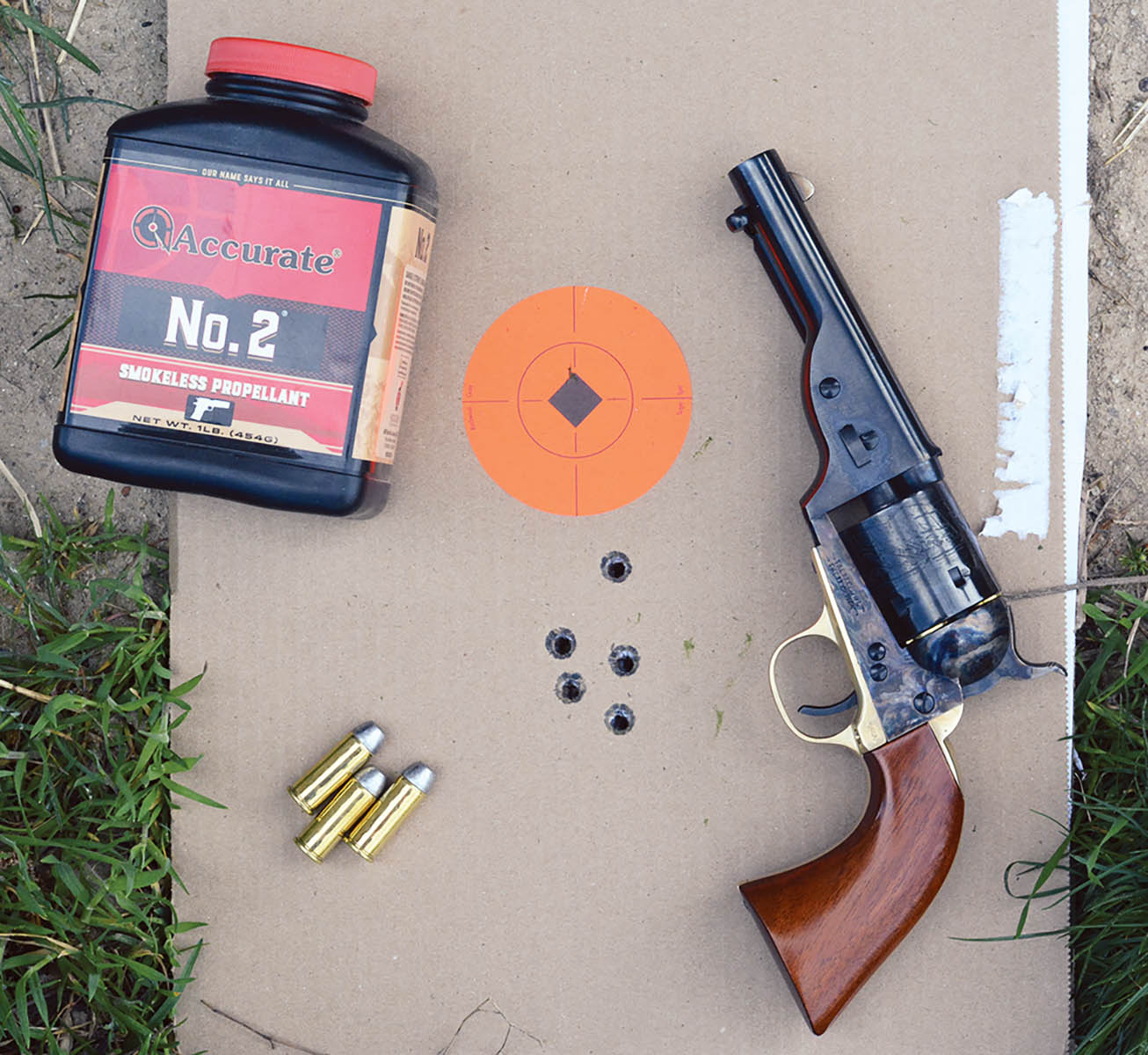
However, this gun differs from Colt SAA pattern guns as there is no so-called safety notch (aka first notch) hammer position. Rather, there is a “Basic Safety Block” installed inside the hammer that is engaged with a flat head screw driver and accessed from the right side of the hammer. This was necessary for this gun to pass the drop tests implemented with the Gun Control Act of 1968 for imported revolvers. To be clear, the Basic Safety Block is not a practical way to carry the gun loaded with six cartridges, as a screwdriver is needed to disengage it before the gun can be fired.
This writer strongly suggests never carrying this gun fully loaded. It should be carried with only five cartridges, the empty chamber resting directly under the hammer. This is also strongly stated in the Cimarron owner’s manual. Generally, the best method to accomplish this is to bring the empty gun to the half-cock position, load one cartridge, and turn the cylinder, leaving the next (2nd) chamber empty, or “skipping” that chamber. Then load four cartridges and pull the hammer back to the full cock position, and then lower it on the empty chamber. Since the chambers are not countersunk, the empty chamber can be viewed from
the side of the cylinder for confirmation. Carried in this method, the gun offers outstanding safety.
Naturally, Uberti uses high tensile chrome-moly steels to ensure that the gun will provide proper strength for modern smokeless-powder loads, along with special heat-treated stress parts such as the barrel wedge. However, the 1871-72 is not a strong design, and it is suggested to keep all handloads within industry pressure specifications established at 15,500 pounds per square inch (psi). Even when loaded to this pressure level, the 44 Special is a powerful cartridge!
The fit and finish are very good, and the gun is properly timed. I maintain that Uberti offers a very good product, especially given their working-man’s price. In short, I am unaware of any U.S. company that could produce this same gun and offer it at a similar price; rather, if it were produced domestically, the price would be much, much higher. This makes the Uberti/Cimarron 1871-72 Open Top a true bargain.
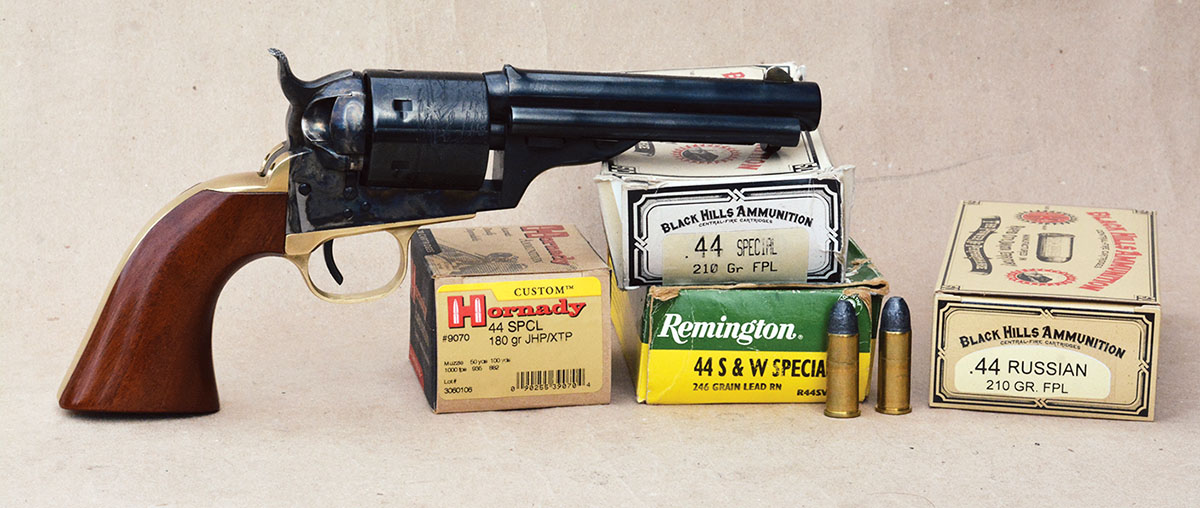
As can be seen in the accompanying chart, three 44 Special factory loads were tried that included the traditional Remington 246-grain lead RN, Black Hills Ammunition Cowboy 210-grain lead FPL and Hornady’s Custom 180-grain JHP/XTP. In spite of the primitive sights (which were smoked for a better sight picture), overall accuracy was very good. Groups measured 1.70 to 2.00 inches at 20 yards. A Black Hills Ammunition 44 Russian Cowboy load was also tried that uses a 210-grain bullet at around 650 feet per second (fps) and grouped into just over 2 inches.
The chamber throats measured .431 inch, the bore measures .417 inch and the groove diameter is .429 inch, while the twist rate is 1:20 inches with right-hand twist. This is a good combination for accuracy with cast bullets sized to .430 inch. Not trying to get the most power possible from this sixgun, the goal was to push 240- to 250-grain bullets at 750 to 850 fps and improve accuracy when compared to the above factory loads. The 250-grain bullets at around 850 fps are powerful loads, as they surpass 45 ACP ball loads.
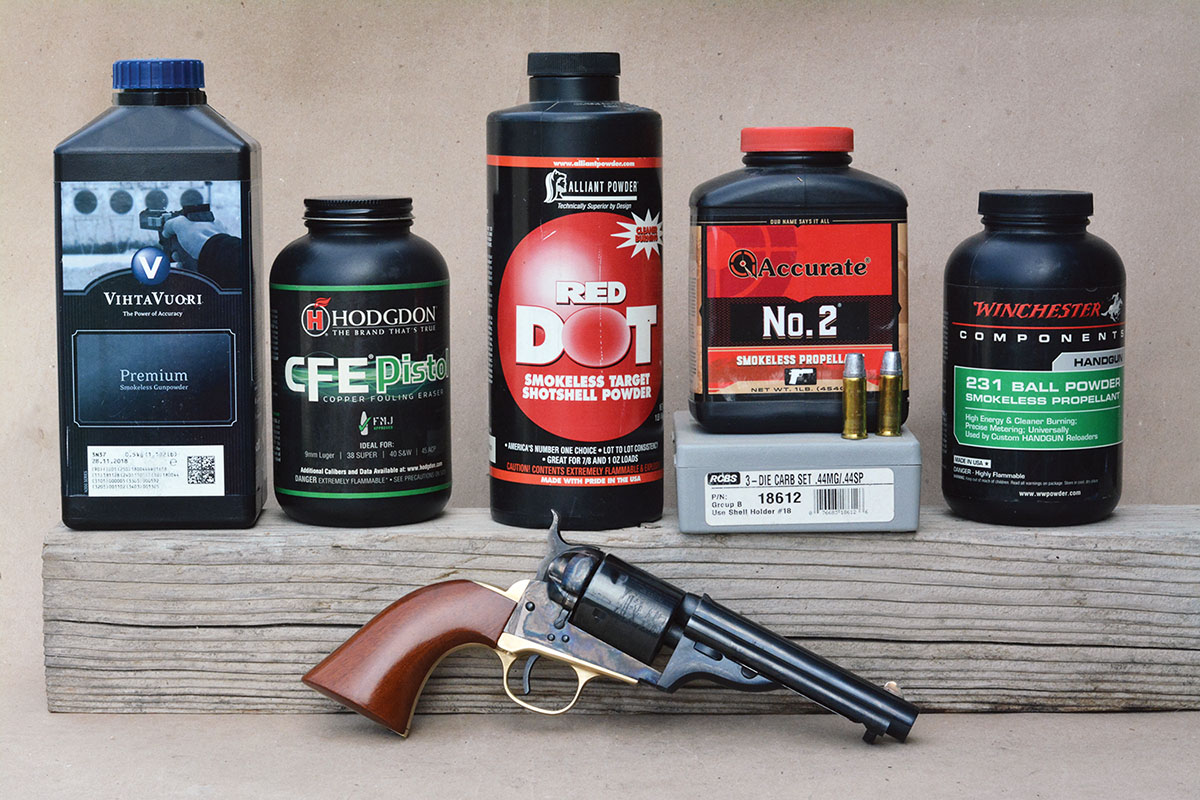
As can be seen in the accompanying table, most handloads grouped into 1.50 to 2.00 inches. For example, using 6.8 grains of Hodgdon CFE Pistol powder with the 250-grain Keith designed cast bullet from Lyman mould 429421, velocity was 813 fps and three groups averaged 1.50 inches. However, similar accuracy was also obtained with Accurate No. 2, Winchester 231 and Alliant Red Dot.
My only real complaint was that all loads grouped low, around 4 inches low at 20 yards with 240- to 250-grain loads. The solution is to lower the front sight; however, it is already a fairly low profile, and there is not much room for correction (although it can be done). The factory really should make the rear sight taller.
In addition to being a historical design, the Uberti 1872 Open Top functioned flawlessly, is handsome and fun to shoot. It’s great to have a quality reproduction offered at a modest cost, typically running $600 to $650.
.jpg)
.jpg)
.jpg)